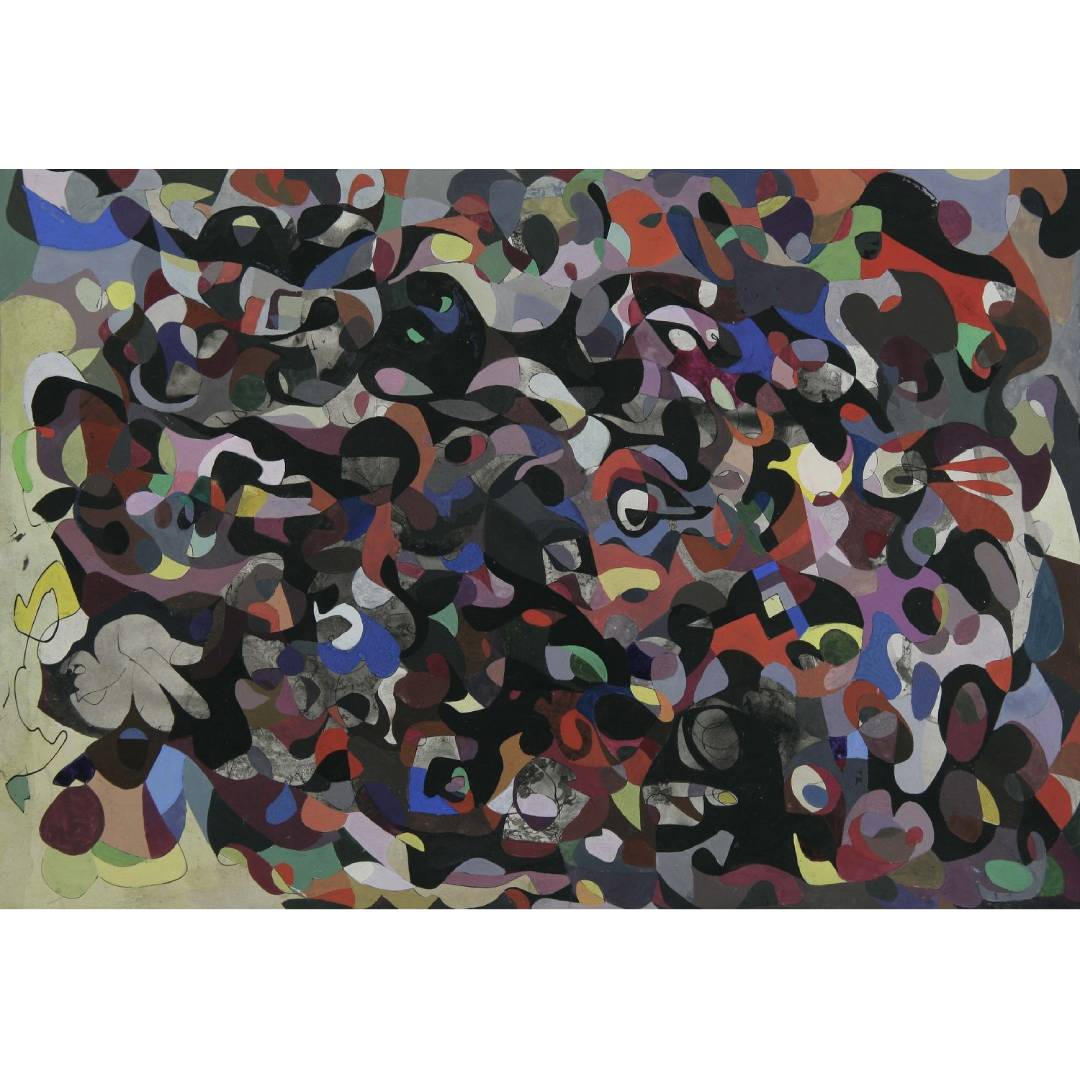
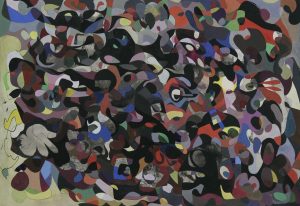
Kamilo Tompa, Structural Composition, 1960 -1970

Kamilo Tompa
Structural Composition, 1960–1970
mixed media on paper
358 × 500 mm
MG-5137

Kamilo Tompa (Samobor, 1903 – Zagreb, 1989) was a Croatian painter, graphic artist, and scenographer. He was educated at the Academy of Fine Arts in Zagreb and continued his studies in art history in Paris. He worked as a professor at the Faculty of Architecture and served as head of the scenography department at the Academy of Theatre Arts in Zagreb.
The artist’s early oeuvre was marked by social engagement and the influence of the Zemlja (Earth) group, while his later work moved along the boundary between figuration and abstraction. After the Second World War, he gravitated toward Surrealism, and from the 1970s onward he devoted himself entirely to pure abstraction, most notably in the cycle Structural Compositions. As a scenographer, he realized numerous acclaimed stage designs at the Croatian National Theatre in Zagreb and also collaborated on animated films. In addition, he worked in mural painting, ceramics, and small-scale sculpture. In 1967, he received the Vladimir Nazor Award for Lifetime Achievement.
The painting Structural Composition from the eponymous cycle belongs to the artist’s mature abstract phase. Its dense, rhythmical composition is built from vibrant, interwoven forms. Abstract shapes, layers of color, and fragmented motifs complicate the perception of the work, creating a tense interplay between form and meaning. This “visual network” functions as a mental landscape- suggestive, introspective, and open to interpretation-demonstrating how Tompa consistently developed his own visual language within abstract poetics.

Text: Luciana Fuks, curator for Museum Documentation at the National Museum of Modern Art © National Museum of Modern Art, Zagreb
Photo: Goran Vranić © National Museum of Modern Art, Zagreb
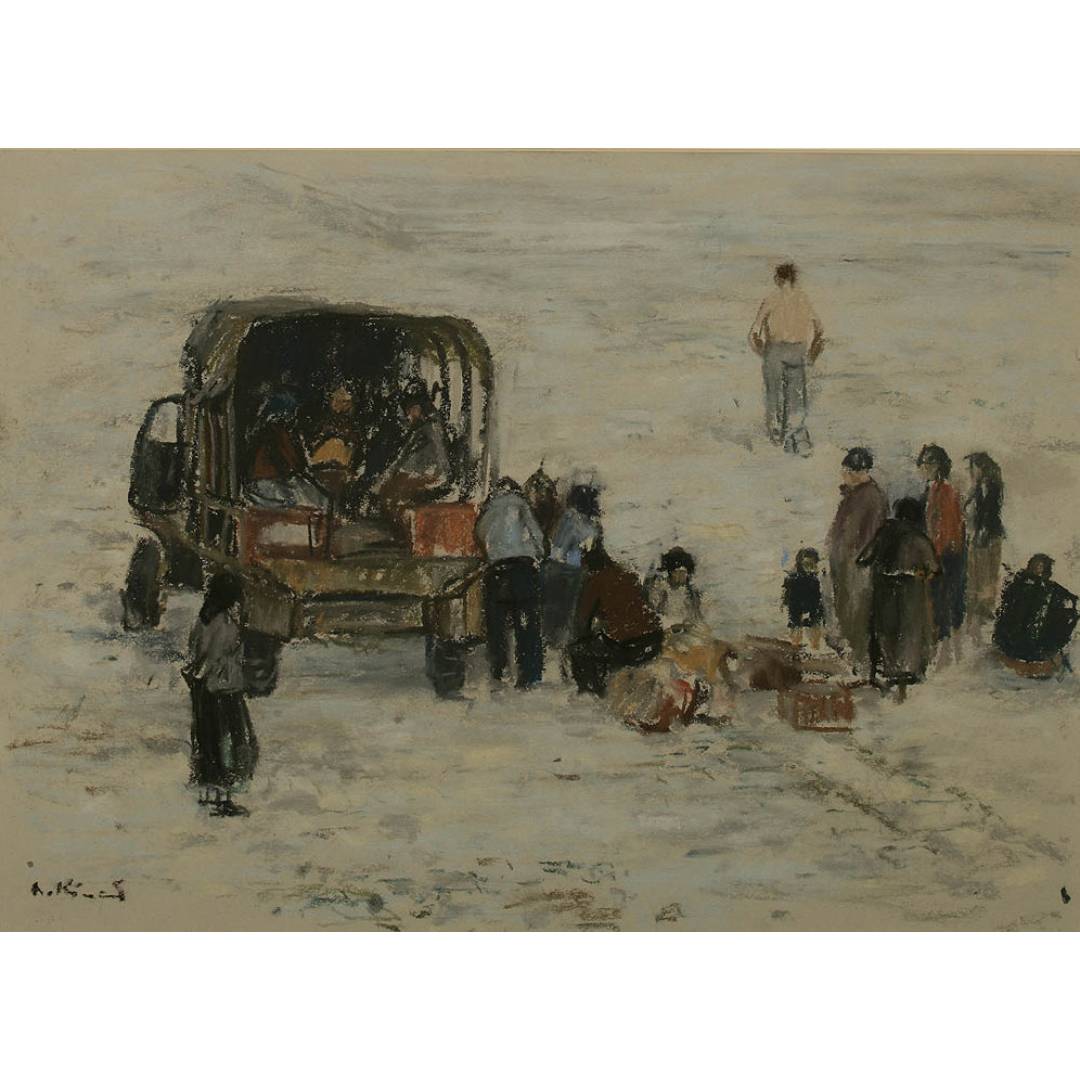
Albert Kinert, Hvar Bus, 1949

Albert Kinert
Hvar Bus, 1949
pastel on paper
27 × 49 cm
MG-2019

Albert Kinert’s Hvar Bus depicts everyday island life, showing a group of people gathered around the open rear of a cargo bus. The composition is constructed on a broad, almost empty light surface that places the scene in a temporal and spatial indeterminacy typical of Kinert’s lyrical interpretation of reality. Thick, broken pastel strokes shape the figures only in suggestion, as coloristic silhouettes in motion, while the vehicle is indicated only to the extent necessary to establish spatial relationships within the scene. This reduction of descriptive content reveals the artist’s inclination toward formal synthesis, in which motifs of daily life are transformed into a rhythm of patches of color, light, and gestural accents. A pale tonal range, dominated by grays and earthy hues, and the absence of narrative emphasis create an atmosphere of quiet tension alongside the simple intimacy of island life. The work bears the characteristics of a transitional period in Kinert’s oeuvre, in which figuration increasingly dissolves into sign and colored stain, while retaining an emotional connection to a recognizable motif.
Albert Kinert (1919–1987) was a Croatian painter and printmaker, and one of the key figures of postwar Croatian graphic art. He graduated from the Academy of Fine Arts in Zagreb in 1946, where he later worked as a professor and headed the special department for printmaking. Initially close to Post-Impressionism, Kinert gradually drew inspiration from Japanese prints as well as prehistoric and archaic Greek painting, developing an expressive language based on simplified forms and a restrained palette. During the 1950s he increasingly deconstructed form into a system of colored patches, guiding his painting toward a lyrical, intimate mood, while around 1960 he moved closer to abstraction and abandoned narrativity. In his later phase, he synthesized figurative and abstract signs.

Text: Lorena Šimić Majić, Curator - museum educator at the National Museum of Modern Art © National Museum of Modern Art, Zagreb
Photo: Goran Vranić © National Museum of Modern Art, Zagreb
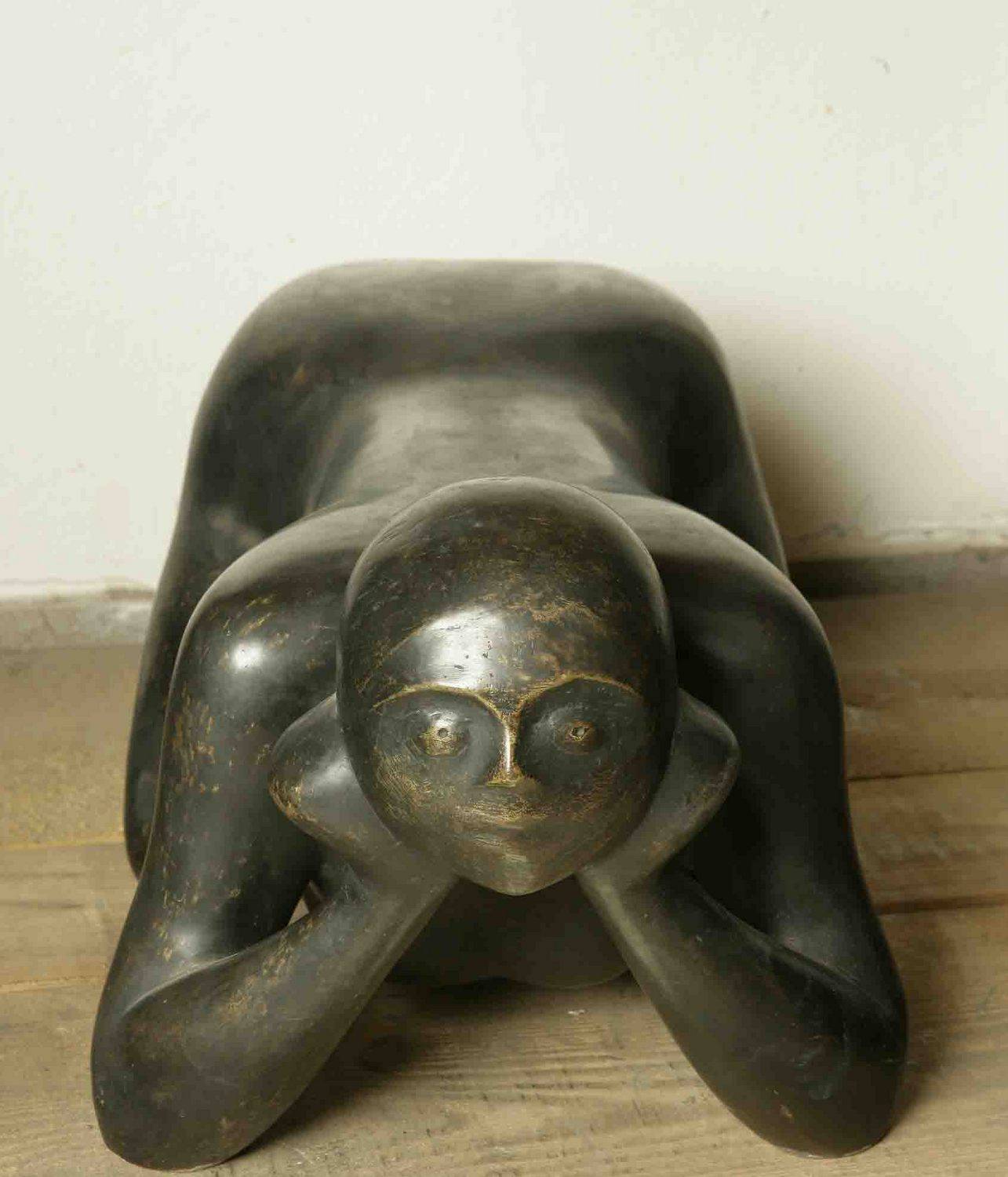
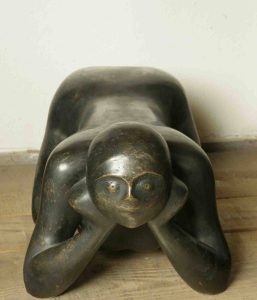
Ivan Sabolić, Figure (Madwoman), 1956

Ivan Sabolić
Figure (Madwoman), 1956
bronze
35 × 25 × 70 cm
MG-2440

Ivan Sabolić (1921 – 1986) belongs to the post-war generation of sculptors searching for a way out of the dominant narrative of engaged art of socialist realism. Early on, he started simplifying the symbolic form, but the human figure remains the sculptor's dominant determinant throughout all phases of creativity. He tries to capture the subject's essence in a reduced form in the portrait.
The sculpture Madwoman, despite the smooth and calm surface of the sculpture, the swelling, voluminous deformation of the body shape reveals the internal tension of the subject, which is accentuated by the choice of theme. The reclining, elbowed figure was created in 1956 and reflects Sabolić's aspiration for purity of form and subtle rhythm, while the thematic figure of the Madwoman reveals all the tragedy of human existence.
This depiction of a "madwoman" opposes traditional stereotypes where madness, or various reinterpretations of mental difficulties and problems, was portrayed as a deviant manifestation of deeper emotional states, and the characters of madmen were considered marginalized social subjects. Here, Sabolić uses the figure of a woman subtly and robustly, opening up space for deeper reflection on the role of women and the perception of craziness in society. His "Madwoman" simultaneously shows inner tension and outer calm, exploring the boundaries between normal and abnormal and questioning social norms that define and limit individual identity.

Text: Marta Radman, curator at the National Museum of Modern Art, Zagreb
Translated by: Marta Radman
Photo: Goran Vranić © National Museum of Modern Art, Zagreb

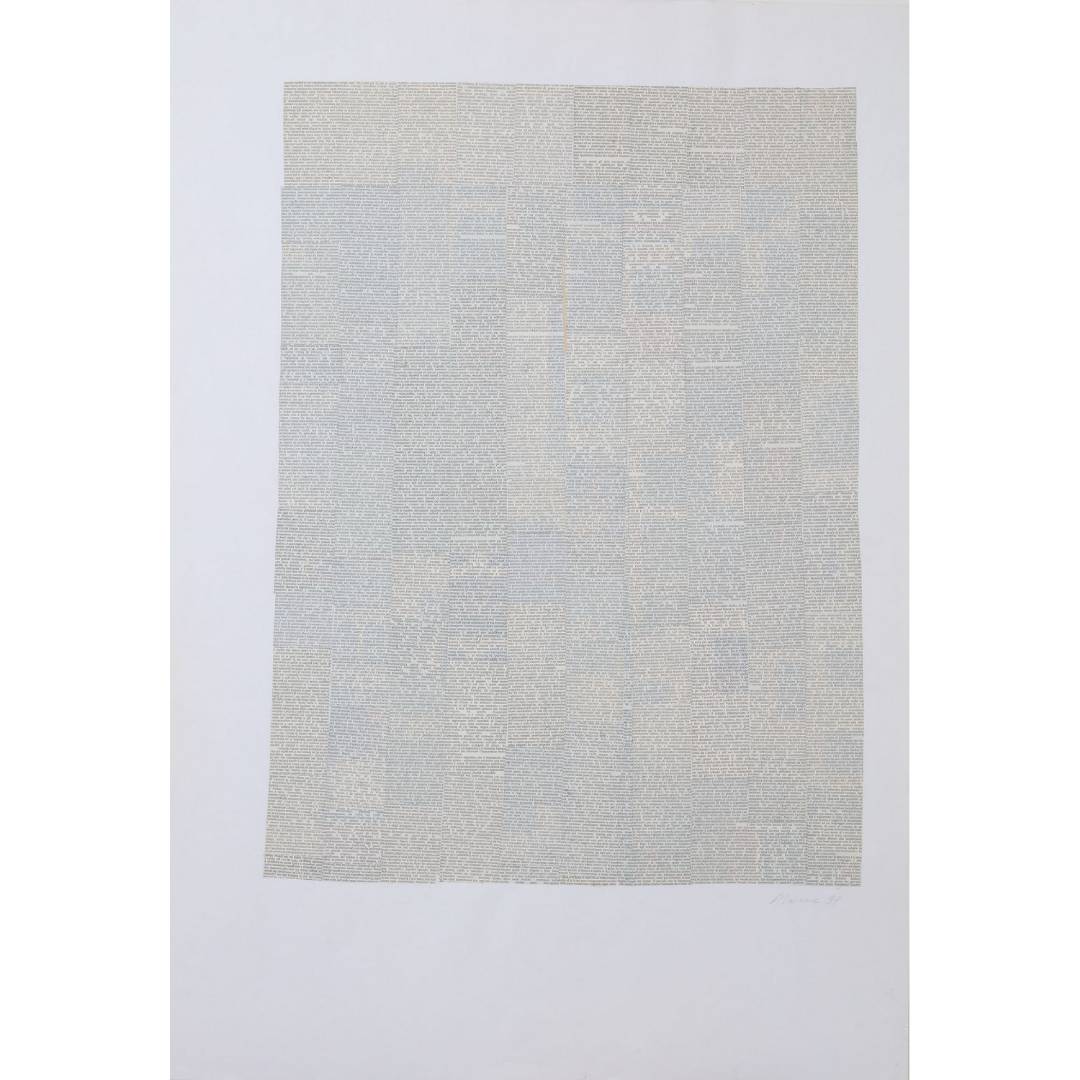
Anabel Zanze, Poljana, 1997

Anabel Zanze
Poljana, 1997
collage / paper, 100 × 70 cm
MG-8762

Anabel Zanze (1971, Dubrovnik) is a prominent Croatian painter and printmaker. She graduated from the Department of Graphic Arts at the Academy of Fine Arts in Zagreb in 1996 and has since held a number of notable solo and group exhibitions. Beginning in 1996, she developed variations of letter-based compositions in collage and oil on canvas, distinguished by strong semantic connotations. Her reflections on her work were published in the book Pogled iznutra. Čitati s razumijevanjem / View from Inside / Close Reading in 2017.
The collage Poljana from 1997 is an early work that already contains the crystallised direction of the artist’s later mature painting. By using words and notions (in Italian), letters and signs, Zanze operates in the realm of meaning. Her affinity for the Italian language (and—recalling the spirit of Vidović—music) is also evident in her continued use of clippings from Italian magazines (Jazz, CD-Classica, Arte) as building material for her collage series Squares, begun in 1996.
A second layer of her syntax in Poljana is the visual impression of meditative repetition, rhythm, harmony, and balance. This is achieved through a web-like mesh of tiny black marks on fragile beige paper, forming condensed, organically uneven columns that together assemble into an irregular rectangle—almost as if dancing. It is as though we observe from above a square, a poljana in Dubrovnik, a piazza or campo in Venice, bordered by the softly curved façades of stone houses, binding these two centuries-old Adriatic centres into a shared narrative.
In the artist’s own words: “The monochrome Poljana is a monolith—as opposed to the compact Metropolis, that congested megalopolis for which I used a rougher matte paper, so it is all sooty and industrial grey—this one is made of finer paper. The collage, composed of precisely arranged stones worn smooth by footsteps, gleams. The Poljana is the heart of the city, a busy place, and its irregular edges—determined by the walls of the surrounding, previously built structures—make it something other than a perfect rectangle.”

Text: Ivana Rončević Elezović, PhD museum advisor at the National Museum of Modern Art © National Museum of Modern Art, Zagreb
Photo: Goran Vranić, National Museum of Modern Art, Zagreb

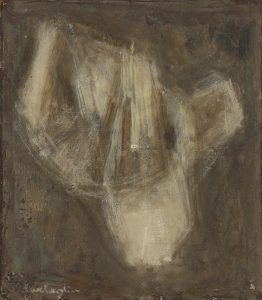
Marino Tartaglia, Flowers on a Dark Background, c. 1966

Marino Tartaglia
Flowers on a Dark Background, c. 1966
oil, canvas, plywood, 38 × 33 cm
MG-2678

Marino Tartaglia (1894–1984) was a universal modernist of both the historical and high-modern periods. His painting represents a synthesis of influences and styles: El Greco and Tintoretto, primitivism, Cézannism, Cubism, Expressionism, Futurism, Neoclassicism, colourism, lyrical and reductive abstraction. Not individually, but integrated, they are present. Tartaglia’s references are often unreadable, and his painting is grounded in the rationalisation of painterly procedures. Through them, he reconciles the principles of plastic order with an emotional approach to the image (T. Maroević). He reduces the painting to planar volume and ultimately arrives at a characteristic form – the pentagram. Tartaglia’s sfumato is in correlation with that of E. Vidović. In his Marginalia, he resolves contradictions with the postulate: “A painting must reconcile all opposites; in its own time it must be a timeless archaeological find.”
From 1912 onward he studied in Florence (Giacometti) and in Rome, at the Instituto Superiore di Belle Arti; he was friends with the Futurists gathered around the journal Lacerba. As the only foreign participant, he exhibited in Rome in 1918 at the Exhibition of Independent Artists alongside eminent representatives of the Italian avant-garde (C. Carrà, G. De Chirico, E. Prampolini, A. Soffici). After the First World War (1918–1921), he lived in Split, Vienna, Belgrade, and France. From 1947 he was a full professor at the Academy of Fine Arts in Zagreb, and from 1948 a full member of the Yugoslav Academy of Sciences and Arts. Flowers on a Dark Background (c. 1966) demonstrates the method of reduction through which the painter distills the motif to what is visually relevant and essentially sublimated, achieved through a narrowed register of (a)chromatic values. He received the Vladimir Nazor Lifetime Achievement Award (1964), and major retrospectives were organised in 1975 at the Art Pavilion in Zagreb and in 2004 at the Klovićevi dvori Gallery.

Text: Željko Marciuš, Museum Advisor at the National Museum of Modern Art © National Museum of Modern Art, Zagreb
Photo: Goran Vranić © National Museum of Modern Art, Zagreb
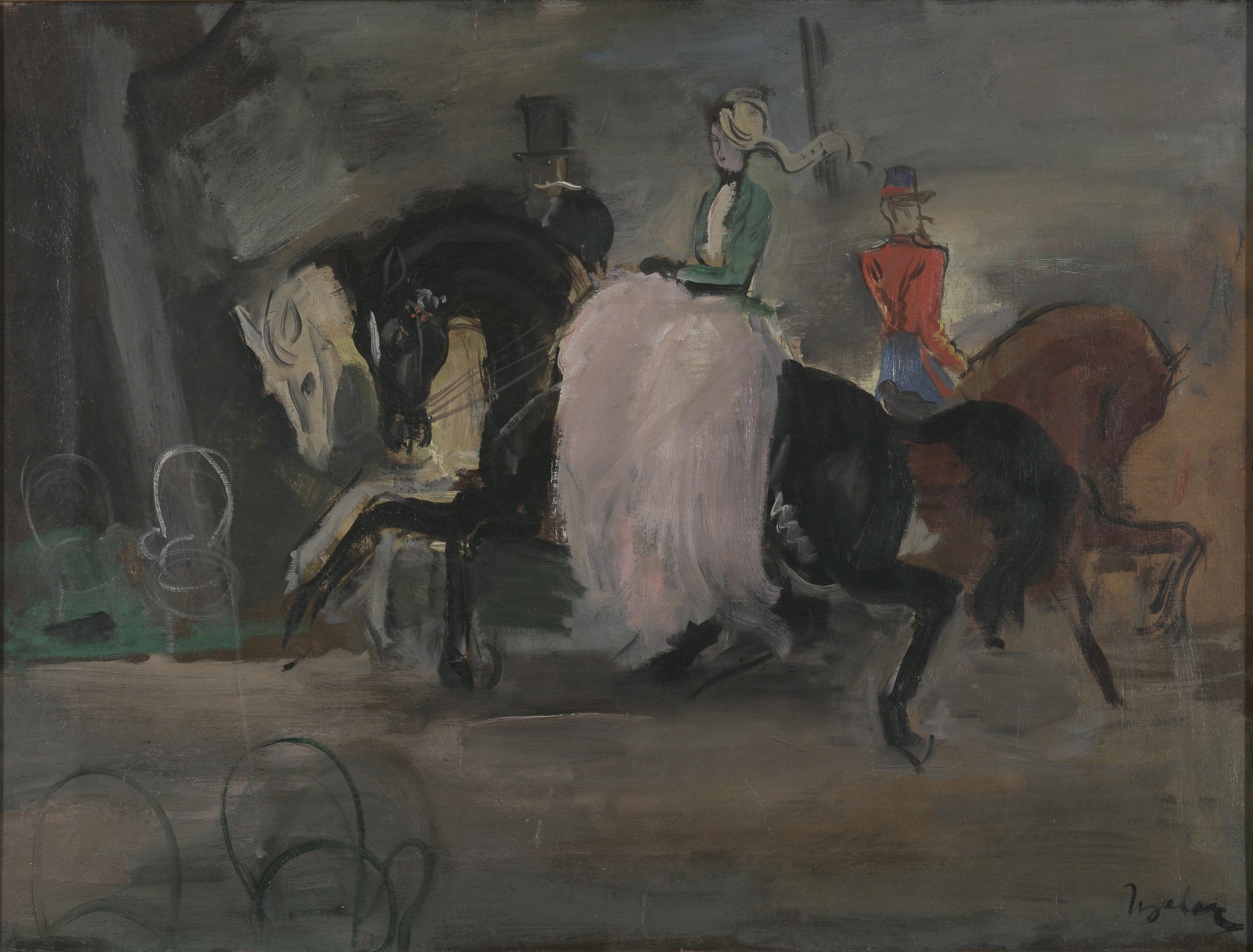
Milivoj Uzelac, Composition with Horses, 1917

Milivoj Uzelac
Composition with Horses, 1917
oil on canvas
54.5 × 72.5 cm
MG-993

In Composition with Horses, Milivoj Uzelac depicts riders and horses within a framing that evokes a theatrical moment, capturing the dynamism of movement with both elegance and swift, confident brushwork. Created in 1917, the painting dates from the period when the artist was living in Prague and developing an Expressionist idiom influenced by Cézanne’s approach to volume and colour. The motif of a female rider accompanied by her entourage, enhanced by striking contrasts of black, white, and pink, reflects Uzelac’s interest in scenes of metropolitan everyday life, spectacle, and social ritual—an interest that would reach its peak in his later works featuring cafés, cabarets, and urban types.
Here, we can still sense a transitional atmosphere: a balance between realistic observation and an increasingly pronounced desire to construct an image as a closed, compositionally harmonious system. Uzelac opens one of the key thematic and painterly directions that would mark his oeuvre—his fascination with scenes of spectacle, urban entertainment, and the world of the circus.
At the centre of the composition stands a female rider in an elegant pink-green dress, placed between two massive horses. This compositional symmetry, together with the contrast between the dark silhouettes of the animals and the lighter human figures, creates a powerful visual rhythm and a sense of motion. The scene is presented without narrative specificity: the space is only loosely suggested, objects are rendered imprecisely, and the contouring brushstroke is free and expressive. Particularly notable is the Expressionist treatment of colour and light: the figures seem to emerge from a dark, semi-abstract environment, while the rider, through her posture and attire, appears as a central symbol of poise and elegance within a transient, almost chaotic world. In the lower part of the painting, the outlines of chairs are merely hinted at—as if surfacing from the subconscious—adding an element of uncertainty and introspective depth. This work stands as an early example of Uzelac’s distinctive fusion of Expressionism and Symbolism, foreshadowing the motifs that would dominate his later oeuvre in France.
Milivoj Uzelac (1897–1977) was one of the key figures of Croatian Modernism between the two world wars. After studying in Zagreb and Prague, he returned to Croatia in 1919, where together with Gecan, Varlaj, and Trepše he transformed the local art scene through their exhibitions at the Spring Salons. His early works blend Expressionism with the influence of Cézanne, while after moving to Paris in 1923 he turned toward colouristic realism and more classical forms. His oeuvre is marked by painterly virtuosity, thematic diversity, and the ability to bridge the local and the international. He exhibited widely at home and abroad, and his works are held in major museum and gallery collections.

Text: Lorena Šimić, curator / museum educator at the National Museum of Modern Art © National Museum of Modern Art, Zagreb
Photo: Goran Vranić © National Museum of Modern Art, Zagreb
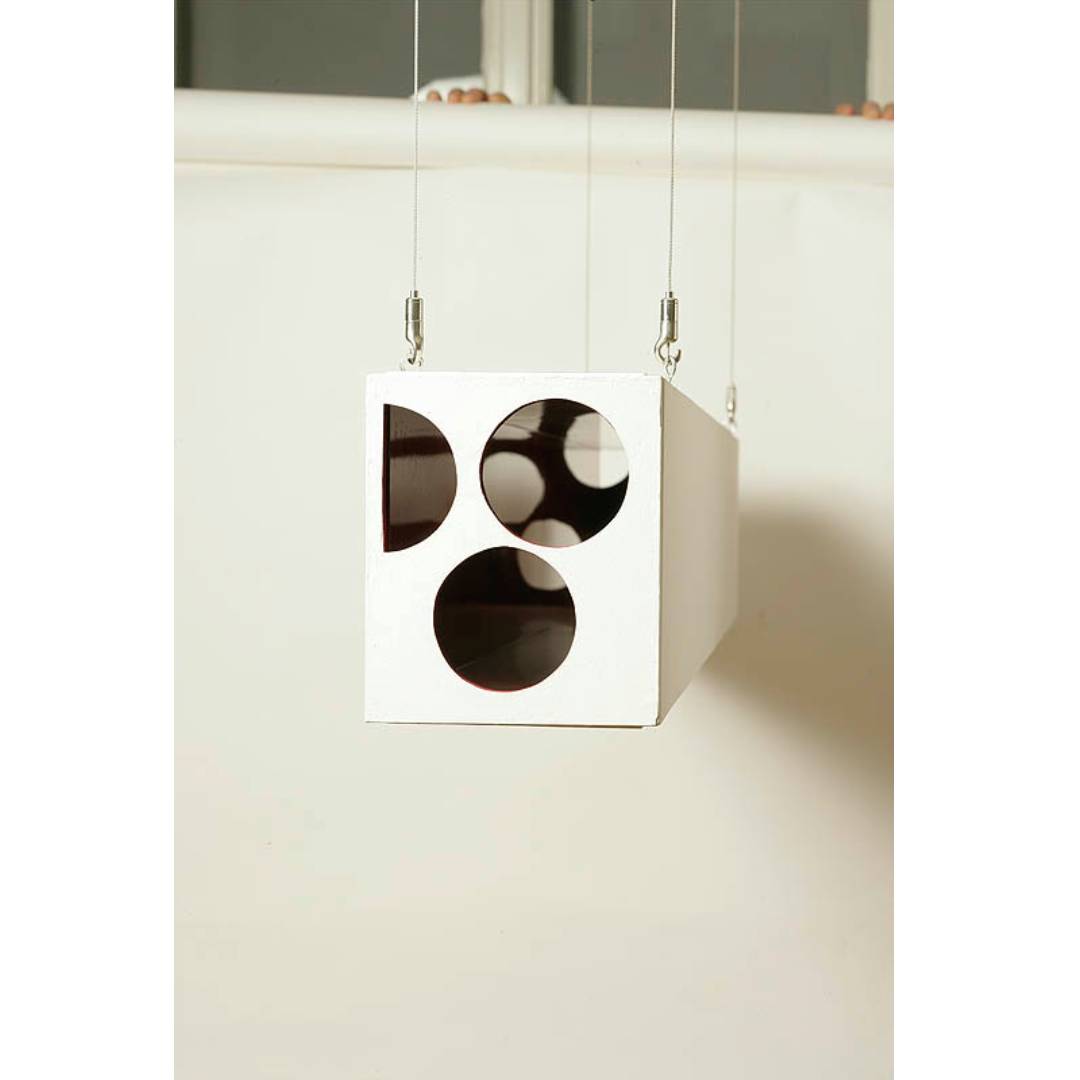
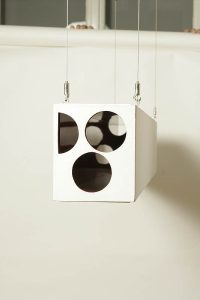
Martina Kramer, Binoculars 1/3, 2001

Martina Kramer
Binoculars 1/3, 2001
sculpture/object
33 × 28 × 210 cm
MG-6743

Martina Kramer (1965) graduated in painting from the Academy of Fine Arts in Zagreb and has lived in France since 1989, when she graduated from the art department of the Lyon Academy of Fine Arts, ENBA. Her works are based on the tradition and experience of constructivism, minimalism, op-art, neoconceptualism, and space art to explore various artistic solutions of perception, space, and light.
Connecting artistic expressions with scientific concepts works between the material and the immaterial, questioning the perception of space and matter. Her field of research is the sphere of the unknown, of what escapes: black holes, voids. She believes these phenomena are behind knowledge and feelings, as a kind of negative of what is exposed to view. A white, wooden, tubular structure is attached to the ceiling. On the front side, there is a circular opening with filters. It functions as a sculpture/object, and the view through the structure's cavity changes how we experience the space in which it is placed.

Text: Marta Radman, curator of the National Museum of Modern Art, Zagreb
Translated by: Marta Radman
Photo: From the archive of the National Museum of Modern Art, Zagreb

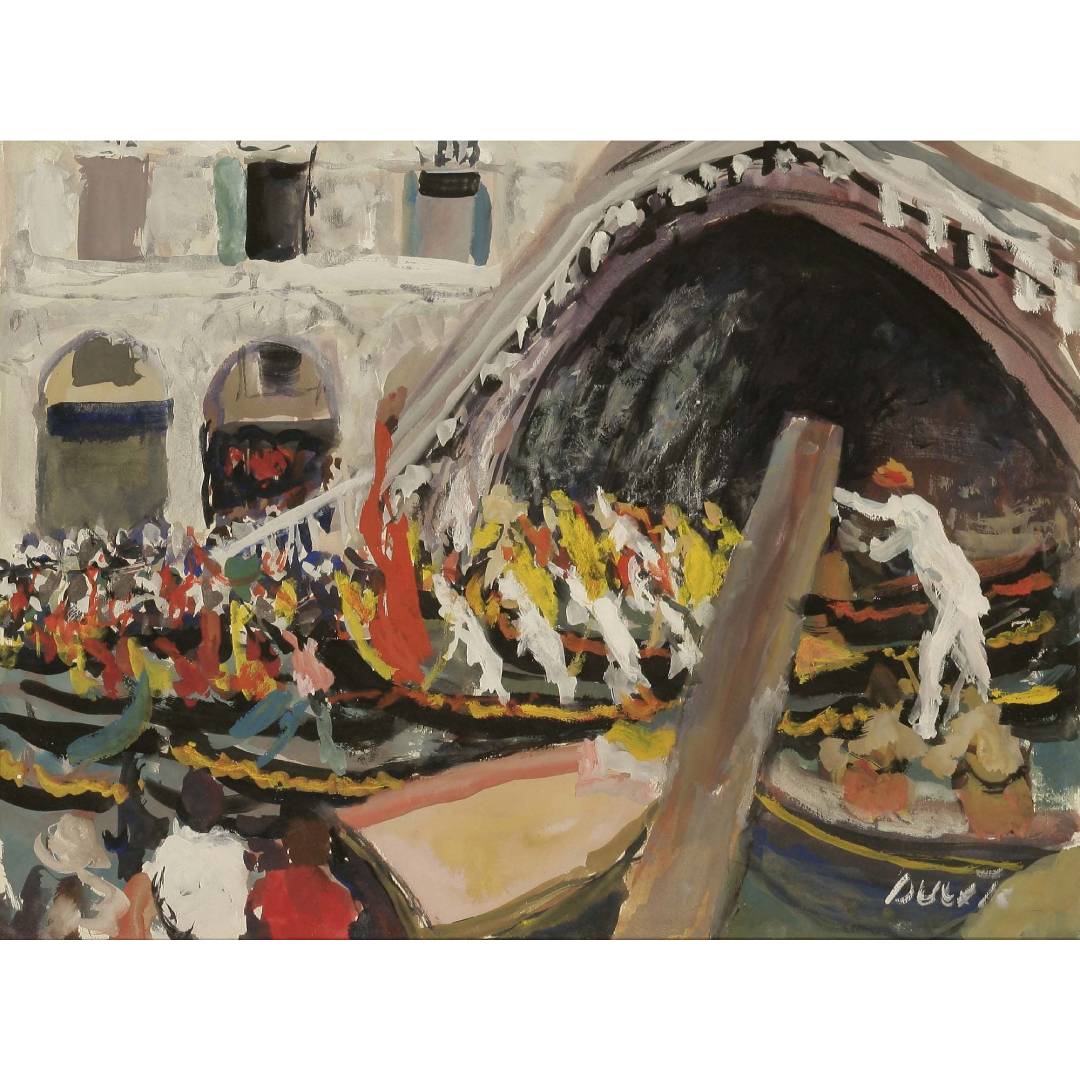
Ivo Dulčić, Venice, c. 1960

Ivo Dulčić
Venice, c. 1960
tempera on paper
35 × 45.5 cm
MG-2335

Ivo Dulčić (1916–1975) was a Croatian painter who spent most of his life between Zagreb and Dubrovnik. With his distinctive, virtuoso approach to abstracted colouristic expressionism infused with the poetics of intimism, he stands as one of the emblematic representatives of mid-20th-century Dubrovnik painting.
Dulčić’s Venice, featuring a vibrant array of figures on gondolas gliding through the Venetian canal beneath bridges and palazzi, almost evokes the impression of a stained-glass window, elevating an everyday scene to a ceremonious one. Although typically known as a pronounced colourist, here he restrains his palette, allowing only occasional flashes of colour within the bustling scene on the water—subtle hints of his artistic signature—and, in doing so, offers a kind of homage to Vidović’s tradition of depicting this mythical city.

Text: Ivana Rončević Elezović PhD, Museum Advisor at the National Museum of Modern Art © National Museum of Modern Art, Zagreb
Photo: Goran Vranić, National Museum of Modern Art, Zagreb

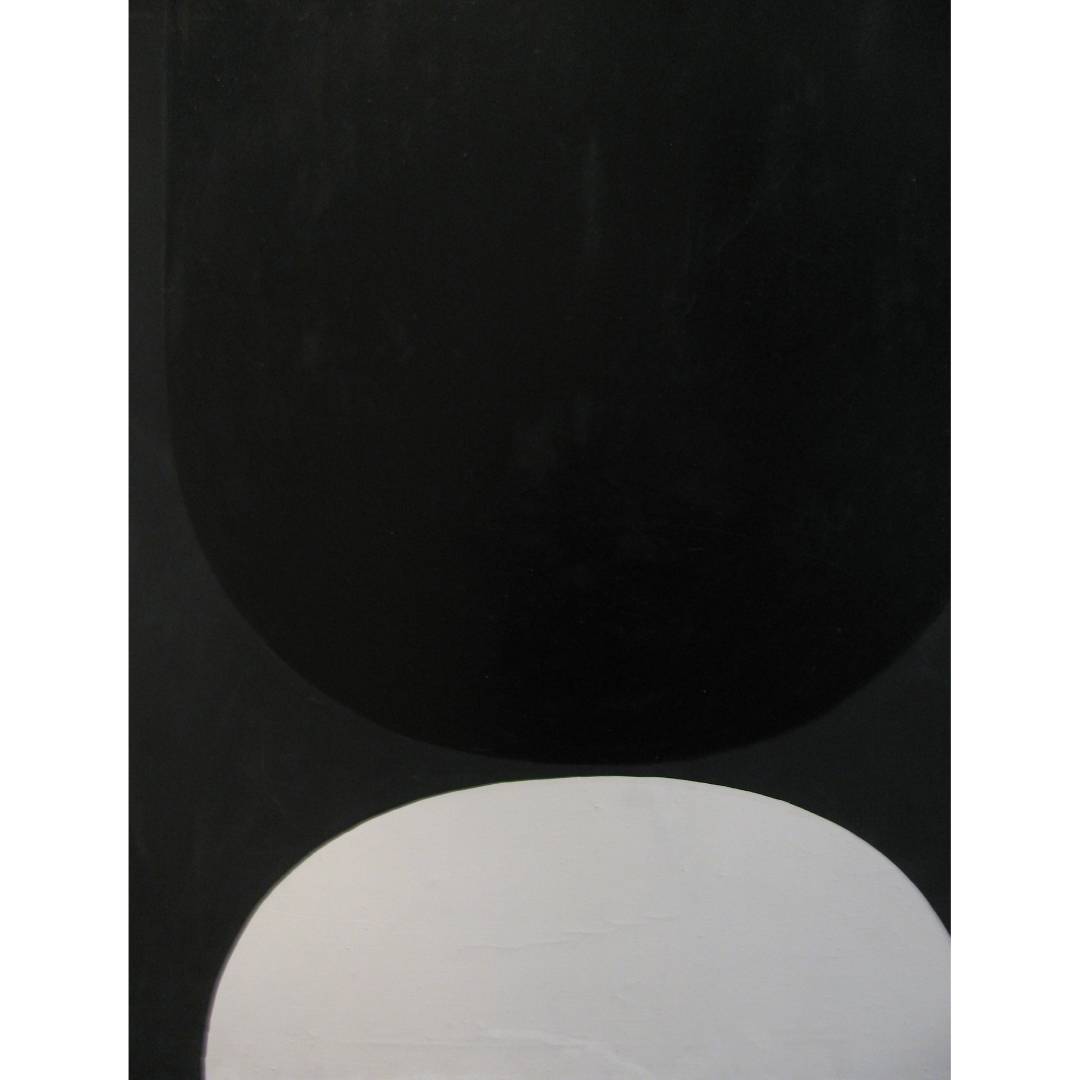
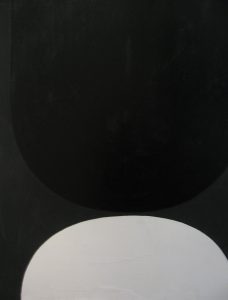
Đuro Seder, Painting III, 1972

Đuro Seder
Painting III, 1972
oil on canvas
130 × 98 cm
MG-2966

Đuro Seder (1927–2022) was a multifaceted and universal painterly figure. He graduated from the Academy of Fine Arts in Zagreb (Antun Mejzdić, 1951; postgraduate program with Marino Tartaglia, 1953). He worked in illustration and graphic design, and in the mid-1950s produced dynamic paintings in the spirit of tachisme. As a founding member of the artistic group Gorgona (1959–1966)—a collective of artists connected by a shared spiritual affinity—he advocated for a neo-avant-garde spirit, for the freedom of art and of the mind, anticipating the later developments of the New Art Practice.
Seder’s oeuvre presents a unique evolution: from the mute, dark impossibility of painting (as he described in his 1971 essay), manifested in the atmosphere and form of non-iconic black-and-white geometry, which also corresponds to this selected work, Painting III (1972). This piece exemplifies Seder’s characteristic dual minimalism which, from the late 1970s onward, gradually transforms into the possibility of painting (artist’s essay, 1981) and the new painting (1981), of which he was one of the pioneers.
From Seder’s Art Informel phase arises a fundamental premise: a painting is an indescribable composition that does not point to anything beyond its own materiality. It is stripped of references to reality and oriented toward the processes of painting itself.
Finally, in the 1990s, Seder developed a distinctive form of neo-expressionism—a total painting and total painterly approach, along with ironic, self-ironic, and warmly humorous, at times even joyful, self-portraits in the spirit of the Neue Wilde (from 2007), as well as new spiritual-sacral works.

Text: Željko Marciuš, museum advisor at the National Museum of the National Museum of Modern Art, Zagreb
Photo: Goran Vranić © National Museum of Modern Art, Zagreb
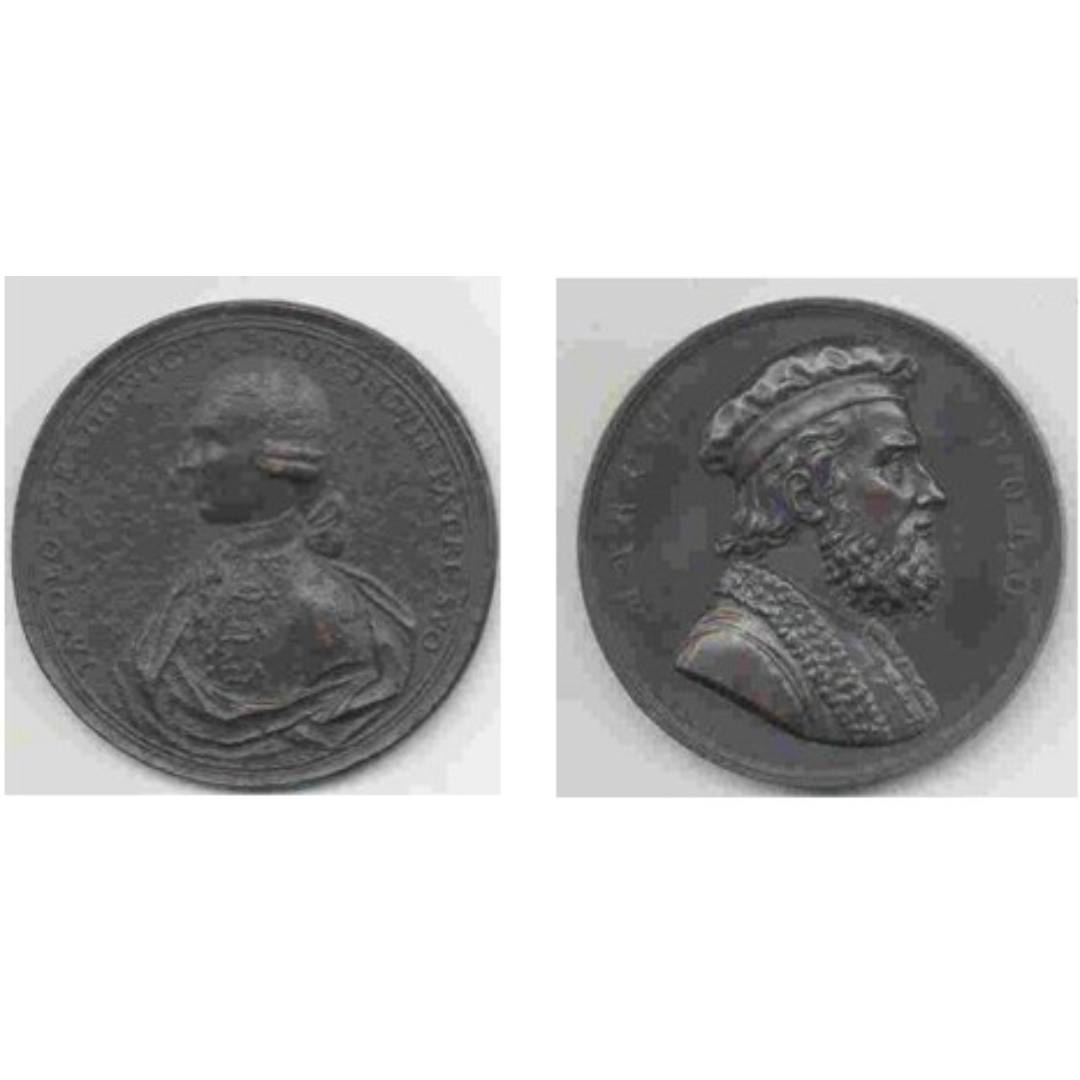
Filippo Balugani Giacomo Gradenigo – Venetian Provveditore of Dalmatia and Albania (1773–1776), 1777
Antonio Fabris Marco Polo, 1857

Filippo Balugani
Giacomo Gradenigo – Venetian Provveditore of Dalmatia and Albania (1773–1776), 1777
galvanic print / striking (double-sided medal), Ø 6.65 cm
MG-2892-2402

Antonio Fabris
Marco Polo, 1857
bronze / striking (double-sided medal), Ø 5.7 cm
MG-2892-849

Among the artworks associated with Venice are two medals featuring realistic relief profile portraits: one depicting Giacomo Gradenigo, the Venetian provveditore of Dalmatia and Albania from 1773 to 1776, created in 1777 by Filippo Balugani (1734–1780); and another portraying Marco Polo, made in 1857 by Antonio Fabris (1792–1865).
Balugani’s medal of the Venetian governor of Dalmatia belongs to the group of portraits of Dalmatian magistrates from the 17th and 18th centuries, which, as noted by Ivan Mirnik, often do not possess significant artistic value but are primarily of historical and cultural-historical importance. They were mostly produced by more modest goldsmiths and silversmiths as farewell gifts from the local nobility to departing provveditori or rectors.
Fabris’s medal, dedicated to the Venetian Marco Polo (1254–1324)—the archetypal (Venetian) explorer, travel writer, and merchant—depicts a figure whose life story is as emblematic as Venice itself. One could say that Marco Polo’s biography embodies the adventurous, intellectual, artistic, commercial, and expansionist spirit of the Serenissima.
Both medals bear witness to the historical and traditional bonds—one might even say destiny—linking the two shores of the Adriatic, Croatian and Italian, each inherently oriented toward the other.

Text: Ivana Rončević Elezović PhD, museum advisor at the National Museum of Modern Art © National Museum of Modern Art, Zagreb
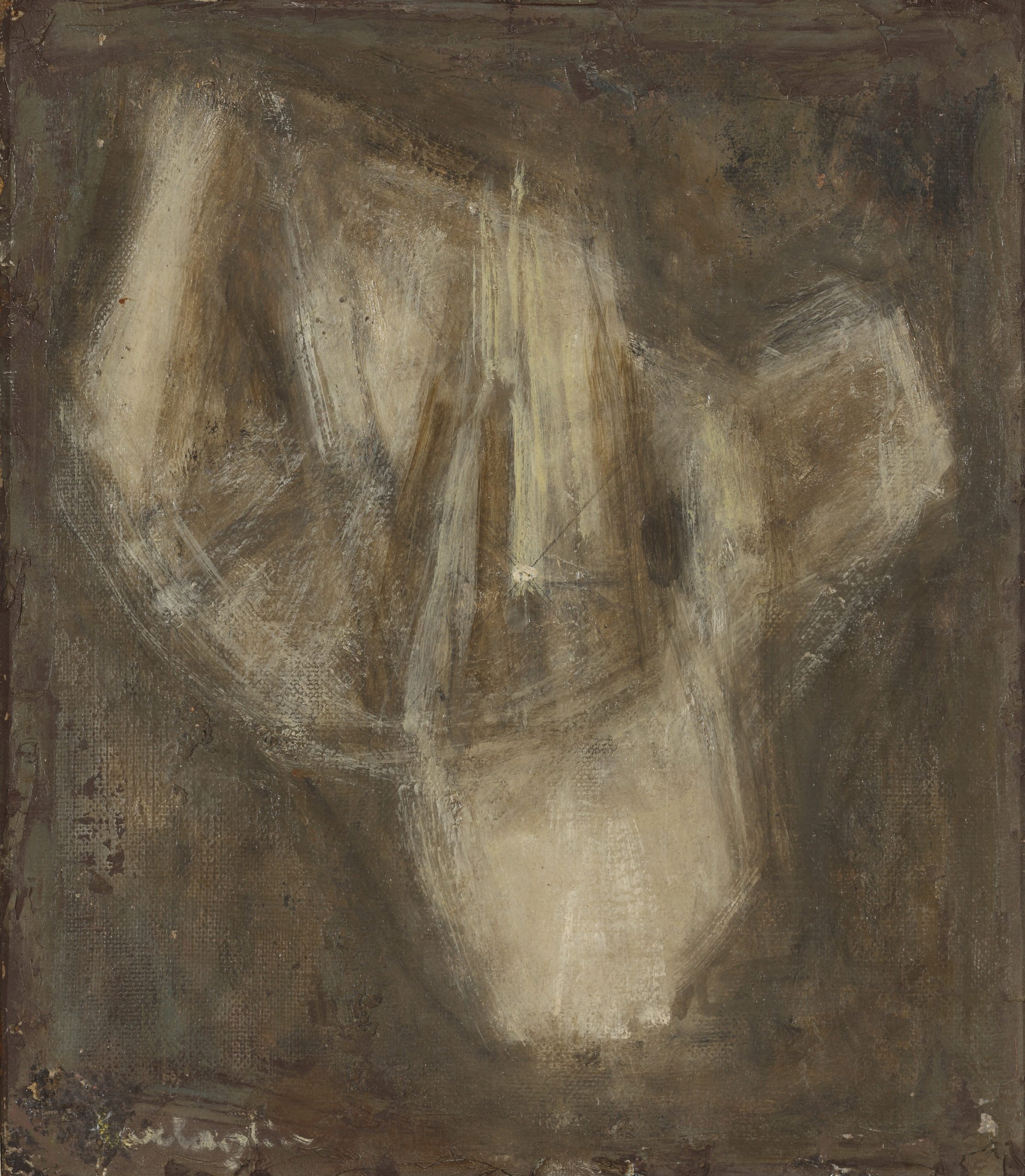
Photo: from the archive of the National Museum of Modern Art, Zagreb