Albert Kinert
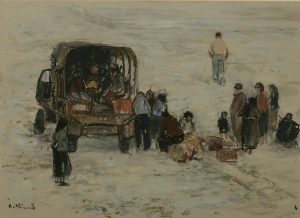
Hvar Bus, 1949
pastel on paper
27 × 49 cm
MG-2019
Albert Kinert’s Hvar Bus depicts everyday island life, showing a group of people gathered around the open rear of a cargo bus. The composition is constructed on a broad, almost empty light surface that places the scene in a temporal and spatial indeterminacy typical of Kinert’s lyrical interpretation of reality. Thick, broken pastel strokes shape the figures only in suggestion, as coloristic silhouettes in motion, while the vehicle is indicated only to the extent necessary to establish spatial relationships within the scene. This reduction of descriptive content reveals the artist’s inclination toward formal synthesis, in which motifs of daily life are transformed into a rhythm of patches of color, light, and gestural accents. A pale tonal range, dominated by grays and earthy hues, and the absence of narrative emphasis create an atmosphere of quiet tension alongside the simple intimacy of island life. The work bears the characteristics of a transitional period in Kinert’s oeuvre, in which figuration increasingly dissolves into sign and colored stain, while retaining an emotional connection to a recognizable motif.
Albert Kinert (1919–1987) was a Croatian painter and printmaker, and one of the key figures of postwar Croatian graphic art. He graduated from the Academy of Fine Arts in Zagreb in 1946, where he later worked as a professor and headed the special department for printmaking. Initially close to Post-Impressionism, Kinert gradually drew inspiration from Japanese prints as well as prehistoric and archaic Greek painting, developing an expressive language based on simplified forms and a restrained palette. During the 1950s he increasingly deconstructed form into a system of colored patches, guiding his painting toward a lyrical, intimate mood, while around 1960 he moved closer to abstraction and abandoned narrativity. In his later phase, he synthesized figurative and abstract signs.
Text: Lorena Šimić Majić, Curator - museum educator at the National Museum of Modern Art © National Museum of Modern Art, Zagreb
Photo: Goran Vranić © National Museum of Modern Art, Zagreb