Anabel Zanze
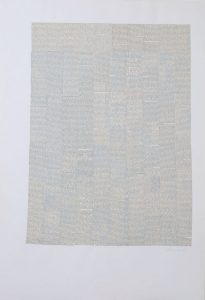
Poljana, 1997
collage / paper, 100 × 70 cm
MG-8762
Anabel Zanze (1971, Dubrovnik) is a prominent Croatian painter and printmaker. She graduated from the Department of Graphic Arts at the Academy of Fine Arts in Zagreb in 1996 and has since held a number of notable solo and group exhibitions. Beginning in 1996, she developed variations of letter-based compositions in collage and oil on canvas, distinguished by strong semantic connotations. Her reflections on her work were published in the book Pogled iznutra. Čitati s razumijevanjem / View from Inside / Close Reading in 2017.
The collage Poljana from 1997 is an early work that already contains the crystallised direction of the artist’s later mature painting. By using words and notions (in Italian), letters and signs, Zanze operates in the realm of meaning. Her affinity for the Italian language (and—recalling the spirit of Vidović—music) is also evident in her continued use of clippings from Italian magazines (Jazz, CD-Classica, Arte) as building material for her collage series Squares, begun in 1996.
A second layer of her syntax in Poljana is the visual impression of meditative repetition, rhythm, harmony, and balance. This is achieved through a web-like mesh of tiny black marks on fragile beige paper, forming condensed, organically uneven columns that together assemble into an irregular rectangle—almost as if dancing. It is as though we observe from above a square, a poljana in Dubrovnik, a piazza or campo in Venice, bordered by the softly curved façades of stone houses, binding these two centuries-old Adriatic centres into a shared narrative.
In the artist’s own words: “The monochrome Poljana is a monolith—as opposed to the compact Metropolis, that congested megalopolis for which I used a rougher matte paper, so it is all sooty and industrial grey—this one is made of finer paper. The collage, composed of precisely arranged stones worn smooth by footsteps, gleams. The Poljana is the heart of the city, a busy place, and its irregular edges—determined by the walls of the surrounding, previously built structures—make it something other than a perfect rectangle.”
Text: Ivana Rončević Elezović, PhD museum advisor at the National Museum of Modern Art © National Museum of Modern Art, Zagreb
Photo: Goran Vranić, National Museum of Modern Art, Zagreb