Milivoj Uzelac
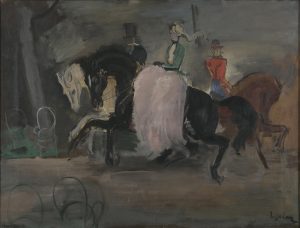
Composition with Horses, 1917
oil on canvas
54.5 × 72.5 cm
MG-993
In Composition with Horses, Milivoj Uzelac depicts riders and horses within a framing that evokes a theatrical moment, capturing the dynamism of movement with both elegance and swift, confident brushwork. Created in 1917, the painting dates from the period when the artist was living in Prague and developing an Expressionist idiom influenced by Cézanne’s approach to volume and colour. The motif of a female rider accompanied by her entourage, enhanced by striking contrasts of black, white, and pink, reflects Uzelac’s interest in scenes of metropolitan everyday life, spectacle, and social ritual—an interest that would reach its peak in his later works featuring cafés, cabarets, and urban types.
Here, we can still sense a transitional atmosphere: a balance between realistic observation and an increasingly pronounced desire to construct an image as a closed, compositionally harmonious system. Uzelac opens one of the key thematic and painterly directions that would mark his oeuvre—his fascination with scenes of spectacle, urban entertainment, and the world of the circus.
At the centre of the composition stands a female rider in an elegant pink-green dress, placed between two massive horses. This compositional symmetry, together with the contrast between the dark silhouettes of the animals and the lighter human figures, creates a powerful visual rhythm and a sense of motion. The scene is presented without narrative specificity: the space is only loosely suggested, objects are rendered imprecisely, and the contouring brushstroke is free and expressive. Particularly notable is the Expressionist treatment of colour and light: the figures seem to emerge from a dark, semi-abstract environment, while the rider, through her posture and attire, appears as a central symbol of poise and elegance within a transient, almost chaotic world. In the lower part of the painting, the outlines of chairs are merely hinted at—as if surfacing from the subconscious—adding an element of uncertainty and introspective depth. This work stands as an early example of Uzelac’s distinctive fusion of Expressionism and Symbolism, foreshadowing the motifs that would dominate his later oeuvre in France.
Milivoj Uzelac (1897–1977) was one of the key figures of Croatian Modernism between the two world wars. After studying in Zagreb and Prague, he returned to Croatia in 1919, where together with Gecan, Varlaj, and Trepše he transformed the local art scene through their exhibitions at the Spring Salons. His early works blend Expressionism with the influence of Cézanne, while after moving to Paris in 1923 he turned toward colouristic realism and more classical forms. His oeuvre is marked by painterly virtuosity, thematic diversity, and the ability to bridge the local and the international. He exhibited widely at home and abroad, and his works are held in major museum and gallery collections.
Text: Lorena Šimić, curator / museum educator at the National Museum of Modern Art © National Museum of Modern Art, Zagreb
Photo: Goran Vranić © National Museum of Modern Art, Zagreb