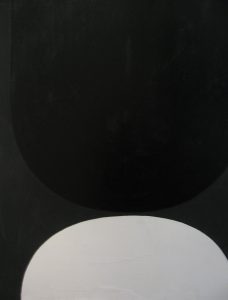
Đuro Seder
Painting III, 1972
oil on canvas
130 × 98 cm
MG-2966
Đuro Seder (1927–2022) was a multifaceted and universal painterly figure. He graduated from the Academy of Fine Arts in Zagreb (Antun Mejzdić, 1951; postgraduate program with Marino Tartaglia, 1953). He worked in illustration and graphic design, and in the mid-1950s produced dynamic paintings in the spirit of tachisme. As a founding member of the artistic group Gorgona (1959–1966)—a collective of artists connected by a shared spiritual affinity—he advocated for a neo-avant-garde spirit, for the freedom of art and of the mind, anticipating the later developments of the New Art Practice.
Seder’s oeuvre presents a unique evolution: from the mute, dark impossibility of painting (as he described in his 1971 essay), manifested in the atmosphere and form of non-iconic black-and-white geometry, which also corresponds to this selected work, Painting III (1972). This piece exemplifies Seder’s characteristic dual minimalism which, from the late 1970s onward, gradually transforms into the possibility of painting (artist’s essay, 1981) and the new painting (1981), of which he was one of the pioneers.
From Seder’s Art Informel phase arises a fundamental premise: a painting is an indescribable composition that does not point to anything beyond its own materiality. It is stripped of references to reality and oriented toward the processes of painting itself.
Finally, in the 1990s, Seder developed a distinctive form of neo-expressionism—a total painting and total painterly approach, along with ironic, self-ironic, and warmly humorous, at times even joyful, self-portraits in the spirit of the Neue Wilde (from 2007), as well as new spiritual-sacral works.
Text: Željko Marciuš, museum advisor at the National Museum of the National Museum of Modern Art, Zagreb
Photo: Goran Vranić © National Museum of Modern Art, Zagreb