Filippo Balugani
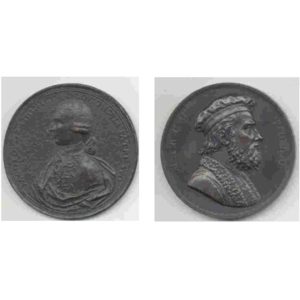
Giacomo Gradenigo – Venetian Provveditore of Dalmatia and Albania (1773–1776), 1777
galvanic print / striking (double-sided medal), Ø 6.65 cm
MG-2892-2402
Antonio Fabris
Marco Polo, 1857
bronze / striking (double-sided medal), Ø 5.7 cm
MG-2892-849
Among the artworks associated with Venice are two medals featuring realistic relief profile portraits: one depicting Giacomo Gradenigo, the Venetian provveditore of Dalmatia and Albania from 1773 to 1776, created in 1777 by Filippo Balugani (1734–1780); and another portraying Marco Polo, made in 1857 by Antonio Fabris (1792–1865).
Balugani’s medal of the Venetian governor of Dalmatia belongs to the group of portraits of Dalmatian magistrates from the 17th and 18th centuries, which, as noted by Ivan Mirnik, often do not possess significant artistic value but are primarily of historical and cultural-historical importance. They were mostly produced by more modest goldsmiths and silversmiths as farewell gifts from the local nobility to departing provveditori or rectors.
Fabris’s medal, dedicated to the Venetian Marco Polo (1254–1324)—the archetypal (Venetian) explorer, travel writer, and merchant—depicts a figure whose life story is as emblematic as Venice itself. One could say that Marco Polo’s biography embodies the adventurous, intellectual, artistic, commercial, and expansionist spirit of the Serenissima.
Both medals bear witness to the historical and traditional bonds—one might even say destiny—linking the two shores of the Adriatic, Croatian and Italian, each inherently oriented toward the other.
Text: Ivana Rončević Elezović PhD, museum advisor at the National Museum of Modern Art © National Museum of Modern Art, Zagreb
Photo: from the archive of the National Museum of Modern Art, Zagreb