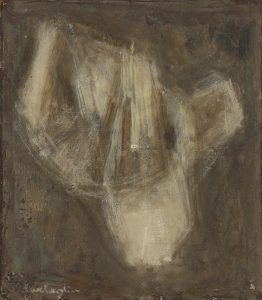
Marino Tartaglia
Flowers on a Dark Background, c. 1966
oil, canvas, plywood, 38 × 33 cm
MG-2678
Marino Tartaglia (1894–1984) was a universal modernist of both the historical and high-modern periods. His painting represents a synthesis of influences and styles: El Greco and Tintoretto, primitivism, Cézannism, Cubism, Expressionism, Futurism, Neoclassicism, colourism, lyrical and reductive abstraction. Not individually, but integrated, they are present. Tartaglia’s references are often unreadable, and his painting is grounded in the rationalisation of painterly procedures. Through them, he reconciles the principles of plastic order with an emotional approach to the image (T. Maroević). He reduces the painting to planar volume and ultimately arrives at a characteristic form – the pentagram. Tartaglia’s sfumato is in correlation with that of E. Vidović. In his Marginalia, he resolves contradictions with the postulate: “A painting must reconcile all opposites; in its own time it must be a timeless archaeological find.”
From 1912 onward he studied in Florence (Giacometti) and in Rome, at the Instituto Superiore di Belle Arti; he was friends with the Futurists gathered around the journal Lacerba. As the only foreign participant, he exhibited in Rome in 1918 at the Exhibition of Independent Artists alongside eminent representatives of the Italian avant-garde (C. Carrà, G. De Chirico, E. Prampolini, A. Soffici). After the First World War (1918–1921), he lived in Split, Vienna, Belgrade, and France. From 1947 he was a full professor at the Academy of Fine Arts in Zagreb, and from 1948 a full member of the Yugoslav Academy of Sciences and Arts. Flowers on a Dark Background (c. 1966) demonstrates the method of reduction through which the painter distills the motif to what is visually relevant and essentially sublimated, achieved through a narrowed register of (a)chromatic values. He received the Vladimir Nazor Lifetime Achievement Award (1964), and major retrospectives were organised in 1975 at the Art Pavilion in Zagreb and in 2004 at the Klovićevi dvori Gallery.
Text: Željko Marciuš, Museum Advisor at the National Museum of Modern Art © National Museum of Modern Art, Zagreb
Photo: Goran Vranić © National Museum of Modern Art, Zagreb