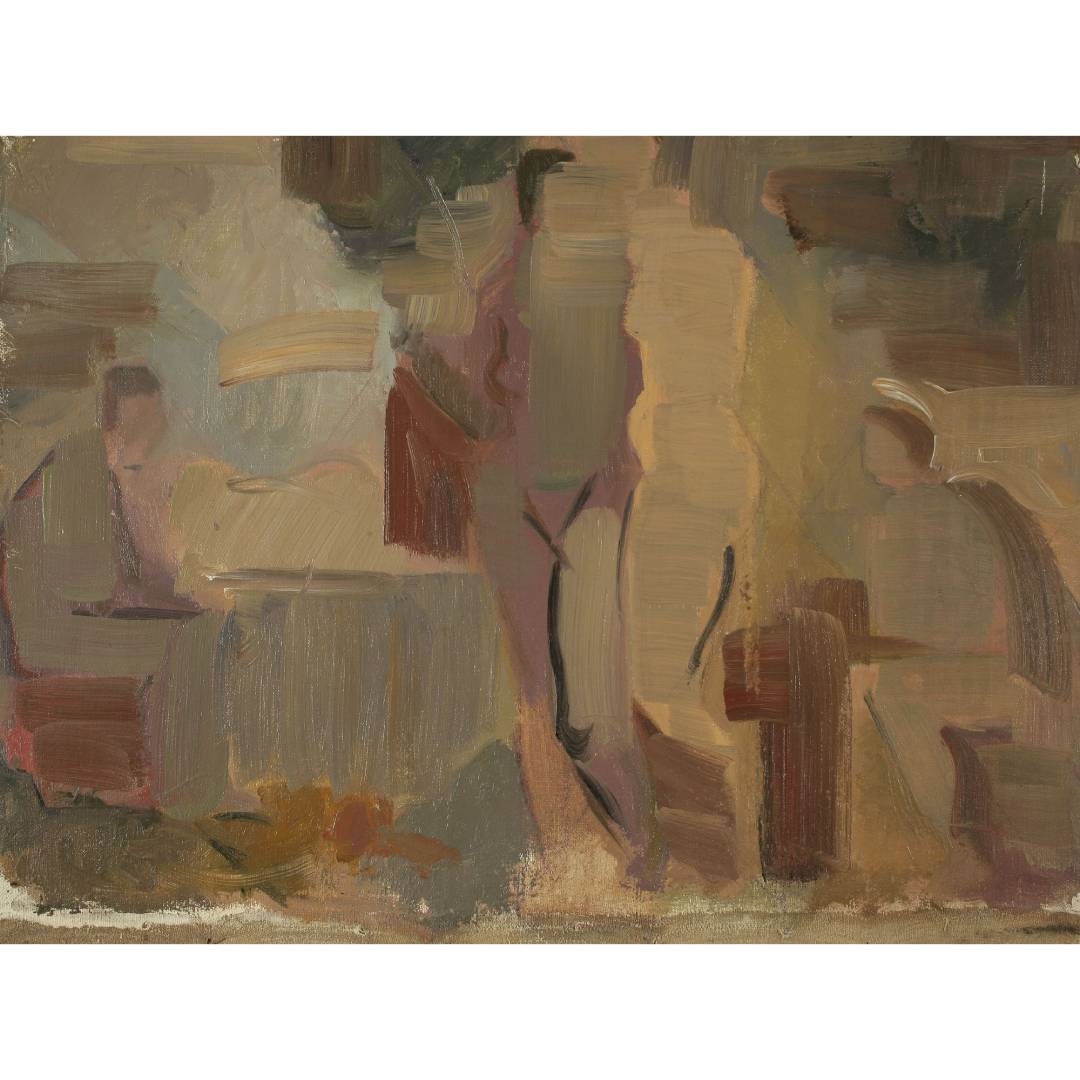
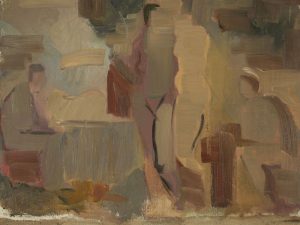
Sonja Kovačić – Tajčević Study of Nudes, 1928–1934

Sonja Kovačić – Tajčević
Study of Nudes, 1928–1934
oil on canvas
49.5 × 50.5 cm
MG-3220

Sonja Kovačić – Tajčević (Bošnjaci, 1894 – Rijeka, 1968) was one of the first academically trained female artists in Croatia, active from the second decade of the 20th century. Her artistic output is characterized by a series of figurative compositions, portraits, and landscapes, which comprise the majority of her oeuvre. She graduated in painting from the Academy of Fine Arts in Zagreb in 1917 and continued her academic training in Graz and Vienna. Further education followed during her study stay in Paris in 1926, where she studied under the renowned French painter André Lhote (Bordeaux, 1885 – Paris, 1962). She returned to Paris between 1928 and 1934, a period during which she created her most significant works under the strong influence of Lhote’s academic Cubism.
It was under this influence that Study of Nudes was created. The artist reduces the female figures to flat, geometrically structured forms, achieving a subtle balance between the figurative and the abstract. The figures are not conceived as individual persons but as universal symbols of the human form, harmoniously integrated into a cohesive compositional whole. This formal approach is further complemented by the chromatic conception: the palette is reduced to earthy and muted tones. The painting thus becomes a paradigmatic example of the artist’s ability to transform the traditional motif of the nude into an exploration of pictorial synthesis, where the figurative and abstract merge into a unified expression.

Text: Luciana Fuks, Assistant Curator at the National Museum of Modern Art © National Museum of Modern Art, Zagreb
Photo: Goran Vranić © National Museum of Modern Art, Zagreb
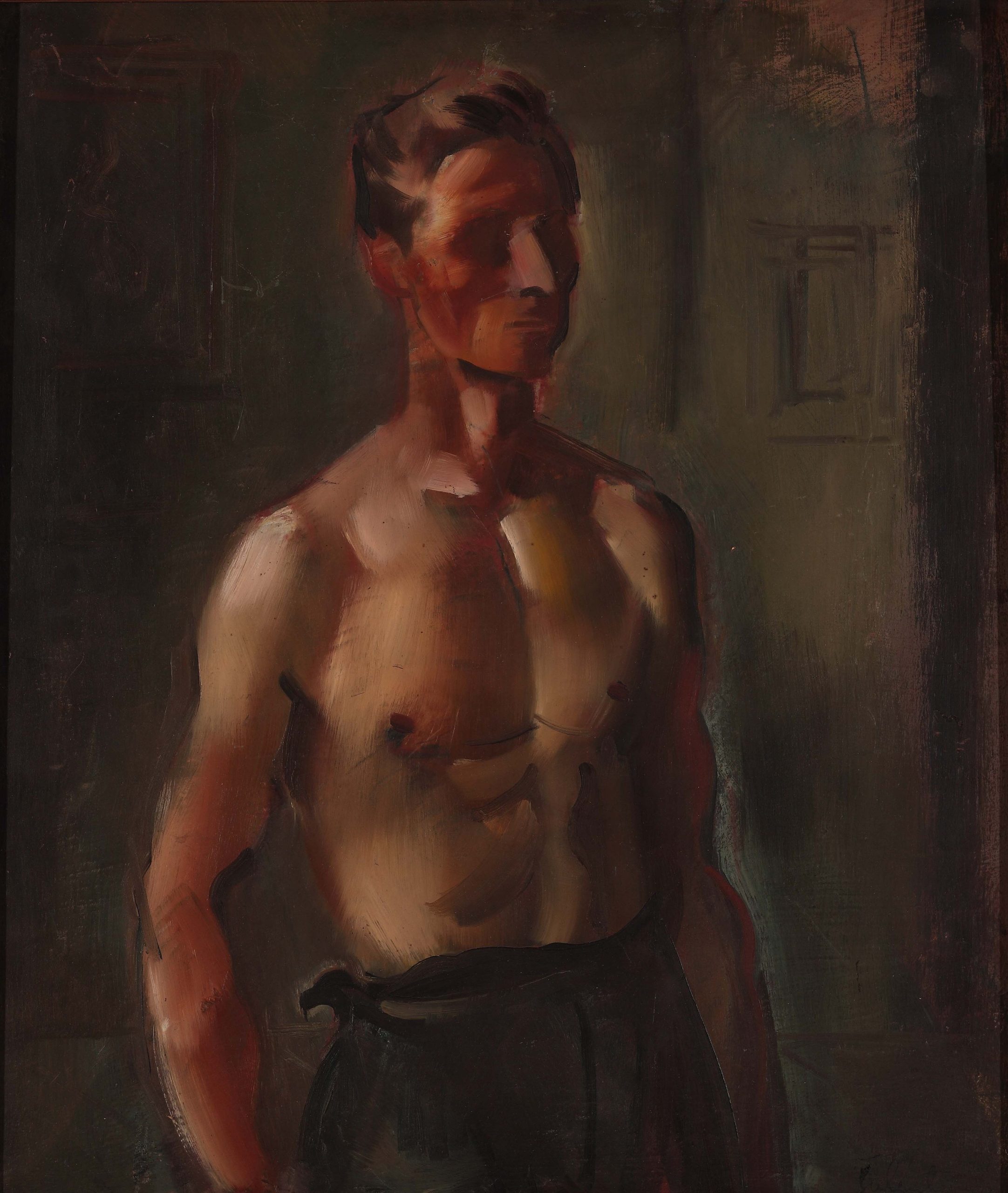
Zlatko Šulentić, Worker, 1934

Zlatko Šulentić
Worker, 1934
oil on plywood
45.5 x 38.4 cm
MG-1117

Zlatko Šulentić (Glina, 1893 – Zagreb, 1971) received his artistic training at the Provisional Advanced School of Arts and Crafts in Zagreb and at the Munich Academy, which he attended from 1911 to 1914. He was a prominent educator, notably at the Academy of Fine Arts in Zagreb. His oeuvre is primarily marked by a striking use of colour, ranging stylistically from expressionist tendencies to intimism, and occasionally approaching lyrical abstraction. He first showed his work at the landmark inaugural exhibition of the Croatian Spring Salon in Zagreb.
Šulentić’s Worker (1934) presents the torso of an anonymous man against an almost entirely darkened background. Departing from the rich colouration of his earlier work, this painting marks an early move away from chromatic intensity and ushers in a new phase of colouristic intimism. In the absence of an expressive palette, the muted tones convey the sitter’s personality, revealing character more through feeling than through visual detail.

Text: Lovre Mrduljaš © National Museum of Modern Art, Zagreb
Photo: Goran Vranić © National Museum of Modern Art, Zagreb
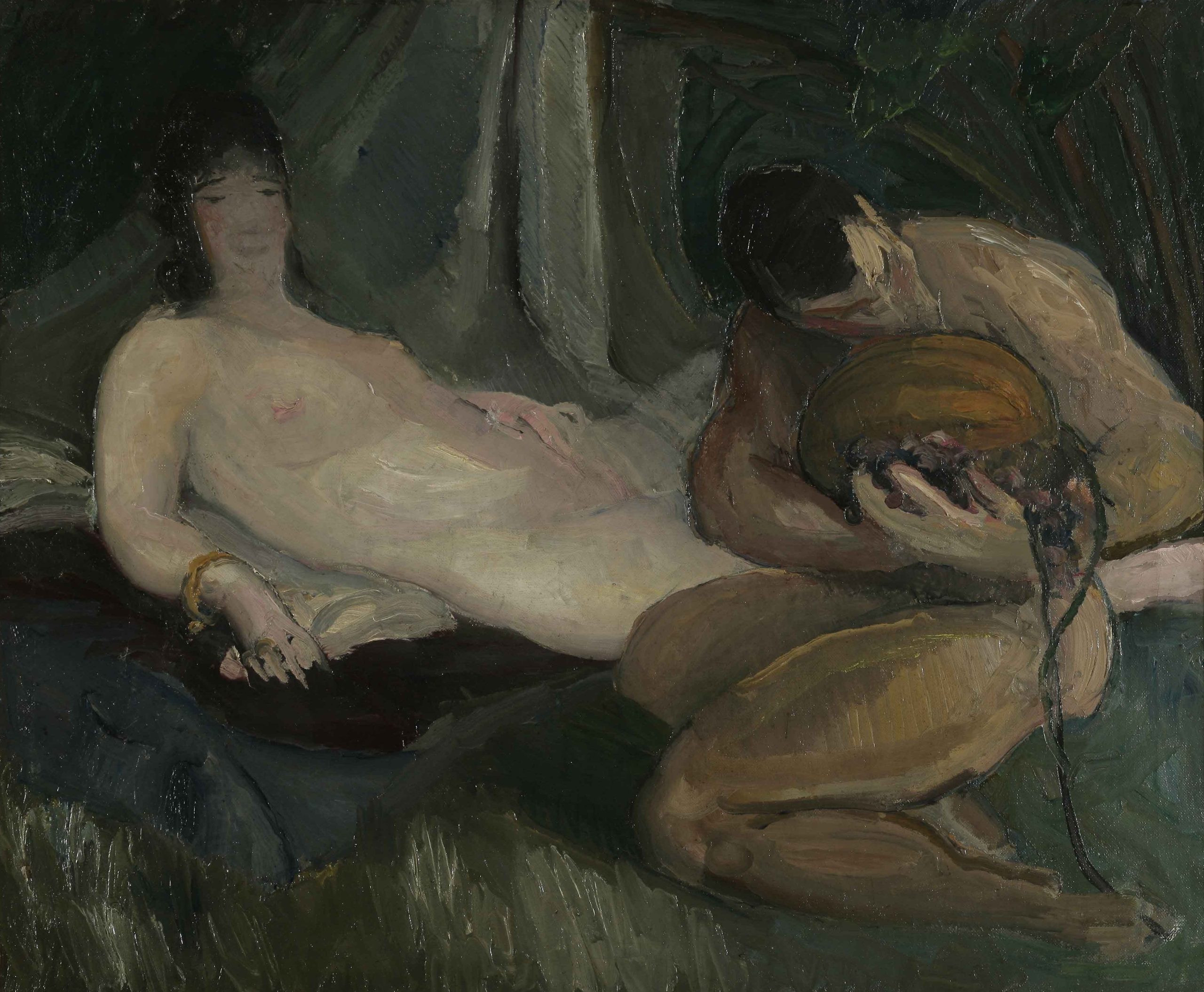
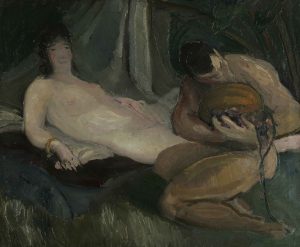
Miroslav Kraljević, Ripe Fruit, 1912

Miroslav Kraljević
Ripe Fruit, 1912
oil on canvas
53.8 × 65 cm
MG-2423

Miroslav Kraljević (Gospić, 1885 – Zagreb, 1913) is one of the key Croatian painters of the early 20th century, whose work is closely linked to the modernist movements of European art. He studied in Vienna and Munich, where he was part of the „Munich Circle“ with Josip Račić (Zagreb, 1885 – Paris, 1908), Oskar Herman (Zagreb, 1886 – 1974), and Vladimir Becić (Slavonski Brod, 1886 – Zagreb, 1954). Despite his short life, Kraljević’s work marked the transition of Croatian painting toward modernism through a vibrant use of color, freer brushwork, and a pronounced sense of atmosphere. His art clearly reflects a synthesis of European Impressionism, Post-Impressionism, and Art Nouveau, infused with personal sensitivity and an intimate tone.

The painting „Ripe Fruit“ (1912) belongs to Kraljević’s thematic circle of nudes and intimate compositions. At the center of the scene lies a nude woman on a white bed, depicted in a calm, almost classical pose, while beside her sits a male figure holding a bowl brimming with ripe fruit. Opposed figures convey symbolic tension: the woman exudes softness and passivity, while the robust man is turned away, focuses solely on the fruit in his hands. Kraljević masterfully merges the motif of the nude with that of still life, where the fruit symbolically accentuates the sensuality and vitality of the scene. The painting reveals his inclination toward psychologically charged, almost symbolist compositions in which the sensual body and expressive color palette merge into a unified artistic expression.

Text: Luciana Fuks, Curator Trainee, National Museum of Modern Art © National Museum of Modern Art, Zagreb
Photo: Goran Vranić © National Museum of Modern Art, Zagreb
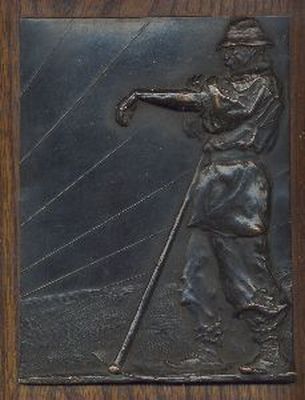
Robert Frangeš-Mihanović, Digger, 1906

Robert Frangeš-Mihanović
Digger, 1906
bronze casting
247 x 192 mm
MG-585

Robert Frangeš–Mihanović (Srijemska Mitrovica, 1872 – Zagreb, 1940) was a pioneering sculptor whose free and innovative approach anticipated the Impressionist and Symbolist currents of modern art at the turn of the century. His mastery of technique, keen sensitivity to materials, particularly bronze, and painterly treatment of relief established him among the foremost European artists of his time. He achieved international recognition for his plaques and medals.
Frangeš’s medals and plaques featuring animal and figurative motifs (Bull and Stallion, 1895; Winegrowers, 1900) heralded the advent of modern Croatian medallic art. The young artist was influenced by the leading figures of French Art Nouveau medal-making, Jules-Clément Chaplain and Oscar Roty, who advanced the medium by reintroducing the Renaissance plaque form and enhancing its allegorical content, thereby further establishing the medal as a legitimate work of art.
Frangeš–Mihanović’s Digger (1906) belongs to the artist’s series of figurative plaques. The relief shows a digger in the foreground, occupying the right side of the composition. His profile faces the observer as he gazes into the distance. With one hand outstretched, scattering seeds into fertile soil, the figure is set against a background illuminated by rays of sunlight. The Digger incorporates metaphorical elements that evoke the concept of a new beginning.

Text: Lovre Mrduljaš © National Museum of Modern Art, Zagreb
Photo: Goran Vranić © National Museum of Modern Art, Zagreb
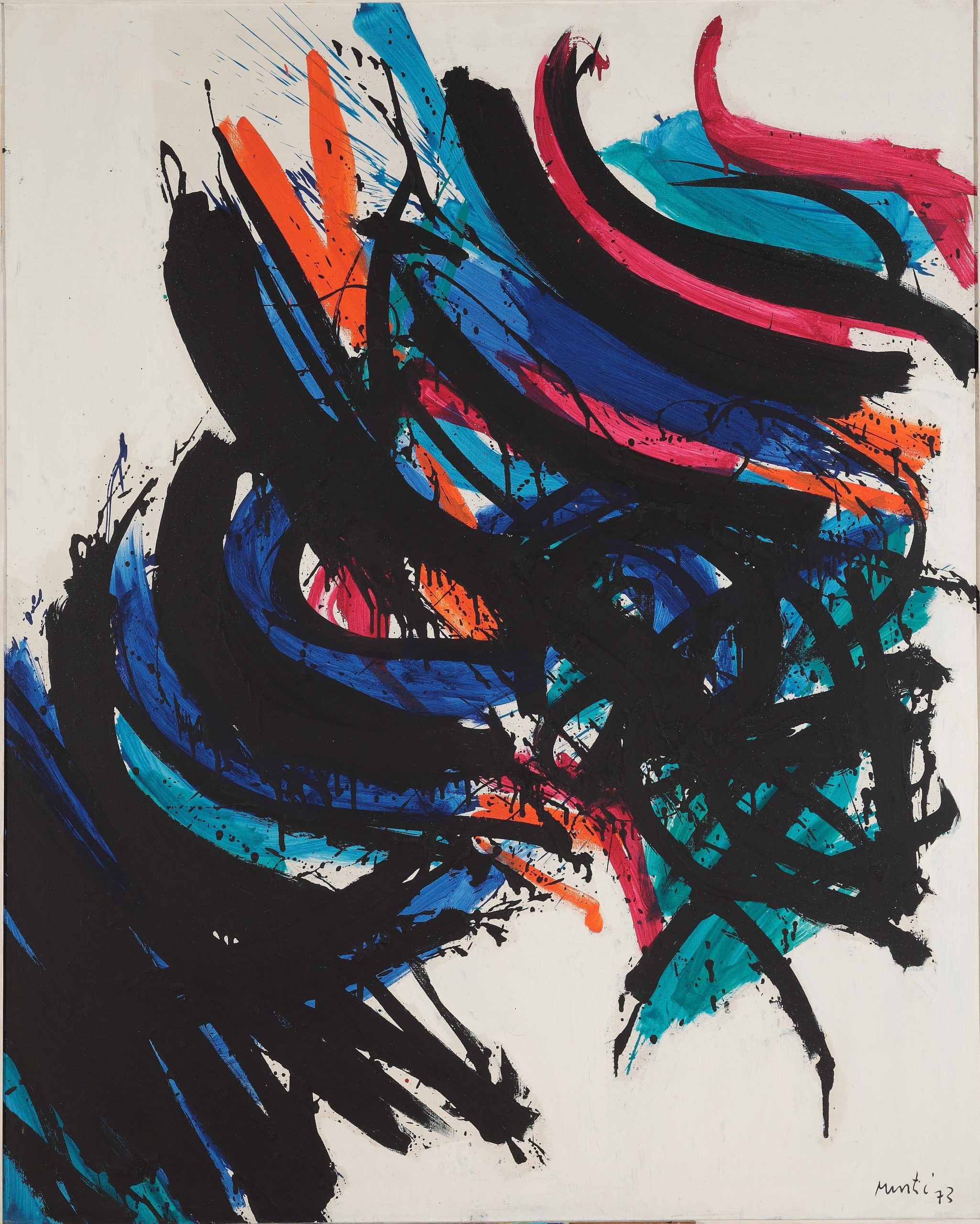
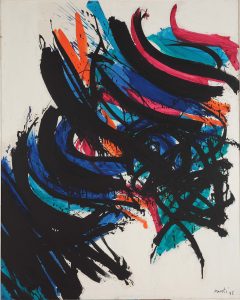
Edo Murtić, March, 1978


Edo Murtić
March, 1978
oil on canvas
164 x 130 cm
MG-3321

Starting from a reduction of reality into landscapes during the 1950s—along the lines of lyrical abstraction and tachism, Edo Murtić (1921–2005) in the early 1960s developed a distinctive abstract painterly style of dynamic gesture and intense color, becoming the most influential and best-known artist of high modernism in socialist Yugoslavia, with a respected international career. In the early 1950s he met Jackson Pollock in the United States, which opened a new freedom in his painting. Unlike Pollock’s splashed automatism of action painting, Murtić works through coloristic expression.
The painting „March“  represents Murtić’s highly evolved version of abstract expressionism at the close of the high-modernist era. Through coloristic action and emphatic diagonal calligraphy he creates an expressive symphony that V. Maleković called a “coloristic sarabande”—a passionate Spanish dance in 3/4 time. The composition’s pronounced drama is underscored by the counterpoint between black diagonal lines and the splashed, condensed knots of red, orange, and light- and dark-blue spread across the composition’s oblique field.
Murtić studied with leading artists of his time at the academies in Zagreb and Belgrade (P. Dobrović, Lj. Babić). A committed socialist, he took part in the anti-fascist People’s Liberation War, and later, as a prominent cultural figure, advocated democratic values. His career, marked by exceptional intensity and influence, spanned sixty years; after a turn to figuration in the 1980s, he remained an abstract painter with a diverse oeuvre until his death.

Text: Željko Marciuš, museum advisor of the National Museum of Modern Art © National Museum of Modern Art, Zagreb
Photo: Goran Vranić © National Museum of Modern Art, Zagreb
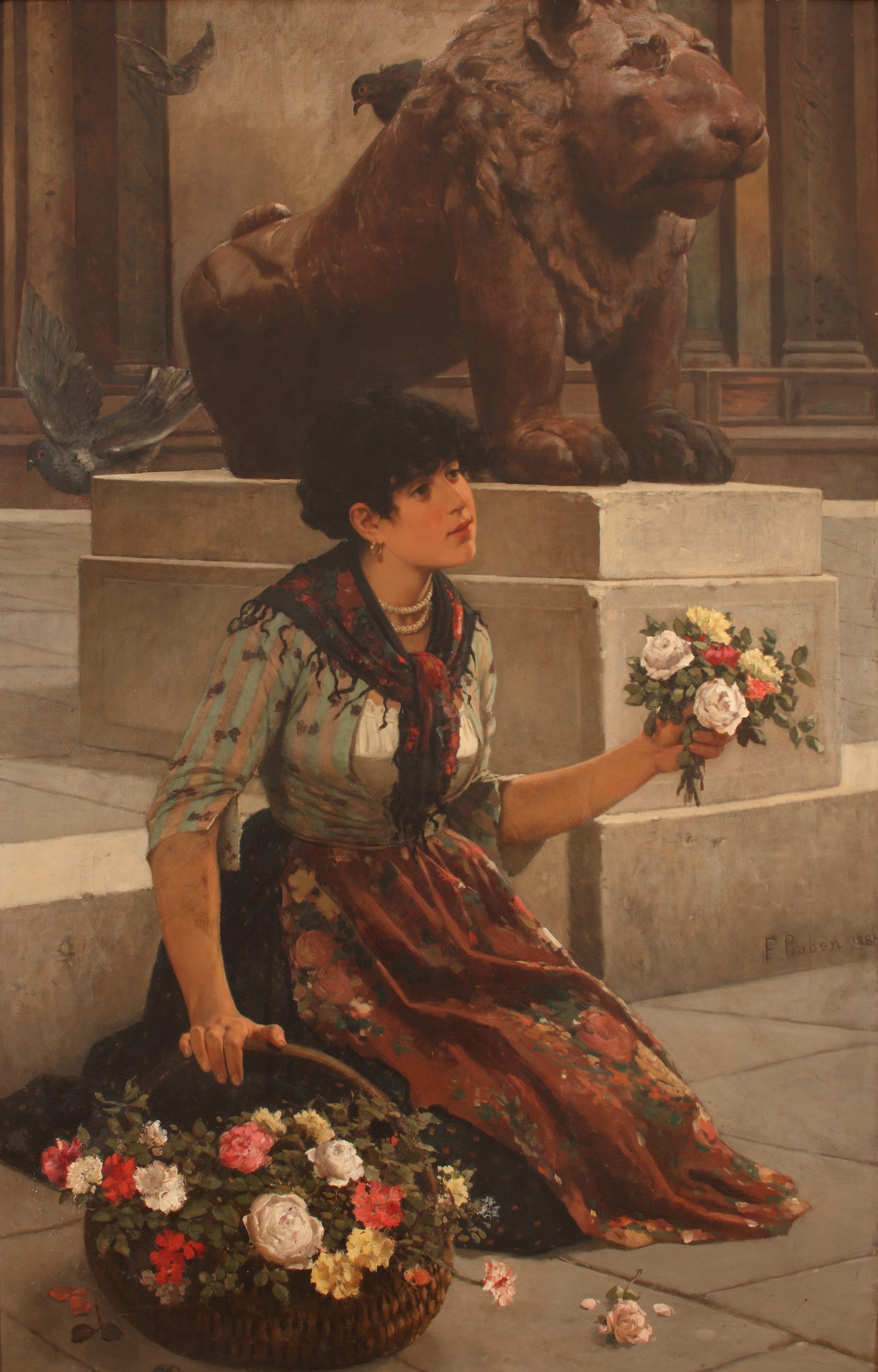
Franz Leo Ruben, Venetian Flower Seller, 1884

Franz Leo Ruben
Venetian Flower Seller, 1884
oil on canvas
155 × 105.3 cm
MG-150

Franz Leo Ruben’s “Venetian Flower Seller” (1884) belongs to the pleasing genre painting typical of the last quarter of the 19th century. Executed in a realistic manner and solid technical standard, the vertically oriented, gently melancholic, aestheticized scene combines the charm of brightly colored flowers; both in the basket and the bouquet, with a young commoner draped in a scarf, watched over by a lion sculpture, the symbol and attribute of Venice’s patron, Saint Mark the Evangelist.

Franz Leo Ruben (Czech: František Ruben) was born in Prague, the son of the German painter Christoph Christian Ruben (1805–1875), director of the Academy of Fine Arts first in Prague and subsequently in Vienna, who studied painting with Peter von Cornelius (1783–1867) at the Düsseldorf Academy from 1823 to 1826. Franz Leo Ruben himself studied at the Vienna Academy, where he also exhibited frequently. Following Europe’s fascination with Italy within the phenomenon of the “Grand Tour”, he like many contemporary intellectuals set out to travel through Italy, painting and documenting motifs from Italian cities and landscapes, and spending extended periods in Rome and Venice. This was a common trajectory for intellectuals and artists of the time, captivated by Italy’s aura and drawn by the magnetic pull of a lore in which fact, myth, and legend intertwined.

Text: Dr. Ivana Rončević Elezović, Senior Curator, National Museum of Modern Art, Zagreb © National Museum of Modern Art, Zagreb
Photo: Goran Vranić © National Museum of Modern Art, Zagreb
Vlado Jakelić, Shoe Shiners, 1977

Vlado Jakelić
Shoe Shiners, 1977
oil on canvas
100 x 130 cm
MG-3932

Vlado Jakelić (Prugovo, near Split, 1943) began his artistic education at the School of Applied Arts in Split and earned a degree in painting from the Academy of Fine Arts in Zagreb in 1962, studying under Antun Mezdjić. He was an associate in Krsto Hegedušić’s Master Workshop from 1967 to 1972 and a member of the Biafra Group from 1972 to 1974. From 1975, he worked as a production painter for Zagreb Television, and since 1978 he has worked as a freelance artist.

After a brief surrealist phase between 1966 and 1967, Jakelić explores abstraction, turning to gestural techniques, Informel, and Expressionism. From 1971, he introduced a recurring motif and elements of hyperrealist poetics, developing a distinctive realistic figuration that blends photographic objectivity with a personal approach to create an intimate atmosphere. His work focuses on Zagreb and the human figure in the urban landscape, depicted in an expressive-realistic style that emphasises detail, structure, materiality, diffuse light, and the greyness of metal on rainy days. By the late 1970s, his palette had lightened, capturing both the atmosphere and the lived reality of the city’s public spaces.

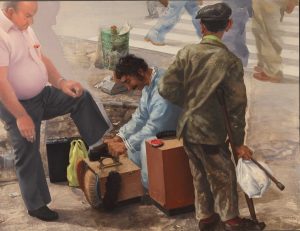
Jakelić’s Shoe Shiners (1977) marks a shift towards a brighter palette and spatial openness in the urban environment. This effect is achieved with the light shades of red, blue, and yellow. The scene depicts a shoe shiner at work and the gentleman whose shoes he is shining, with the cleaner partially obscured by a young onlooker. Through this detail, Jakelić conveys the spontaneity of city life, while the luminous colours evoke the ease and lightness of everyday experience.

Text: Lovre Mrduljaš © National Museum of Modern Art, Zagreb
Photo: Goran Vranić © National Museum of Modern Art, Zagreb
Marta Ehrlich, Autumn Day at Dusk, 1970

Marta Ehrlich, Autumn Day at Dusk, 1970

Marta Ehrlich

Autumn Day at Dusk, 1970

Oil on canvas

49 × 64 cm

MG-3029


Marta Ehrlich (Zagreb, 1910 – 1980) was a prominent Croatian painter of the 20th century. She graduated in painting from the Academy of Fine Arts in Zagreb in 1934 as a private student of Vladimir Becić, and the following year she spent a study period in Paris. In the early phase of her artistic work, she relied on Becić’s painterly influence, but in later years she moved closer to surrealist poetics. She most frequently painted cityscapes, landscapes, interiors, and still lifes, developing an intimate and imaginative painterly expression.bDuring the 1960s, she increasingly devoted herself to ceramics, producing small-scale sculpture, painted tiles, and plates, while in her painting she turned to an abstract mode of expression in the style of Art Informel.

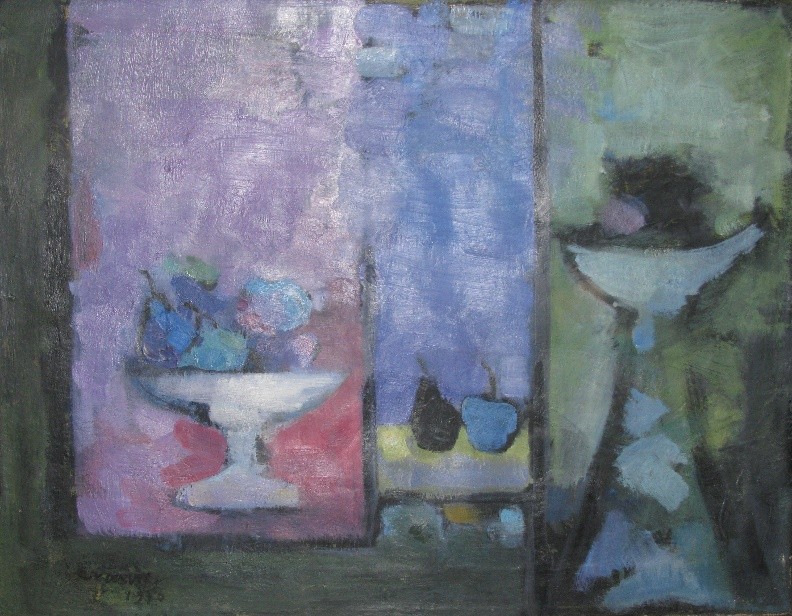
It is precisely this painterly approach that can be recognized in this still life, where the classical motifs of a bowl and fruit are gradually reduced to coloristic planes and abstracted forms. The composition is divided into three parts: on the left, a light shallow bowl with fruit dominates, in which blue and purple tones can be discerned, with a pinkish-purple background. The central part of the painting shows darker fruit forms, while the right side presents an abstractly shaped white vessel set against a greenish background. The entire surface of the painting is built up through layered applications of paint, with visible brushstrokes and rich textures. The coloristic contrasts of purple, blue, green, and black create a sense of poetic and intimate atmosphere, typical of Marta Ehrlich’s oeuvre. The work exudes lyrical abstraction and can be linked to her later development toward abstract expression and Art Informel, while still preserving the recognizable still life motifs that were among the central themes of her artistic interest.


Text: Luciana Fuks, Curatorial Intern © National Museum of Modern Art, Zagreb

Photo: Goran Vranić © National Museum of Modern Art, Zagreb
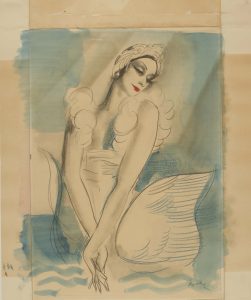
Milivoj Uzelac, Ana Pavlova in Costume (Swan Lake), 1925

Milivoj Uzelac
Ana Pavlova in Costume (Swan Lake), 1925
Watercolour, pastel, cardboard
50 × 35 cm
MG-986

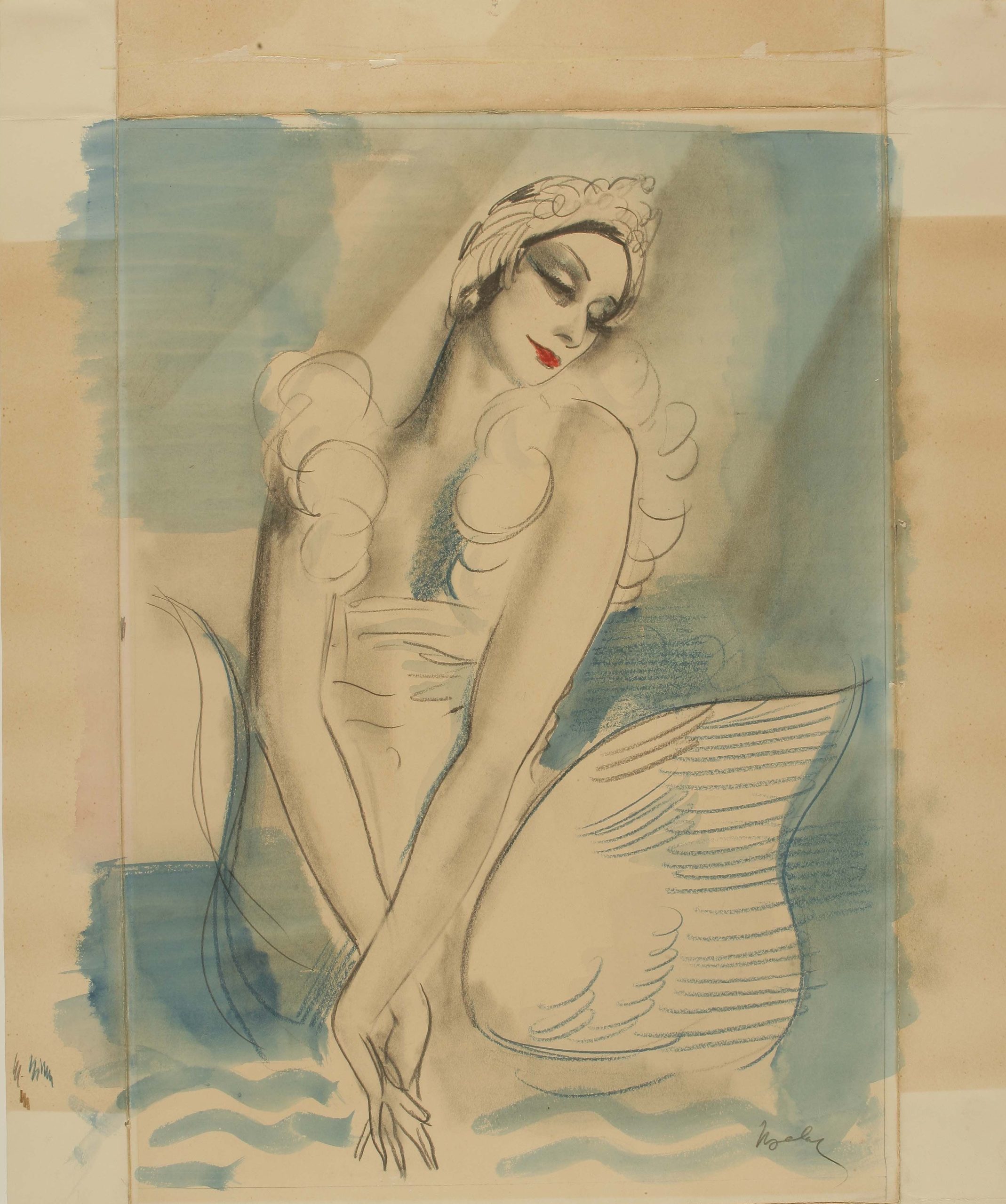
Milivoj Uzelac, one of the most versatile and influential figures of Croatian interwar modernism, merges the elegance of drawing with the softness of watercolour modelling in „Ana Pavlova in Costume“. The portrait of the famous Russian ballerina, depicted in her iconic swan costume, is distinguished by refined lines and an almost sculptural sense of form. With her eyes closed and head gently tilted, the figure exudes introspection, grace, and a sense of elevated stillness, while the accentuated red lips introduce a striking focal point within the delicate chromatic palette.

This drawing reflects Uzelac’s virtuosity in draftsmanship and his enduring interest in figural representation, theatre, and contemporary aesthetics. Having developed a distinctive painterly language in Paris following his early expressionist phase in Prague and Zagreb, Uzelac continually explored the interplay between modernist innovation and classical tradition. In his work with paper media, especially pastel and watercolour, he demonstrated exceptional technical ease and a fine sensitivity to atmosphere, as seen in this composition that fuses precision in line with visual poetry.

Text: Lorena Šimić, Curator / Museum Educator © National Museum of Modern Art, Zagreb
Photo: Goran Vranić © National Museum of Modern Art, Zagreb
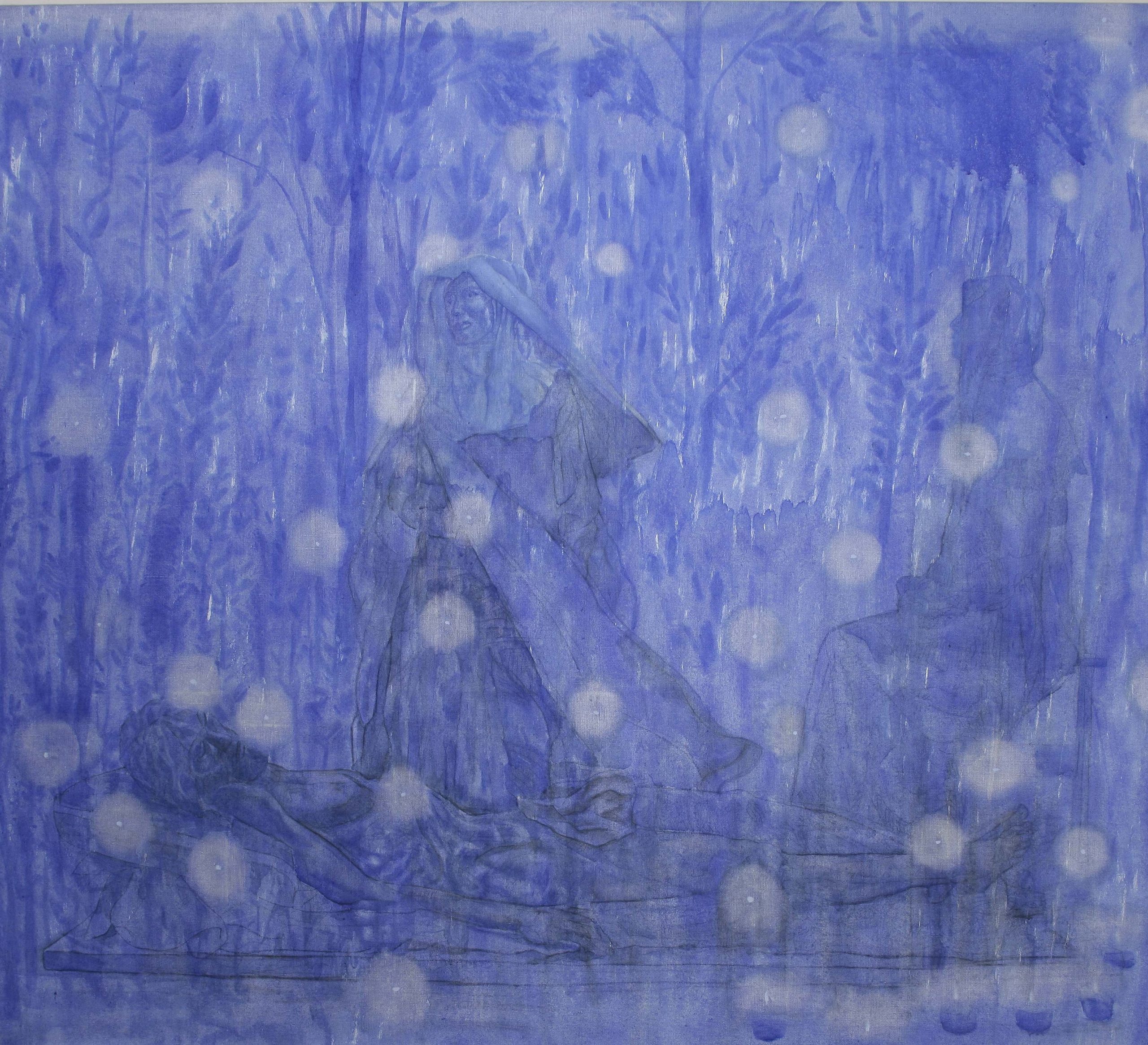
Tomislav Buntak, Meditation – Fireflies in the Garden, 2010

Tomislav Buntak
Meditation – Fireflies in the Garden, 2010
acrylic on canvas
180 x 200 cm
MG-7164

Tomislav Buntak (b. 1971) is one of the most prominent postmodern figurative draughtsmen and painters in Croatia. Quotation is the central principle of his painting practice, which he uses to creatively transform methods and motifs from the visual heritage of humanity, literature, pop culture, and comics, preserving and deepening them in the process. His commitment to figuration and his continuous exploration of painterly and drawing languages endured from a period unfavourable to such expression to a time when it became contemporary, paving the way for new generations of artists. His drawings, and often his paintings, are characterised by two- and three-tone shading. Such multifaceted light-and-shadow arrangements are evident in his painting „Crucifixion“ (2006), where echoes of Mannerism are refracted through Buntak’s postmodern (neo-)mannerist lens. His originality manifests in the restricted tonal palette within individual sections, in the monumentality and pathos of his compositions, in figuration and elongated proportions of the figures, and in the subtle emotional charge of works like „Meditation – Fireflies in the Garden“ (2010). Buntak’s artistic range includes paintings, drawings, wall murals, and site-specific ultraviolet installations. Highlights include exhibitions at MMSU, Rijeka (2004); P.S.1, New York (2005); and the Art Pavilion in Zagreb (2008). He graduated in painting from the Academy of Fine Arts in Zagreb in 1997, in the class of Miroslav Šutej. A recipient of numerous awards, his works are held in major Croatian museums and galleries. Since 2018, he has served as the President of the Croatian Association of Fine Artists (HDLU) and as Dean of the Academy of Fine Arts in Zagreb. His monograph, authored by Branko Franceschi, was published by Fraktura in 2012.

Text: Željko Marciuš, Museum Advisor, National Museum of Modern Art © National Museum of Modern Art, Zagreb
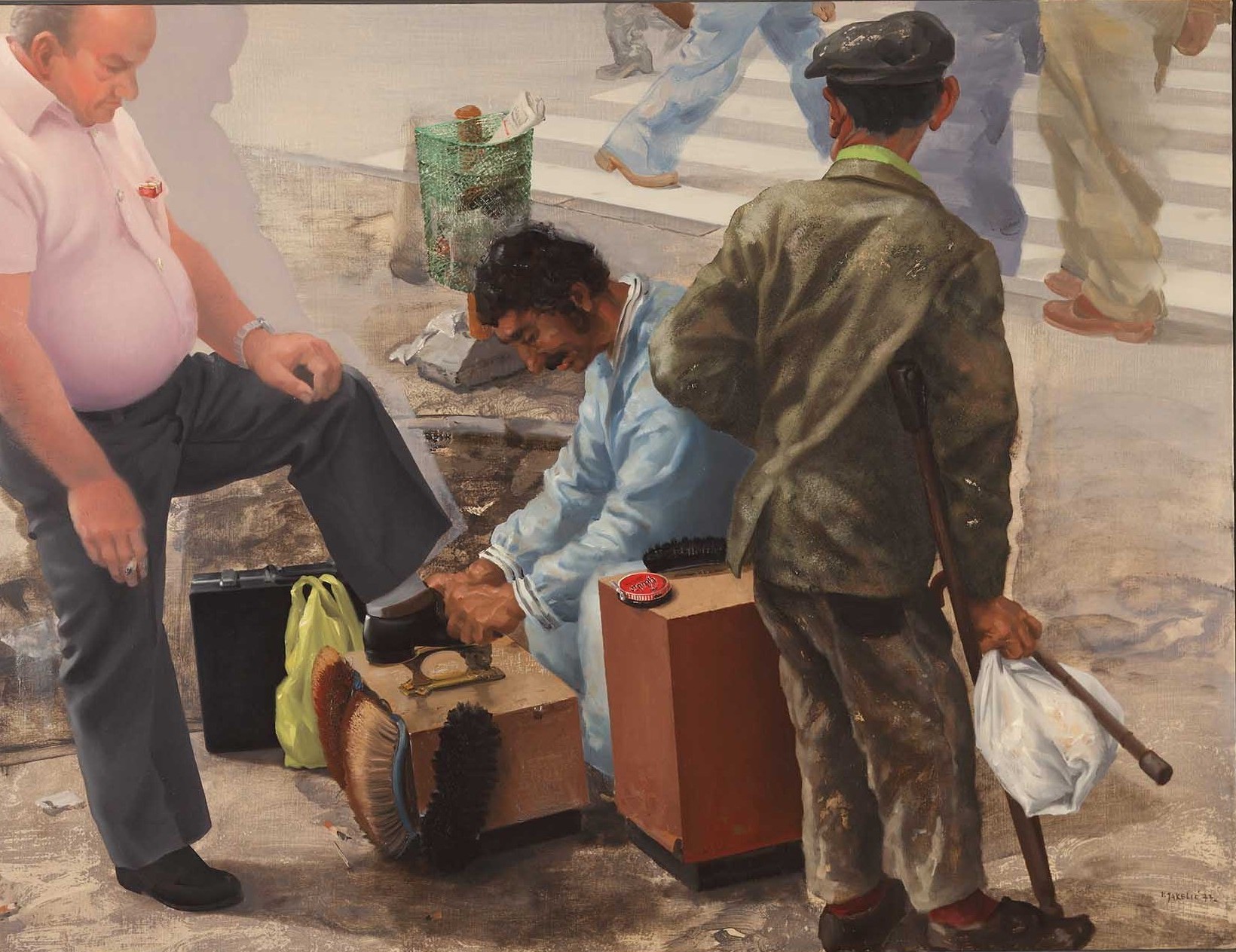
Photo: Goran Vranić © National Museum of Modern Art, Zagreb