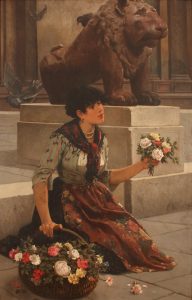
Franz Leo Ruben
Venetian Flower Seller, 1884
oil on canvas
155 × 105.3 cm
MG-150
Franz Leo Ruben’s “Venetian Flower Seller” (1884) belongs to the pleasing genre painting typical of the last quarter of the 19th century. Executed in a realistic manner and solid technical standard, the vertically oriented, gently melancholic, aestheticized scene combines the charm of brightly colored flowers; both in the basket and the bouquet, with a young commoner draped in a scarf, watched over by a lion sculpture, the symbol and attribute of Venice’s patron, Saint Mark the Evangelist.
Franz Leo Ruben (Czech: František Ruben) was born in Prague, the son of the German painter Christoph Christian Ruben (1805–1875), director of the Academy of Fine Arts first in Prague and subsequently in Vienna, who studied painting with Peter von Cornelius (1783–1867) at the Düsseldorf Academy from 1823 to 1826. Franz Leo Ruben himself studied at the Vienna Academy, where he also exhibited frequently. Following Europe’s fascination with Italy within the phenomenon of the “Grand Tour”, he like many contemporary intellectuals set out to travel through Italy, painting and documenting motifs from Italian cities and landscapes, and spending extended periods in Rome and Venice. This was a common trajectory for intellectuals and artists of the time, captivated by Italy’s aura and drawn by the magnetic pull of a lore in which fact, myth, and legend intertwined.
Text: Dr. Ivana Rončević Elezović, Senior Curator, National Museum of Modern Art, Zagreb © National Museum of Modern Art, Zagreb
Photo: Goran Vranić © National Museum of Modern Art, Zagreb