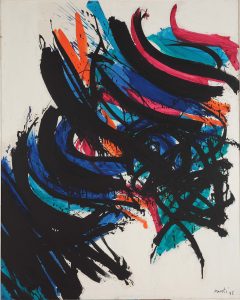
Edo Murtić
March, 1978
oil on canvas
164 x 130 cm
MG-3321
Starting from a reduction of reality into landscapes during the 1950s—along the lines of lyrical abstraction and tachism, Edo Murtić (1921–2005) in the early 1960s developed a distinctive abstract painterly style of dynamic gesture and intense color, becoming the most influential and best-known artist of high modernism in socialist Yugoslavia, with a respected international career. In the early 1950s he met Jackson Pollock in the United States, which opened a new freedom in his painting. Unlike Pollock’s splashed automatism of action painting, Murtić works through coloristic expression.
The painting „March“ represents Murtić’s highly evolved version of abstract expressionism at the close of the high-modernist era. Through coloristic action and emphatic diagonal calligraphy he creates an expressive symphony that V. Maleković called a “coloristic sarabande”—a passionate Spanish dance in 3/4 time. The composition’s pronounced drama is underscored by the counterpoint between black diagonal lines and the splashed, condensed knots of red, orange, and light- and dark-blue spread across the composition’s oblique field.
Murtić studied with leading artists of his time at the academies in Zagreb and Belgrade (P. Dobrović, Lj. Babić). A committed socialist, he took part in the anti-fascist People’s Liberation War, and later, as a prominent cultural figure, advocated democratic values. His career, marked by exceptional intensity and influence, spanned sixty years; after a turn to figuration in the 1980s, he remained an abstract painter with a diverse oeuvre until his death.
Text: Željko Marciuš, museum advisor of the National Museum of Modern Art © National Museum of Modern Art, Zagreb
Photo: Goran Vranić © National Museum of Modern Art, Zagreb