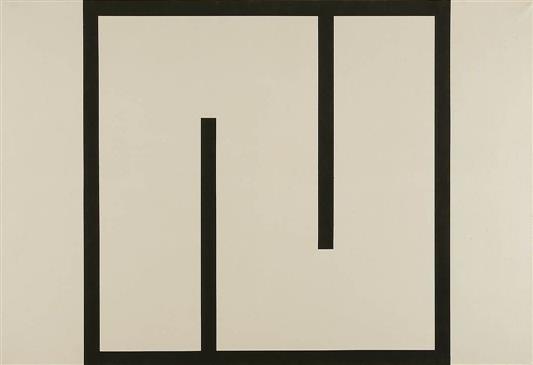
Julije Knifer, Meander, 1978

Julije Knifer
Meander, 1978
Acrylic on canvas, 190 × 130 cm
MG-4002

The meander is an anthology motif in the oeuvre of one of the most important Croatian painters of the 20th century, Julije Knifer (1924–2004). Knifer’s reductive abstraction is characterized by the selection of a single motif and its systematic exploration. The meander—formally determined by the boundaries of the painting, with equal black and white surfaces—became Knifer’s exclusive subject from 1959 onward. The term meander was introduced by Igor Zidić and subsequently adopted by Knifer.
The consistency in repeating the meander’s rhythm, along with the continuity of space and time, defined Knifer’s entire body of work. A pronounced sense of absurdity, paradox, and irony brought him close to the Gorgona Group, of which he was a co-founder and member from its inception in 1959.
Prototypes of the “anti-painting,” as Knifer referred to the meander in his 1960s Notes, represent strict, non-psychological repetitions of his Self-Portraits (1949–1952). These ideas are also present in his drawings—repeated depictions of Stenjevec (1952)—in which the underlying structure of the meander becomes visible. Precedents can also be found in his minimalist compositions from the 1950s.
The 1978 painting bears the title Meander, which it inherently implies through both its visual language and categorization. The meander is emphasized as an ultimate symbol structured in two parts: white, which extends across the painting’s ground, and the final linear motif—also a white meander—executed as a continuous, uniform broad surface, framed by a black line. The resulting visual structure can be described as: white (meander surface), black (border line), white (painting ground).
Within Knifer’s systematic approach of uniform, monotonous rhythm, we can observe influences ranging from the philosophy of existence and the absurd to Kazimir Malevich and Paul Cézanne (Z. Maković). One of his favorite Renaissance artists—by no means coincidentally—was Piero della Francesca.

Text: Željko Marciuš, Muswum Asvisor at the National Museum of Modern Art / National Museum of Modern Art © National Museum of Modern Art, Zagreb
Photo: Goran Vranić © National Museum of Modern Art, Zagreb
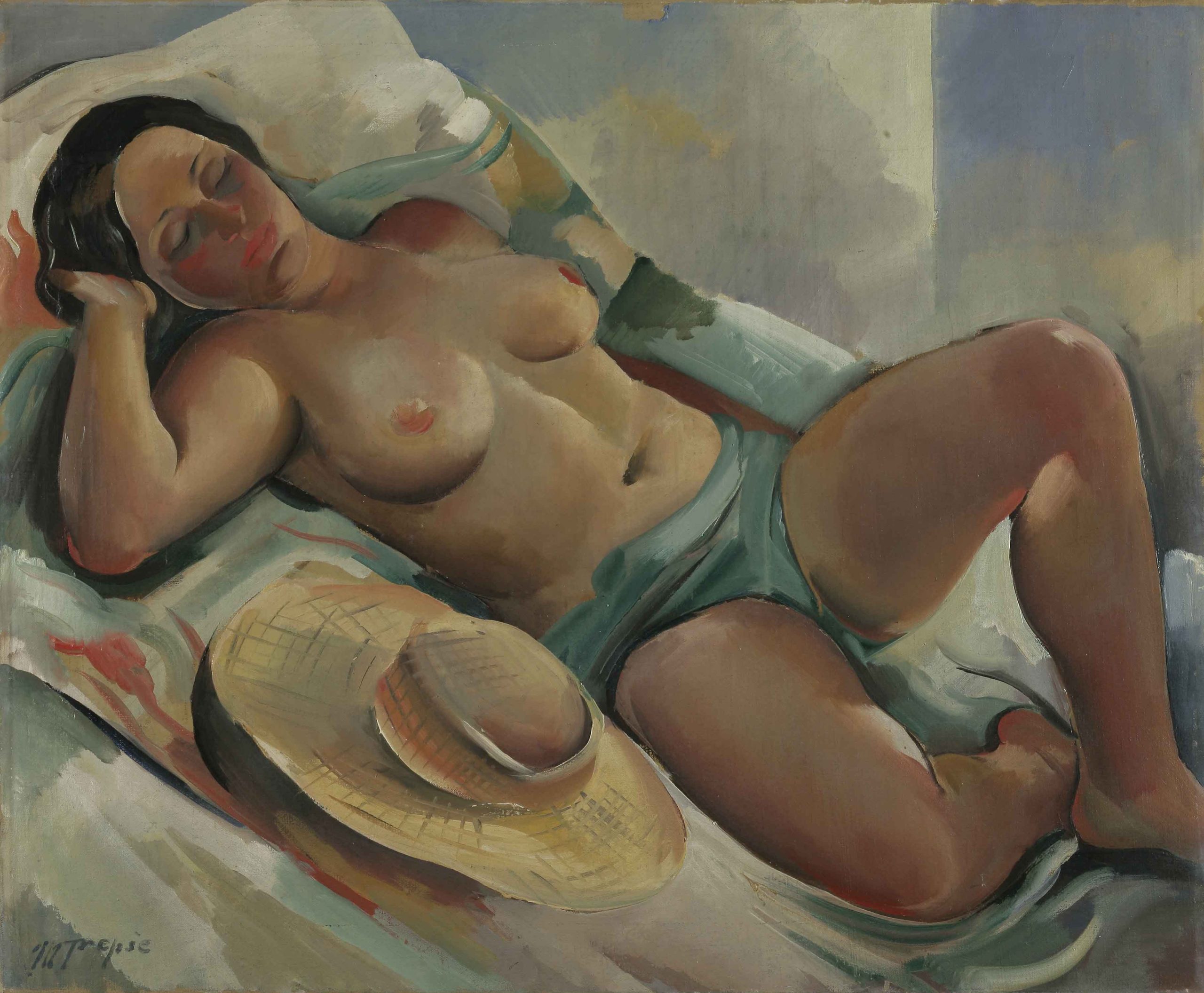
Marijan Trepše, Reclining Female Nude, 1933

Marijan Trepše
Reclining Female Nude, 1933
oil on canvas
66.8 × 80 cm
MG-1092

Marijan Trepše (Zagreb, 1897 – 1964) was one of the key representatives of Croatian Expressionism and interwar modern art. He graduated in painting in Zagreb in 1918, and later continued his training in Prague, where he absorbed the influences of Cézannism, Expressionism, and Cubism. Together with Milivoj Uzelac, Vilko Gecan, and Vladimir Varlaj, he formed the so-called “Prague Four,” a generation of artists who brought radical changes to Croatian art through the Spring Salon exhibitions. In addition to a rich body of work in painting and printmaking, Trepše was also a notable stage designer at the Croatian National Theatre in Zagreb. His work is characterized by remarkable technical skill and a sustained exploration of form, light, and expression.
From the early 1930s onward, the artist increasingly embraced a coloristic approach, shaping the pictorial surface with a freer, more expressive handling of paint. During this period, he produced a series of landscapes, still lifes, portraits, and monumental female nudes, often set within interior spaces. In this context, Reclining Female Nude (1933) represents a characteristic example of Trepše’s mature phase, conceived in the spirit of modernist figurative painting, with recognizable influences of Post-Impressionism and Cubism in the simplification of form and treatment of the pictorial plane. The female figure, depicted at rest, is rendered through rounded contours and a rich green-ochre palette typical of the artist’s coloristic expression. The palette is subdued yet nuanced, while the interplay of warm flesh tones and cooler hues of fabric and shadow creates a harmonious contrast. The figure’s pose, the closed composition, and the presence of personal objects all contribute to the intimate atmosphere of the painting.

Text: Luciana Fuks, Museum Documentation Curator at the National Museum of Modern Art Zagreb
Photo: Goran Vranić © National Museum of Modern Art, Zagreb

Šime Perić, Movement, 1969

Šime Perić
Movement, 1969
oil on canvas, 120 × 135 cm
MG-4502

Šime Perić (1920–2019) was a figurative-abstract fantasist and a classic of Croatian painting. In the 1950s, his oeuvre विकसित from impressionistic, coloristic figuration toward abstraction grounded in action painting and Tachism. Following the dark, painterly Informel phase of the 1960s, the 1970s saw him create works of refined yet intense chromatic expression. By abandoning the rectangular format of the canvas, he occasionally produced paintings in the form of a tondo, invoking through the circular form the archetypal image of the island. From the 1980s onward, he also worked successfully in sculpture.
A semester spent in Paris in 1949 was crucial for his artistic development and intellectual expansion. He studied fresco painting at the École des Beaux-Arts in Paris. He graduated from the Academy of Applied Arts in Belgrade in 1952 and was an associate of the Master Workshop of Krsto Hegedušić until 1957. At the Academy of Fine Arts in Zagreb, he was a professor from 1969 to 1984.
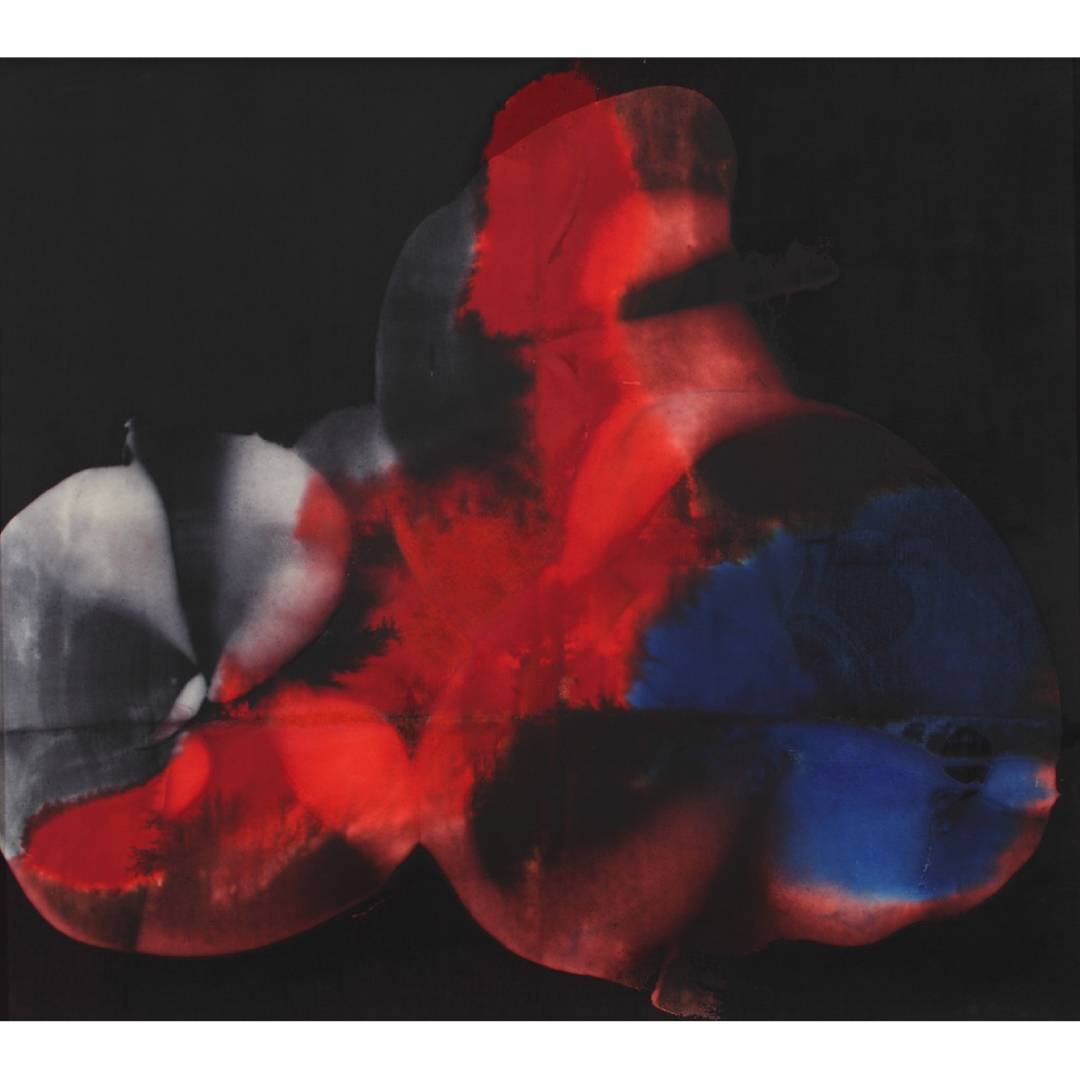
The stain and its transformation into chromatic centrifugal and centripetal movements constitute one of the foundations of Perić’s oeuvre. Movement (1969) is both a chronological and morphological marker of abstract colorism. It is articulated through the gradation of clusters and the formation of a distinctive colored translucency. The work stands at the intersection of physical materiality and a chromatic symphony that absorbs and radiates in all directions, forming a kind of colored amalgam—an amorphous yet shaped core of everything. This color symphony is marked by pronounced elegance and delicacy, with a dispersed, glowing, and in parts absorbing expression achieved against a black ground.
Šime Perić received the “Vladimir Nazor” Lifetime Achievement Award in 1989. In 2003, a monograph on Perić by T. Maroević and M. Šolman was published. In 2007, based on Perić’s designs, the 12th section of the “White Road” was realized in Dubova Park near Labin.

Text: Željko Marciuš, Museum Advisor at the National Museum of Modern Art © National Museum of Modern Art, Zagreb
Photo: Goran Vranić © National Museum of Modern Art, Zagreb
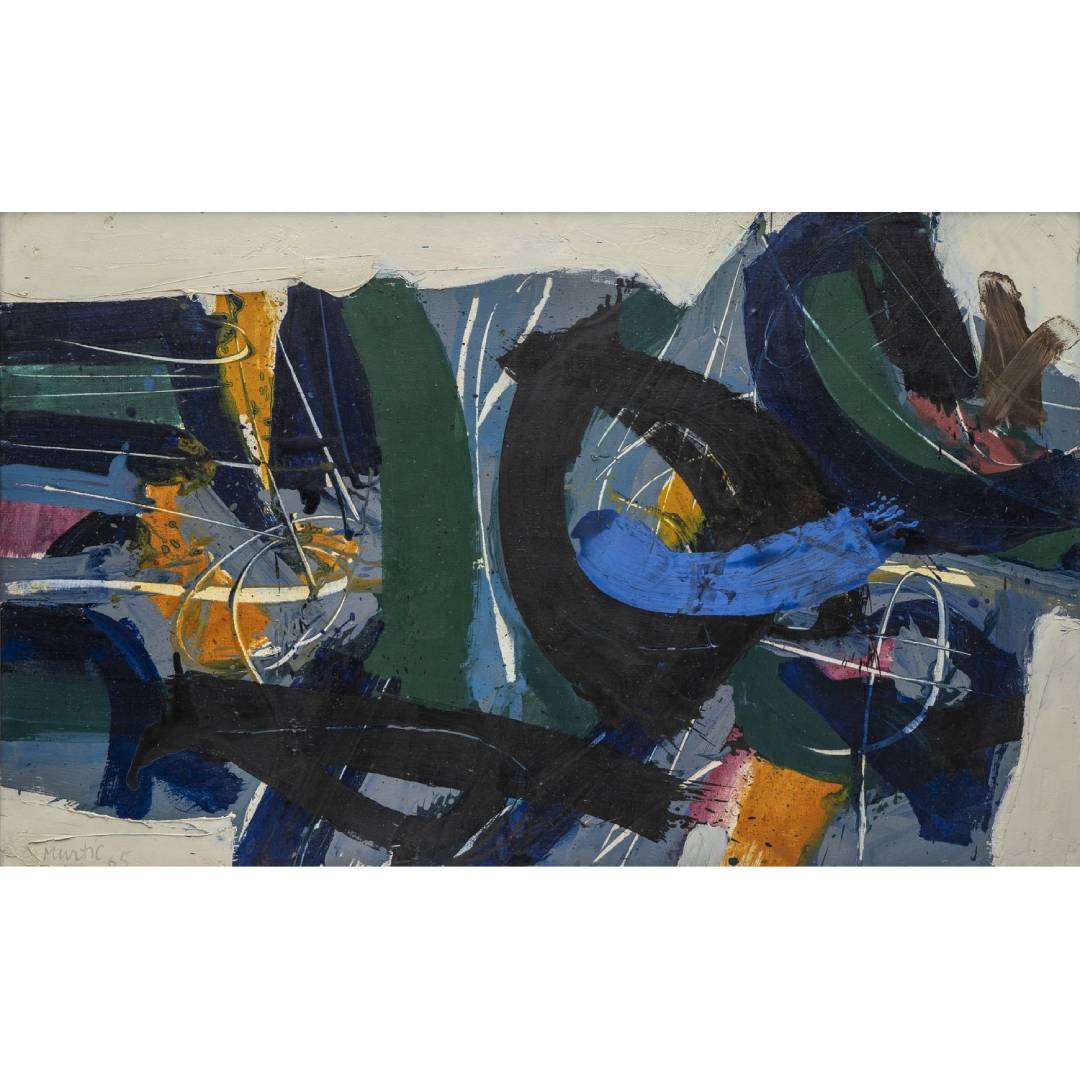
Edo Murtić, Green Serenity, 1965

Edo Murtić
Green Serenity, 1965
oil on canvas
94.5 × 143 cm
MG-2655

Edo Murtić (1921–2005), in Green Serenity (1965), presents a striking example of a richly expansive coloristic confrontation between some of the fundamental visual elements: gesture and color. The entire visual field—apart from the marginal whites, which are partially echoed along the lower edge—is highly dynamic. Everything is in tension: brushstroke, chromatic and achromatic values, gesture. The edges and the core engage in a vivid chromatic interplay and diagonal calligraphy, creating an expressive symphony that Vladimir Maleković describes as a “coloristic sarabande”—a passionate Spanish dance in triple meter (3/4 time).
The pronounced dramatic quality of the composition is emphasized by the counterpoint between broad black strokes and the equally dynamic, dense interweaving of blues and greens, accented by flashes of orange values dispersed throughout the composition’s gestural unity.
Murtić was educated by leading artists of his time at academies in Zagreb and Belgrade. A committed socialist, he participated in the World War II in Yugoslavia, and later, as a prominent cultural figure, became an advocate of democratic values. His career—marked by exceptional intensity and influence—spanned sixty years. After a return to figuration in the 1980s, he remained an abstract painter until his death, characterized by a Picasso-like eclecticism.

Text: Željko Marciuš, Museum Advisor at the National Museum of Modern Art © National Museum of Modern Art, Zagreb
Photo: Goran Vranić © National Museum of Modern Art, Zagreb
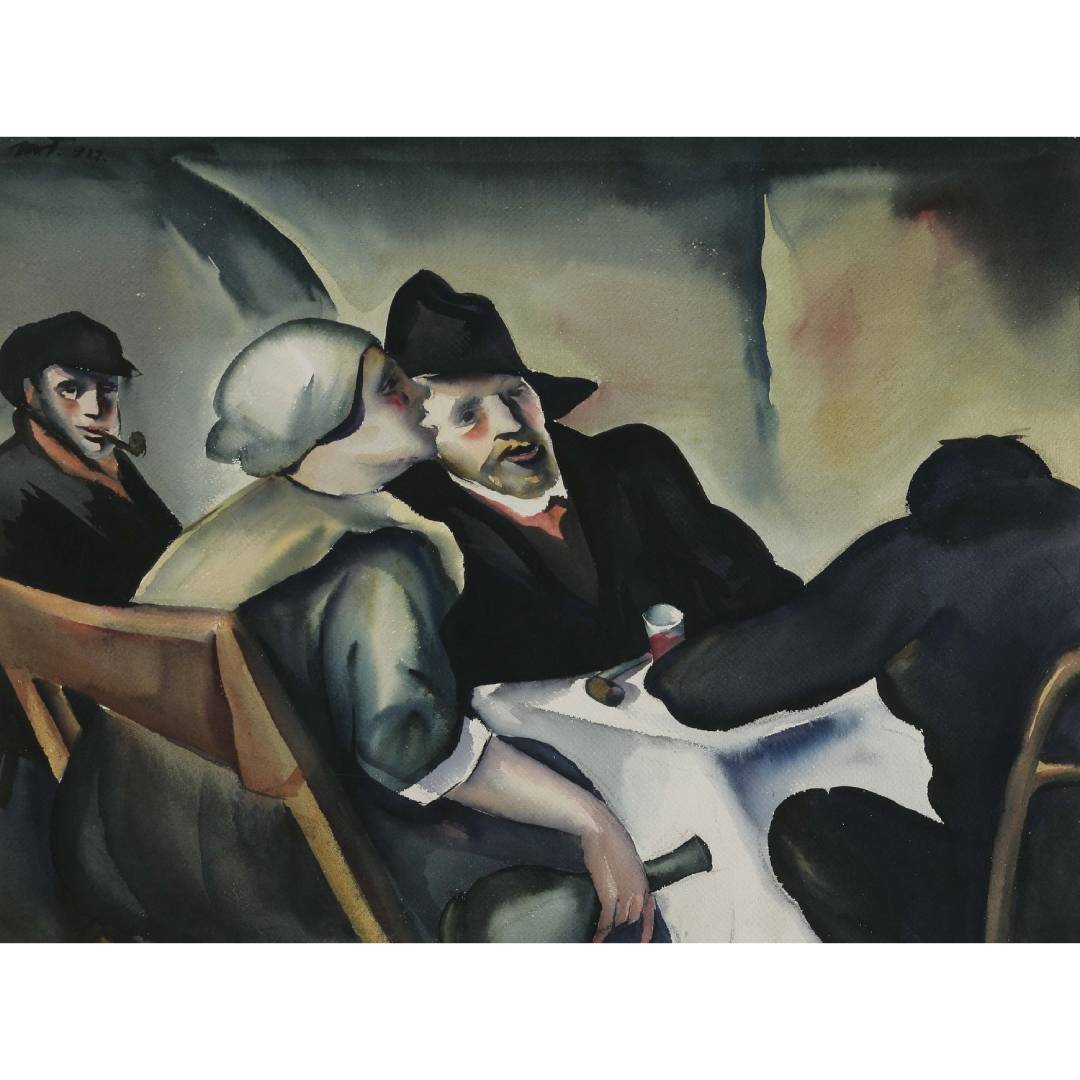
Marijan Trepše, In the Tavern II, 1922

Marijan Trepše
In the Tavern II, 1922
Watercolor on paper
50.5 × 66 cm
MG-1099

In the painting In the Tavern II, Marijan Trepše depicts a scene from everyday popular life: the interior of a tavern where three figures are gathered around a table, while a fourth sits aside, observing the scene from the half-shadow. Although the space is not precisely defined, the watercolor modelling of the figures and the dramatized lighting create a strong atmosphere—dark yet vibrant, almost theatrical. The figures are shaped with clearly cut contours, while their gestures and facial expressions suggest intimacy and ease. A palette of dark tones, with occasional accents of red and white, enhances the impression of eerie intimacy. The depiction is reduced to expressive elements that transcend descriptive reality.
Trepše, one of the key representatives of the so-called Prague Four, in this work synthesizes an expressionist approach to the human figure with a Cézannist conception of space. The rhythm of the composition, the positions of the bodies, and the diagonal tensions of the table also reveal Cubist influences, while the distinctive, almost stylized treatment of volume in watercolor confirms the artist’s mastery of this medium. In the typical spirit of Croatian Expressionism, the painting does not merely depict a scene—it interprets it and offers an emotional commentary.
During the 1920s Trepše frequently painted scenes set in taverns, cabarets, and urban interiors, where emotions and psychological tensions are intensified through pose, composition, and contrasts of light. In the Tavern II reflects this thematic interest as well as the technical maturity of an artist who was already developing a recognizable personal style.
Marijan Trepše (1897–1964) was one of the most significant Croatian painters, printmakers, and scenographers of the interwar period, known for his expressionist idiom and his activity within the Prague Four. He trained in Zagreb, Prague, and Paris, and in his work combined Cézannism, Expressionism, and Neoclassical tendencies, creating striking portraits, watercolors, and coastal and urban scenes. As a long-time scenographer at the Croatian National Theatre, he designed several hundred stage sets, leaving a profound mark on Croatian theatre and visual arts.

Text: Lorena Šimić Majić, curator / museum educator at the National Museum of Modern Art © National Museum of Modern Art, Zagreb
Photo: Goran Vranić © National Museum of Modern Art, Zagreb
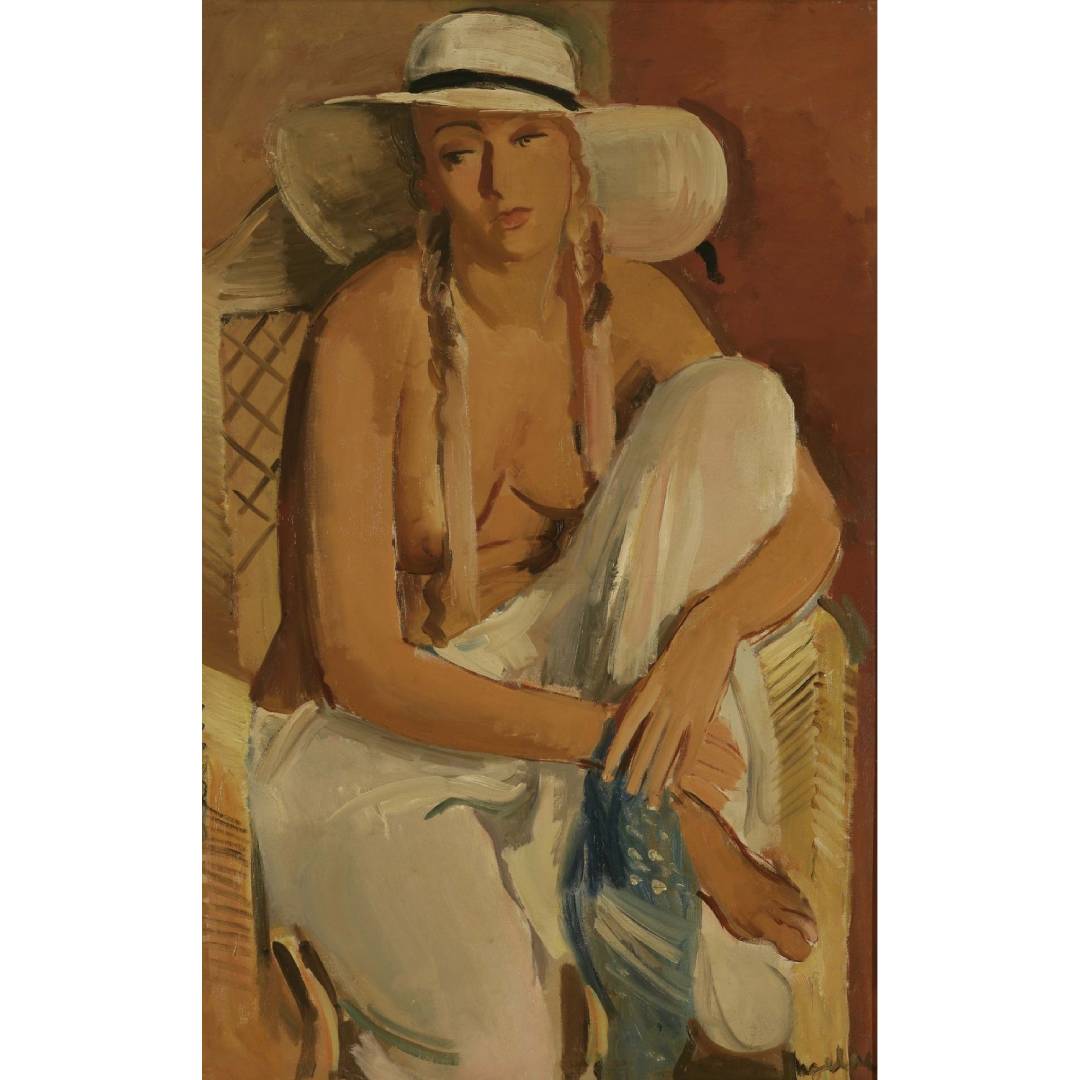
Milivoj Uzelac, Femme avec Chapeau, 1928

Milivoj Uzelac
Femme avec Chapeau, 1928
oil on canvas
100 × 65 cm
MG-997

Milivoj Uzelac (Mostar, 1897 – Cotignac, France, 1977) was one of the key painters of Croatian modernism, whose oeuvre developed in close dialogue with contemporary European artistic movements. After studying in Banja Luka and Zagreb, he continued his training in Prague, where he associated with Vilko Gecan (Kuželj near Brod na Kupi, 1894 – Zagreb, 1973), Marijan Trepše (Zagreb, 1897 – 1964), and Vladimir Varlaj (Zagreb, 1895 – 1962). Together they represented a new expressionist tendency in Croatian art and are often referred to as the Prague Four.
After a brief period spent in Zagreb, Uzelac moved to France in 1923, where he continued to develop his artistic practice in dialogue with then-current movements such as Fauvism, Expressionism, and Cubism. Although he lived and worked abroad, he continued to exhibit regularly in Croatia, exerting a strong influence on the new generation of Croatian painters of the interwar period.
Uzelac’s artistic production in France after the 1930s is marked by a Fauvist sensitivity to colour and an expressionist emotional intensity. The painting Femme avec Chapeau (1928) is a striking example of a work that synthesizes French artistic models with the painter’s own distinctive style. The composition presents a monumentally shaped female figure wearing a white hat, seated in an armchair in a relaxed pose, her gaze turned away from the viewer. The composition is simple yet dynamic, animated by free brushstrokes and a rich palette of warm and cool tones.
The study of works by French masters such as Henri Matisse (Le Cateau-Cambrésis, 1869 – Nice, 1954) and André Derain (Chatou, 1880 – Garches, 1954) left a noticeable mark on Uzelac’s paintings of this period. In this work, their influence can be seen in the free treatment of colour and the pronounced voluminosity of the figure.

Text: Luciana Fuks, Curator for Museum Documentation at the National Museum of Modern Art © National Museum of Modern Art, Zagreb
Photo: Goran Vranić © National Museum of Modern Art, Zagreb
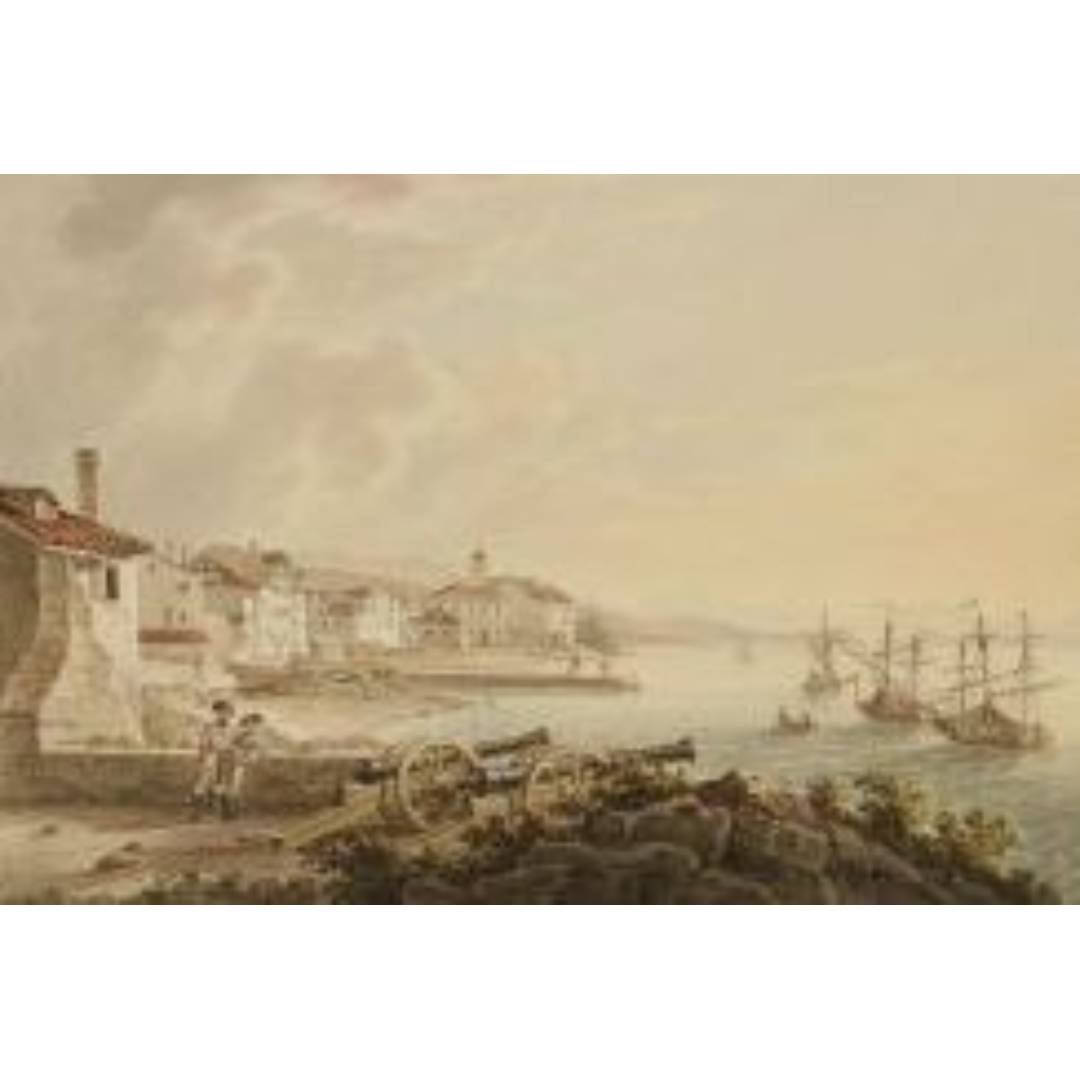
Franz Jaschke, Rijeka, around 1815

Franz Jaschke
Rijeka, around 1815
watercolour, ink, pen, paper
44.1 × 63.5 cm
MG-40

Franz Jaschke (Rosenthal near Kłodzko, 1775 – Vienna, 1842), an Austrian painter born in Rosenthal, left a profound mark on the artistic depiction of Croatian landscapes and urban spaces at the beginning of the 19th century. He studied at the Vienna Academy of Fine Arts from 1794, where he acquired strong foundations in classical aesthetics, particularly within the framework of Austrian topographical veduta painting. As court painter to Archdukes Ludwig and Rainer, Jaschke travelled through Croatian regions on several occasions—especially in 1807, 1808 and 1810. During these journeys he recorded landscapes, towns and inhabitants in watercolours and drawings that possess great documentary value as well as high artistic quality. His works include views of the fortresses of Gradiška and Brod, vistas of Trsat and Rijeka, and natural landmarks such as the source of the Una River and the Plitvice Lakes.
Jaschke’s watercolour depicting the Rijeka waterfront from the early 19th century belongs to his topographical veduta oeuvre, shaped within the Viennese classical tradition. The composition is clearly organized in spatial planes: in the foreground a fortification with cannons and military figures is prominently displayed, while the middle ground develops the urban structure of the city along the coast. The architecture is simplified yet precisely defined, with the verticals of church towers emphasized along the horizon. The palette is restrained, based on warm ochres and grey-blue tonalities, with soft, gradual transitions characteristic of the watercolour technique. Even, diffused light unifies all planes of the composition and deepens the impression of spatial atmosphere. The presence of ships in the harbour further emphasizes Rijeka’s maritime and commercial role as a key coastal centre.

Text: Luciana Fuks, Curator for Museum Documentation Affairs, National Museum of Modern Art © National Museum of Modern Art, Zagreb
Photo: Goran Vranić © National Museum of Modern Art, Zagreb
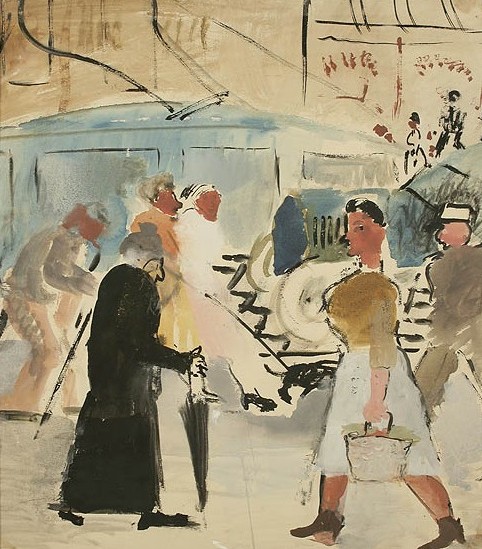
Kamilo Tompa, On the Street, 1931

Kamilo Tompa
On the Street, 1931
watercolor on paper
58.5 × 52 cm
MG-2517

The watercolor On the Street by Kamilo Tompa presents a vivid scene of urban bustle, shaped by the free and expressive brushstrokes characteristic of his artistic language. In the foreground, figures of pedestrians in motion stand out—a woman with an umbrella, a woman carrying a basket, a worker in uniform—whose dynamic arrangement and strong contours create a sense of rhythm and continuous movement.
The composition is further animated by the tram in the background, its volume suggested through broad, almost sketch-like planes of blue and grey. Overhead electric wires and fragments of buildings clearly situate the scene within an urban environment. The artist avoids precise narration and realistic detail, relying instead on condensed expression and chromatic accents to evoke the atmosphere of haste and the transience of everyday city life.
Although the figures are only indicated, they retain their individuality. Each is shaped with swift yet deliberate strokes, conveying distinct character and gesture. This economy of expression, intrinsic to watercolor as a medium, enables Tompa to achieve immediacy of impression and a compelling synthesis of observation and personal interpretation of urban life.
Kamilo Tompa (Samobor, 1903 – Zagreb, 1989) was a Croatian painter, printmaker, and stage designer, and one of the more versatile artists of his generation. He graduated in 1926 from the Academy of Fine Arts in Zagreb and subsequently studied art history in Paris, where he encountered new artistic tendencies that would influence the development of his later work. Initially close to the socially engaged poetics of the Zemlja group, Tompa moved over the years between figuration and abstraction, incorporating elements of Surrealism and structural abstraction. Alongside his painting practice, he made a significant contribution to stage design, particularly as head of the scenography department at the Academy of Dramatic Art in Zagreb, and through his pedagogical and theoretical work on visual expression.
His diverse oeuvre testifies to a continual openness to experimentation and the exploration of visual language.

Text: Lorena Šimić Majić, Curator / Museum Educator at the National Museum of Modern Art © National Museum of Modern Art, Zagreb
Photo: Goran Vranić © National Museum of Modern Art, Zagreb
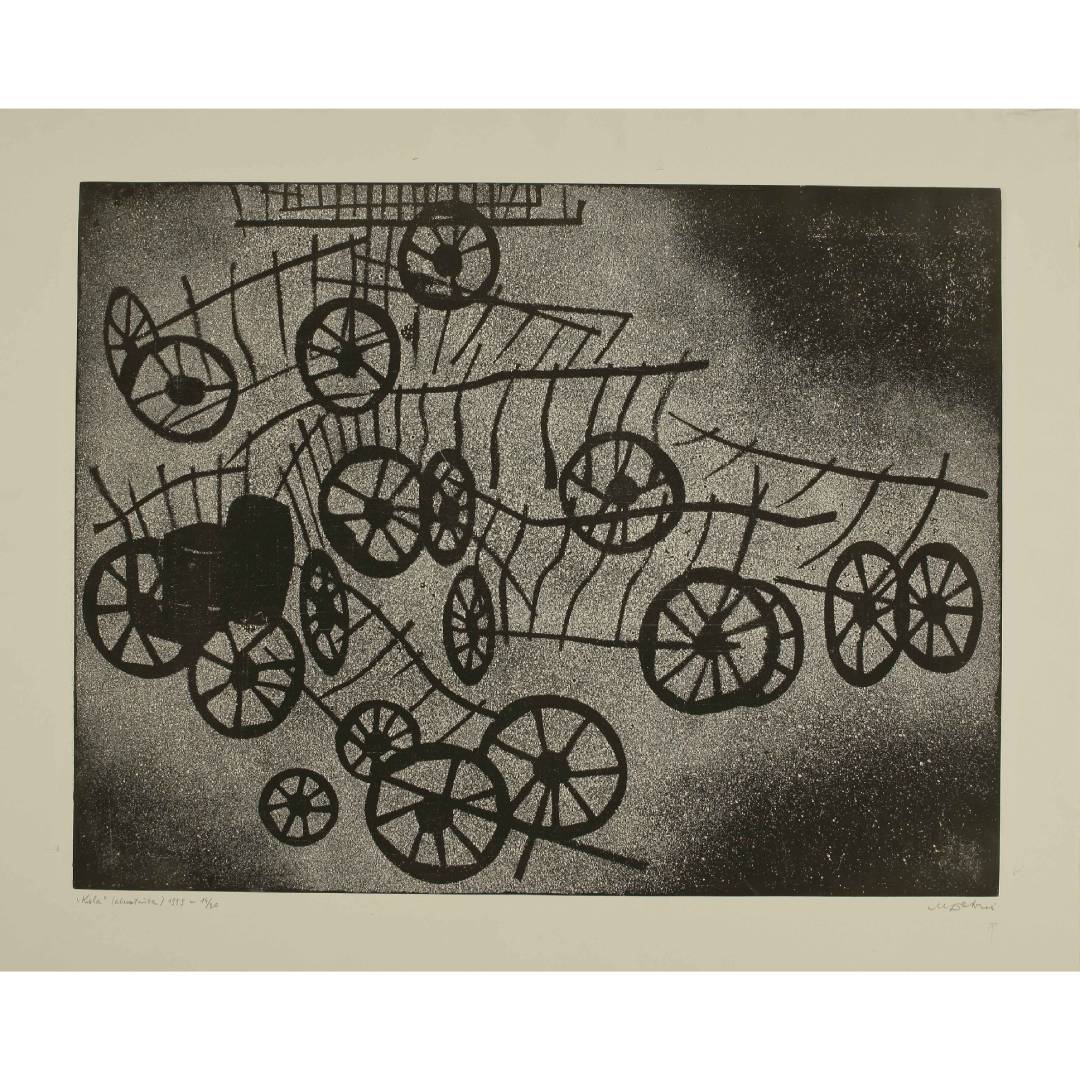
Marijan Detoni, Kola (Carts), 1959

Marijan Detoni
Carts, 1959
aquatint
49 × 64 cm
MG-2594

The print Kola (Carts) from 1959, executed in the aquatint technique, is one of the representative works from the later creative period of Marijan Detoni, during which he increasingly turned toward abstract compositions. The image is dominated by the rhythmic repetition of circular wheel forms and the skeletal structure of a cart, appearing to float in a weightless, cosmic space.
In the lower left section, the outline of a carriage or old-fashioned vehicle can be discerned, while a sequence of wheels spills diagonally toward the lower right corner, creating an impression of movement, vortex, or chaos. The granular black-and-grey background further intensifies the feeling of uncertainty and detachment from real space, transforming the composition into a visual expression of inner unrest or memories losing their concrete form.
Kola thus functions as a metaphor for time gone by, fragments of history, and personal experience, but also as a poetic record of a powerful imaginative impulse. The work vividly demonstrates Detoni’s ability to synthesize figurative and abstract expression — a defining characteristic of his art from the 1950s onward.
Although he began his career as one of the most prominent members of the Zemlja Group, creating works strongly marked by social critique and primitivist form, by the mid-1930s Detoni had begun introducing more pronounced coloristic elements and gradually distancing himself from ideologically charged themes. In the postwar years, following his intense experience in the Partisan resistance and his subsequent academic career, his oeuvre entered a new phase. Inspired by Surrealist symbolism, the experiences of the Paris School, and modern European tendencies, he began producing works grounded in dreamlike associations, free compositions, and rich symbolism.
Marijan Detoni (1905–1981) studied painting and printmaking at the Academy of Fine Arts in Zagreb, where his mentor was Ljubo Babić, and further refined his printmaking skills under Tomislav Krizman. He rose to prominence in the early 1930s, producing some of the key works of socially engaged Croatian painting. In later decades, however, he developed an introspective and visually innovative style. As a long-standing professor at the Academy of Fine Arts in Zagreb and one of the leading printmakers of his time, he left a profound mark on twentieth-century Croatian visual culture.

Text: Lorena Šimić Majić, Curator / Museum Educator at the National Museum of Modern Art, Zagreb
Photo: Goran Vranić © National Museum of Modern Art, Zagreb
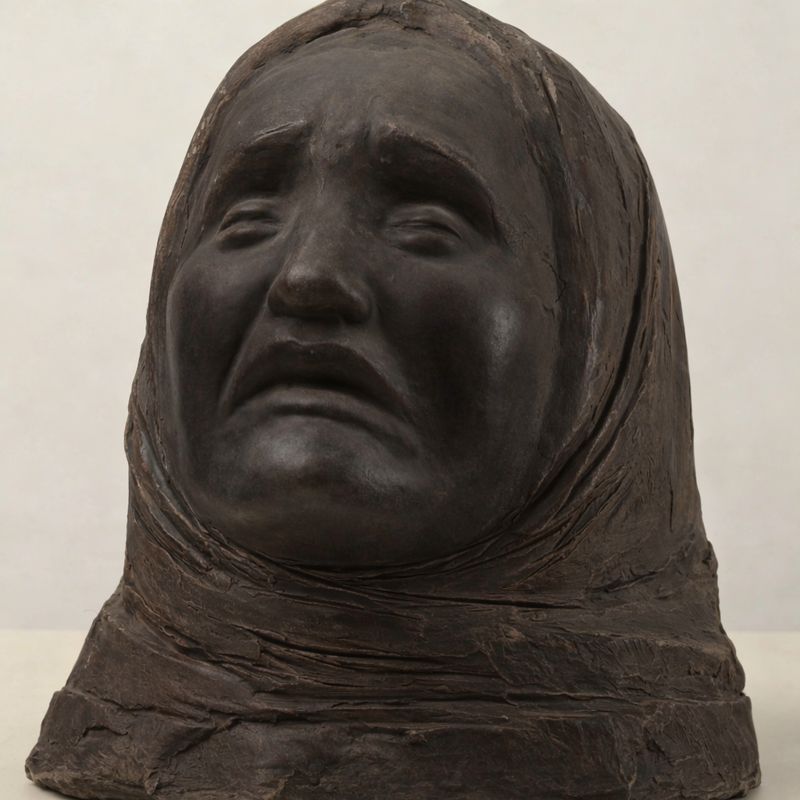
Jelena Veszely Szilvássy, Mourning, 1940s

Jelena Veszely Szilvássy
(1917–2020)
Mourning, 1940s
patinated plaster
24 × 21 × 25 cm
MG-3162

A sculptor who graduated in 1941 from the Academy of Fine Arts in Zagreb in the class of Frane Kršinić, Jelena Veszely Szilvássy developed an exceptionally fruitful international career. Although she was professionally active primarily in Hungary, her artistic roots remained firmly grounded in Croatia. Her oeuvre is marked by remarkable versatility, stylistic coherence, and profound human emotion, which in her sculptural language is transformed into universal symbols of pain, love, and human connectedness.
Her life and artistic path were shaped by historical circumstances and personal choices. In 1943, she moved with her husband, the painter Pál Szilvássy, to Nagybánya, where they remained until the end of the Second World War. The artistic couple then worked briefly in post-war Yugoslavia before settling permanently in Budapest. Despite this relocation, the artist maintained strong ties to Croatia, as evidenced by her early exhibitions in Zagreb in 1946 and 1947, as well as by the high Croatian state decoration she received in 2018 for her contribution to the development and international reputation of the Republic of Croatia.
Her artistic practice is characterised by both a diversity of media and a clear thematic focus. She created small-scale sculpture, public monuments, drawings, prints, and watercolours, working with materials such as stone, wood, and metal. Yet despite this breadth of expression, one constant runs throughout her work: the human figure. Her sculptural figures are neither strictly static nor playfully dynamic; instead, they embody a tension between these two opposites. Through gently elongated, stylised, and purified forms of women, mothers, children, or couples, she shaped intimate relationships that transcend the personal and become archetypal images of universal emotion.
A particularly representative example of this symbolic language is already present in her early depiction of mourning. The physiognomy of the female face—covered with a headscarf and lifted toward an undefined space beyond the viewer’s gaze, with half-open, tense lips, a pronounced chin, closed eyes, and furrowed brows—constructs a visual register of emotional suffering, loss, and inner endurance. In this context, naturalistic modelling does not serve a mimetic purpose but functions as a semantic tool for articulating an archetypal motif of grief. The headscarf, as a culturally coded sign of female identity and mourning practice, is integrated into the volumetric structure of the head and acts as a stabilising compositional element, while the expressive modulation of the face destabilises the formal closure of the volume and introduces an inner, psychologically driven dynamism. The result is a sculpture in which affective content and plastic structure intertwine to form a coherent iconographic and formal whole.
Through her long-standing activity in Hungary—where from 1970 onward she regularly exhibited in institutions such as the Institute for Cultural Relations, the Csók Gallery, and the Vigadó in Budapest, as well as in cities across the country including Hatvan, Veszprém, Tihany, and Balassagyarmat—the artist made a significant contribution to the visual culture of that region. Her public sculptures, permanently installed in Hungarian urban spaces, engage with audiences on a daily basis, making her oeuvre a living part of the collective identity.
Thanks to a continuous artistic practice that transcends boundaries between the private and the public, the national and the universal, intimacy and collective memory, this sculptor rightfully occupies an important place in contemporary Central European art. Her life and work stand as an example of artistic dedication and of the universality of visual language which, even when deeply personal, speaks to all people.

Text: Tatijana Gareljić, Museum Advisor, National Museum of Modern Art © National Museum of Modern Art, Zagreb
Photo: Goran Vranić © National Museum of Modern Art, Zagreb