Kamilo Tompa
On the Street, 1931
watercolor on paper
58.5 × 52 cm
MG-2517
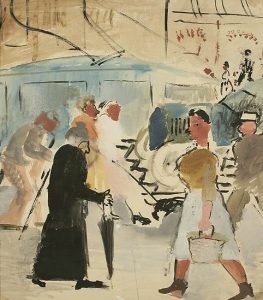
The watercolor On the Street by Kamilo Tompa presents a vivid scene of urban bustle, shaped by the free and expressive brushstrokes characteristic of his artistic language. In the foreground, figures of pedestrians in motion stand out—a woman with an umbrella, a woman carrying a basket, a worker in uniform—whose dynamic arrangement and strong contours create a sense of rhythm and continuous movement.
The composition is further animated by the tram in the background, its volume suggested through broad, almost sketch-like planes of blue and grey. Overhead electric wires and fragments of buildings clearly situate the scene within an urban environment. The artist avoids precise narration and realistic detail, relying instead on condensed expression and chromatic accents to evoke the atmosphere of haste and the transience of everyday city life.
Although the figures are only indicated, they retain their individuality. Each is shaped with swift yet deliberate strokes, conveying distinct character and gesture. This economy of expression, intrinsic to watercolor as a medium, enables Tompa to achieve immediacy of impression and a compelling synthesis of observation and personal interpretation of urban life.
Kamilo Tompa (Samobor, 1903 – Zagreb, 1989) was a Croatian painter, printmaker, and stage designer, and one of the more versatile artists of his generation. He graduated in 1926 from the Academy of Fine Arts in Zagreb and subsequently studied art history in Paris, where he encountered new artistic tendencies that would influence the development of his later work. Initially close to the socially engaged poetics of the Zemlja group, Tompa moved over the years between figuration and abstraction, incorporating elements of Surrealism and structural abstraction. Alongside his painting practice, he made a significant contribution to stage design, particularly as head of the scenography department at the Academy of Dramatic Art in Zagreb, and through his pedagogical and theoretical work on visual expression.
His diverse oeuvre testifies to a continual openness to experimentation and the exploration of visual language.
Text: Lorena Šimić Majić, Curator / Museum Educator at the National Museum of Modern Art © National Museum of Modern Art, Zagreb
Photo: Goran Vranić © National Museum of Modern Art, Zagreb