Marijan Detoni
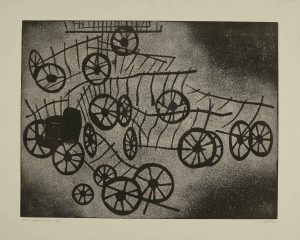
Carts, 1959
aquatint
49 × 64 cm
MG-2594
The print Kola (Carts) from 1959, executed in the aquatint technique, is one of the representative works from the later creative period of Marijan Detoni, during which he increasingly turned toward abstract compositions. The image is dominated by the rhythmic repetition of circular wheel forms and the skeletal structure of a cart, appearing to float in a weightless, cosmic space.
In the lower left section, the outline of a carriage or old-fashioned vehicle can be discerned, while a sequence of wheels spills diagonally toward the lower right corner, creating an impression of movement, vortex, or chaos. The granular black-and-grey background further intensifies the feeling of uncertainty and detachment from real space, transforming the composition into a visual expression of inner unrest or memories losing their concrete form.
Kola thus functions as a metaphor for time gone by, fragments of history, and personal experience, but also as a poetic record of a powerful imaginative impulse. The work vividly demonstrates Detoni’s ability to synthesize figurative and abstract expression — a defining characteristic of his art from the 1950s onward.
Although he began his career as one of the most prominent members of the Zemlja Group, creating works strongly marked by social critique and primitivist form, by the mid-1930s Detoni had begun introducing more pronounced coloristic elements and gradually distancing himself from ideologically charged themes. In the postwar years, following his intense experience in the Partisan resistance and his subsequent academic career, his oeuvre entered a new phase. Inspired by Surrealist symbolism, the experiences of the Paris School, and modern European tendencies, he began producing works grounded in dreamlike associations, free compositions, and rich symbolism.
Marijan Detoni (1905–1981) studied painting and printmaking at the Academy of Fine Arts in Zagreb, where his mentor was Ljubo Babić, and further refined his printmaking skills under Tomislav Krizman. He rose to prominence in the early 1930s, producing some of the key works of socially engaged Croatian painting. In later decades, however, he developed an introspective and visually innovative style. As a long-standing professor at the Academy of Fine Arts in Zagreb and one of the leading printmakers of his time, he left a profound mark on twentieth-century Croatian visual culture.
Text: Lorena Šimić Majić, Curator / Museum Educator at the National Museum of Modern Art, Zagreb
Photo: Goran Vranić © National Museum of Modern Art, Zagreb