Marijan Trepše
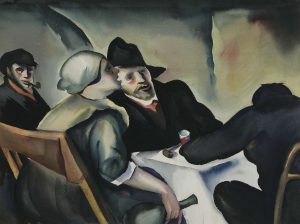
In the Tavern II, 1922
Watercolor on paper
50.5 × 66 cm
MG-1099
In the painting In the Tavern II, Marijan Trepše depicts a scene from everyday popular life: the interior of a tavern where three figures are gathered around a table, while a fourth sits aside, observing the scene from the half-shadow. Although the space is not precisely defined, the watercolor modelling of the figures and the dramatized lighting create a strong atmosphere—dark yet vibrant, almost theatrical. The figures are shaped with clearly cut contours, while their gestures and facial expressions suggest intimacy and ease. A palette of dark tones, with occasional accents of red and white, enhances the impression of eerie intimacy. The depiction is reduced to expressive elements that transcend descriptive reality.
Trepše, one of the key representatives of the so-called Prague Four, in this work synthesizes an expressionist approach to the human figure with a Cézannist conception of space. The rhythm of the composition, the positions of the bodies, and the diagonal tensions of the table also reveal Cubist influences, while the distinctive, almost stylized treatment of volume in watercolor confirms the artist’s mastery of this medium. In the typical spirit of Croatian Expressionism, the painting does not merely depict a scene—it interprets it and offers an emotional commentary.
During the 1920s Trepše frequently painted scenes set in taverns, cabarets, and urban interiors, where emotions and psychological tensions are intensified through pose, composition, and contrasts of light. In the Tavern II reflects this thematic interest as well as the technical maturity of an artist who was already developing a recognizable personal style.
Marijan Trepše (1897–1964) was one of the most significant Croatian painters, printmakers, and scenographers of the interwar period, known for his expressionist idiom and his activity within the Prague Four. He trained in Zagreb, Prague, and Paris, and in his work combined Cézannism, Expressionism, and Neoclassical tendencies, creating striking portraits, watercolors, and coastal and urban scenes. As a long-time scenographer at the Croatian National Theatre, he designed several hundred stage sets, leaving a profound mark on Croatian theatre and visual arts.
Text: Lorena Šimić Majić, curator / museum educator at the National Museum of Modern Art © National Museum of Modern Art, Zagreb
Photo: Goran Vranić © National Museum of Modern Art, Zagreb