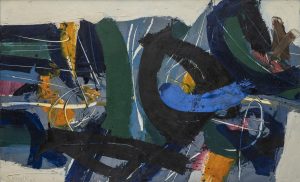
Edo Murtić
Green Serenity, 1965
oil on canvas
94.5 × 143 cm
MG-2655
Edo Murtić (1921–2005), in Green Serenity (1965), presents a striking example of a richly expansive coloristic confrontation between some of the fundamental visual elements: gesture and color. The entire visual field—apart from the marginal whites, which are partially echoed along the lower edge—is highly dynamic. Everything is in tension: brushstroke, chromatic and achromatic values, gesture. The edges and the core engage in a vivid chromatic interplay and diagonal calligraphy, creating an expressive symphony that Vladimir Maleković describes as a “coloristic sarabande”—a passionate Spanish dance in triple meter (3/4 time).
The pronounced dramatic quality of the composition is emphasized by the counterpoint between broad black strokes and the equally dynamic, dense interweaving of blues and greens, accented by flashes of orange values dispersed throughout the composition’s gestural unity.
Murtić was educated by leading artists of his time at academies in Zagreb and Belgrade. A committed socialist, he participated in the World War II in Yugoslavia, and later, as a prominent cultural figure, became an advocate of democratic values. His career—marked by exceptional intensity and influence—spanned sixty years. After a return to figuration in the 1980s, he remained an abstract painter until his death, characterized by a Picasso-like eclecticism.
Text: Željko Marciuš, Museum Advisor at the National Museum of Modern Art © National Museum of Modern Art, Zagreb
Photo: Goran Vranić © National Museum of Modern Art, Zagreb