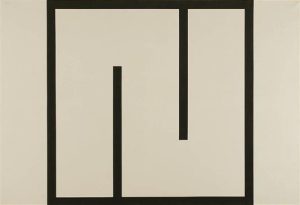
Julije Knifer
Meander, 1978
Acrylic on canvas, 190 × 130 cm
MG-4002
The meander is an anthology motif in the oeuvre of one of the most important Croatian painters of the 20th century, Julije Knifer (1924–2004). Knifer’s reductive abstraction is characterized by the selection of a single motif and its systematic exploration. The meander—formally determined by the boundaries of the painting, with equal black and white surfaces—became Knifer’s exclusive subject from 1959 onward. The term meander was introduced by Igor Zidić and subsequently adopted by Knifer.
The consistency in repeating the meander’s rhythm, along with the continuity of space and time, defined Knifer’s entire body of work. A pronounced sense of absurdity, paradox, and irony brought him close to the Gorgona Group, of which he was a co-founder and member from its inception in 1959.
Prototypes of the “anti-painting,” as Knifer referred to the meander in his 1960s Notes, represent strict, non-psychological repetitions of his Self-Portraits (1949–1952). These ideas are also present in his drawings—repeated depictions of Stenjevec (1952)—in which the underlying structure of the meander becomes visible. Precedents can also be found in his minimalist compositions from the 1950s.
The 1978 painting bears the title Meander, which it inherently implies through both its visual language and categorization. The meander is emphasized as an ultimate symbol structured in two parts: white, which extends across the painting’s ground, and the final linear motif—also a white meander—executed as a continuous, uniform broad surface, framed by a black line. The resulting visual structure can be described as: white (meander surface), black (border line), white (painting ground).
Within Knifer’s systematic approach of uniform, monotonous rhythm, we can observe influences ranging from the philosophy of existence and the absurd to Kazimir Malevich and Paul Cézanne (Z. Maković). One of his favorite Renaissance artists—by no means coincidentally—was Piero della Francesca.
Text: Željko Marciuš, Muswum Asvisor at the National Museum of Modern Art / National Museum of Modern Art © National Museum of Modern Art, Zagreb
Photo: Goran Vranić © National Museum of Modern Art, Zagreb