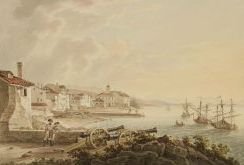
Franz Jaschke
Rijeka, around 1815
watercolour, ink, pen, paper
44.1 × 63.5 cm
MG-40
Franz Jaschke (Rosenthal near Kłodzko, 1775 – Vienna, 1842), an Austrian painter born in Rosenthal, left a profound mark on the artistic depiction of Croatian landscapes and urban spaces at the beginning of the 19th century. He studied at the Vienna Academy of Fine Arts from 1794, where he acquired strong foundations in classical aesthetics, particularly within the framework of Austrian topographical veduta painting. As court painter to Archdukes Ludwig and Rainer, Jaschke travelled through Croatian regions on several occasions—especially in 1807, 1808 and 1810. During these journeys he recorded landscapes, towns and inhabitants in watercolours and drawings that possess great documentary value as well as high artistic quality. His works include views of the fortresses of Gradiška and Brod, vistas of Trsat and Rijeka, and natural landmarks such as the source of the Una River and the Plitvice Lakes.
Jaschke’s watercolour depicting the Rijeka waterfront from the early 19th century belongs to his topographical veduta oeuvre, shaped within the Viennese classical tradition. The composition is clearly organized in spatial planes: in the foreground a fortification with cannons and military figures is prominently displayed, while the middle ground develops the urban structure of the city along the coast. The architecture is simplified yet precisely defined, with the verticals of church towers emphasized along the horizon. The palette is restrained, based on warm ochres and grey-blue tonalities, with soft, gradual transitions characteristic of the watercolour technique. Even, diffused light unifies all planes of the composition and deepens the impression of spatial atmosphere. The presence of ships in the harbour further emphasizes Rijeka’s maritime and commercial role as a key coastal centre.
Text: Luciana Fuks, Curator for Museum Documentation Affairs, National Museum of Modern Art © National Museum of Modern Art, Zagreb
Photo: Goran Vranić © National Museum of Modern Art, Zagreb