Dušan Džamonja, Metal Sculpture 3, 1959

Dušan Džamonja
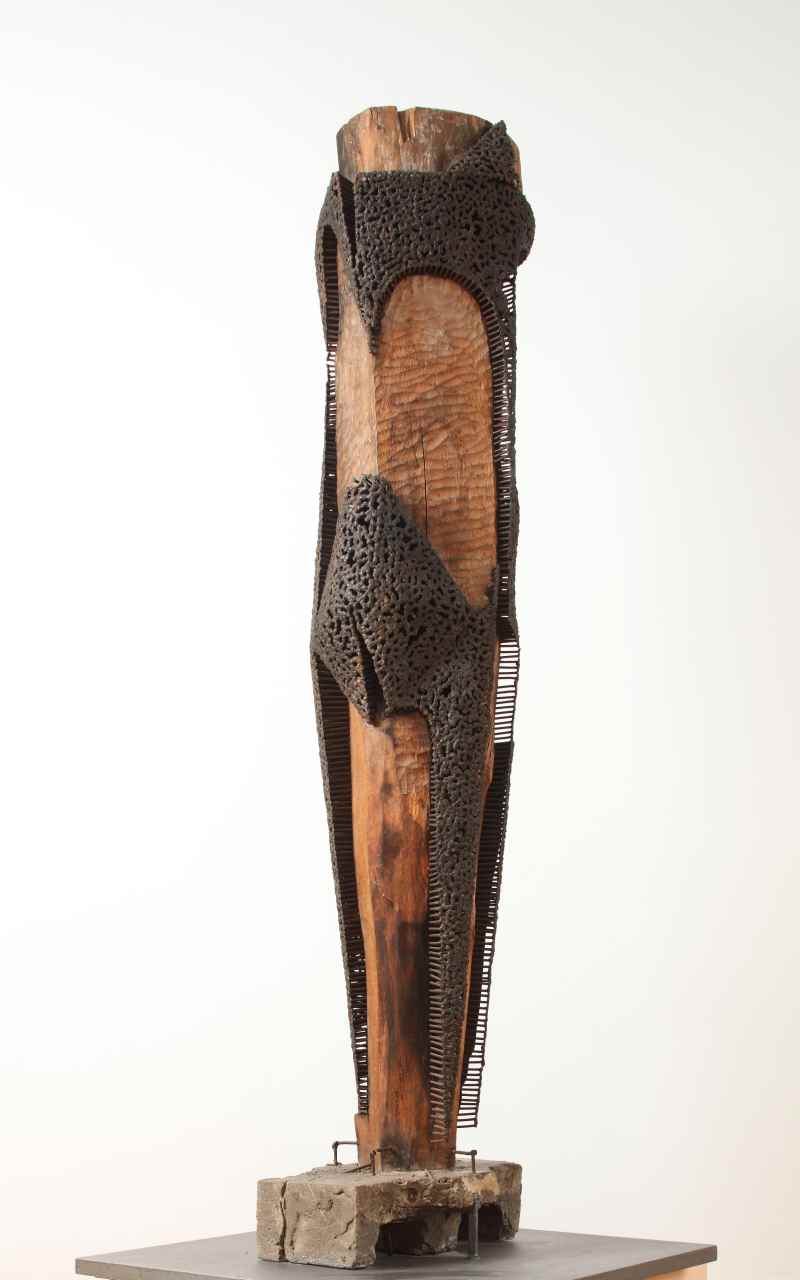
Metal Sculpture 3, 1959
metal, wood
174.8 × 36 × 39 cm
MG-2445

Dušan Džamonja (1928–2009) graduated from the Academy of Fine Arts in Zagreb in 1951. While his early works were figurative, he soon began experimenting with abstract forms, unconventional materials and techniques, particularly welded metal constructions, and his signature combinations of a wooden core partially covered with a metal shield executed through hundreds of steel nails. By the late 1950s, he had established himself as one of the leading figures of abstract sculpture in Yugoslavia, exploring the relationship between interior, surface, void and monumentality.

By the end of the 1950s, Džamonja had fully embraced abstraction. Metal Sculpture 3 is an example of his trademark interplay of wood and metal, where a wooden pillar functions as a structural core activated by a dynamic surface composed of hundreds of nails. This radical departure from figurative monumentality corresponded with Yugoslavia’s post-1948 cultural reorientation, when abstraction came to signify artistic autonomy and international alignment. The work exemplifies the broader shift in sculpture from commemorative representation toward material experimentation and spatial exploration.

Text: Marta Radman, curator at the National Museum of Modern Art, Zagreb
Translated by: Marta Radman
Photo: Goran Vranić © National Museum of Modern Art, Zagreb
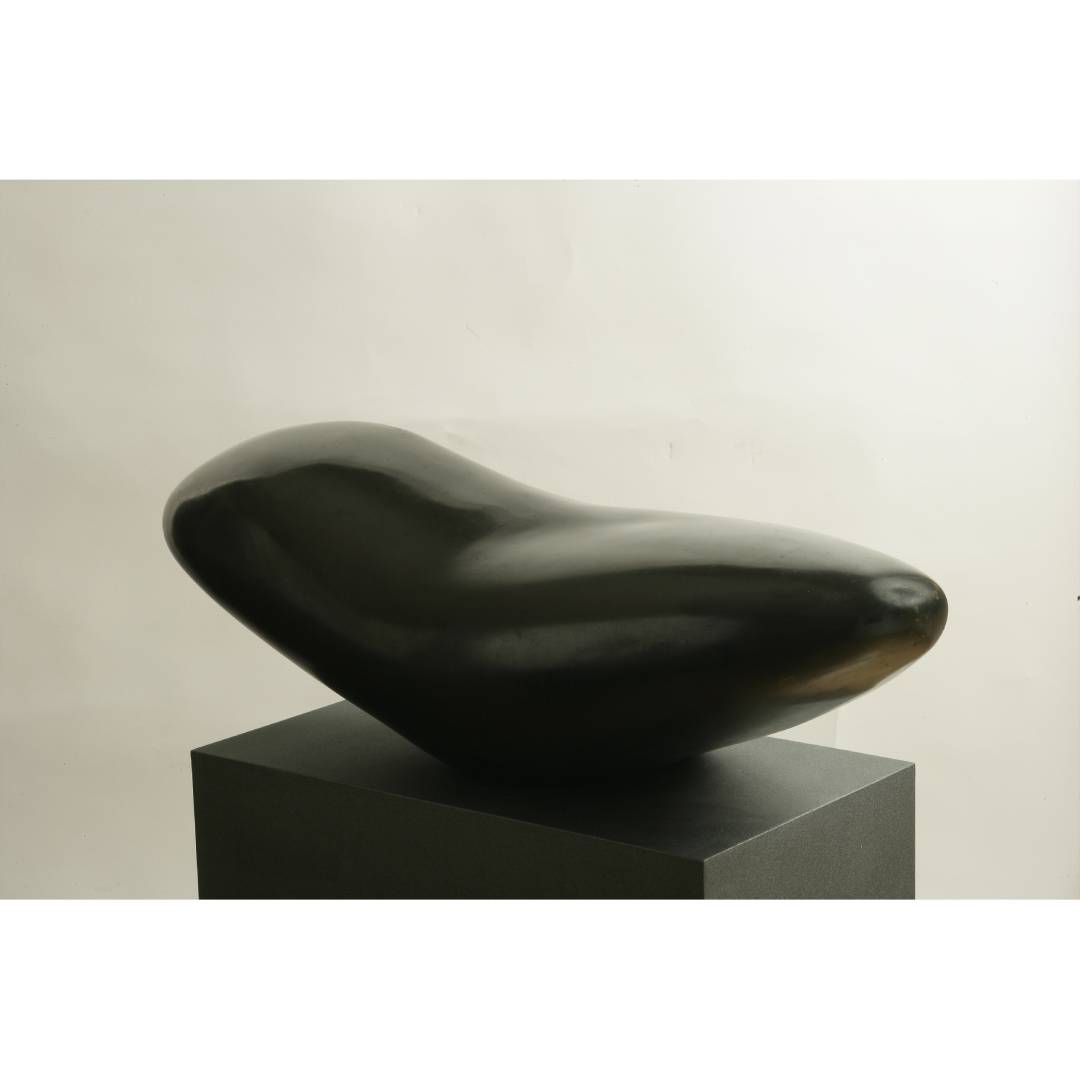
Vojin Bakić, Reclining Torso, 1957

Vojin Bakić
Reclining Torso, 1957
bronze
20 × 30 × 65 cm
MG-2447

Vojin Bakić (1915–1992) studied in Zagreb under Frano Kršinić and drew inspiration from both classical and modernist traditions. During the 1950s, his work progressively abandoned descriptive detailing in favour of structural unity and formal abstraction in both small-scale works and monumental commemorative sculptures that brought him international recognition.
By the mid-1950s, Bakić had achieved a synthesis of organic and abstract form. In Reclining Torso, the human body is condensed into a smooth, continuous volume, with anatomical details largely absorbed into the whole. Subtle indentations and barely perceptible protrusions suggest the figure without explicitly describing it. The sculpture abandons narrative and symbolism, focusing instead on the concentration of energy within its core volume. This transformation reflects a broader shift in Yugoslav art after 1948, when abstraction became a state-endorsed aesthetic program.

Text: Marta Radman, curator at the National Museum of Modern Art, Zagreb
Translated by: Marta Radman
Photo: Goran Vranić © National Museum of Modern Art, Zagreb
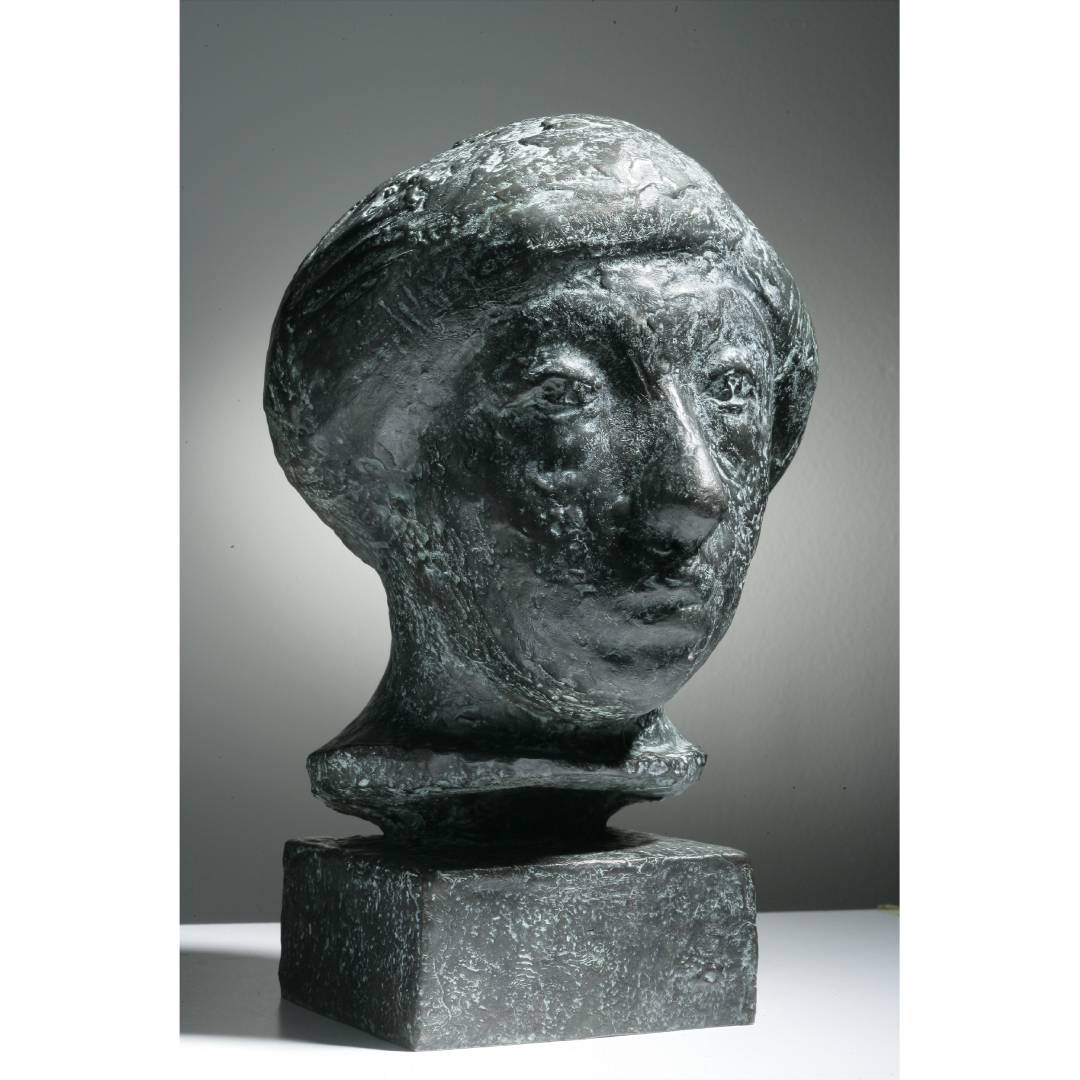
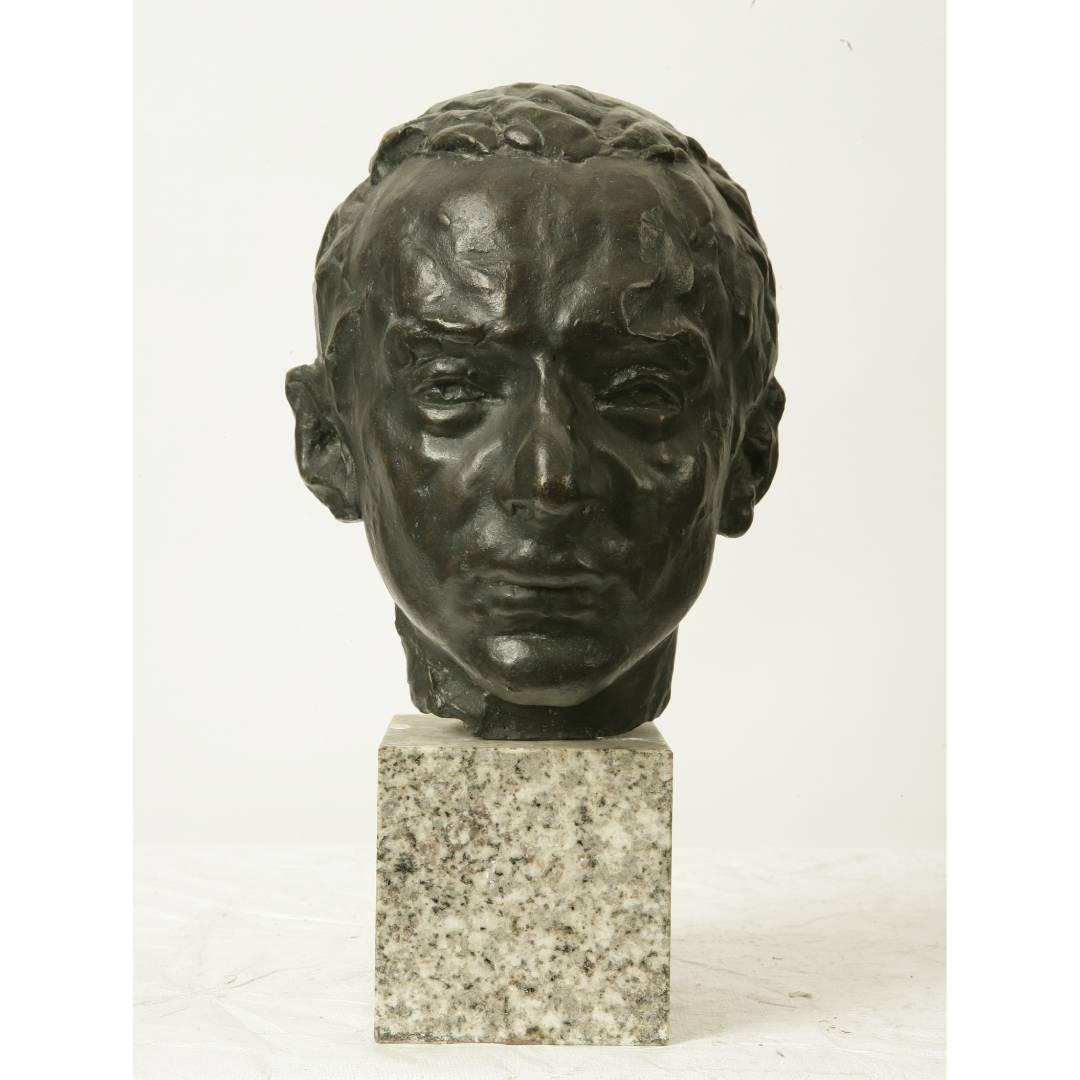
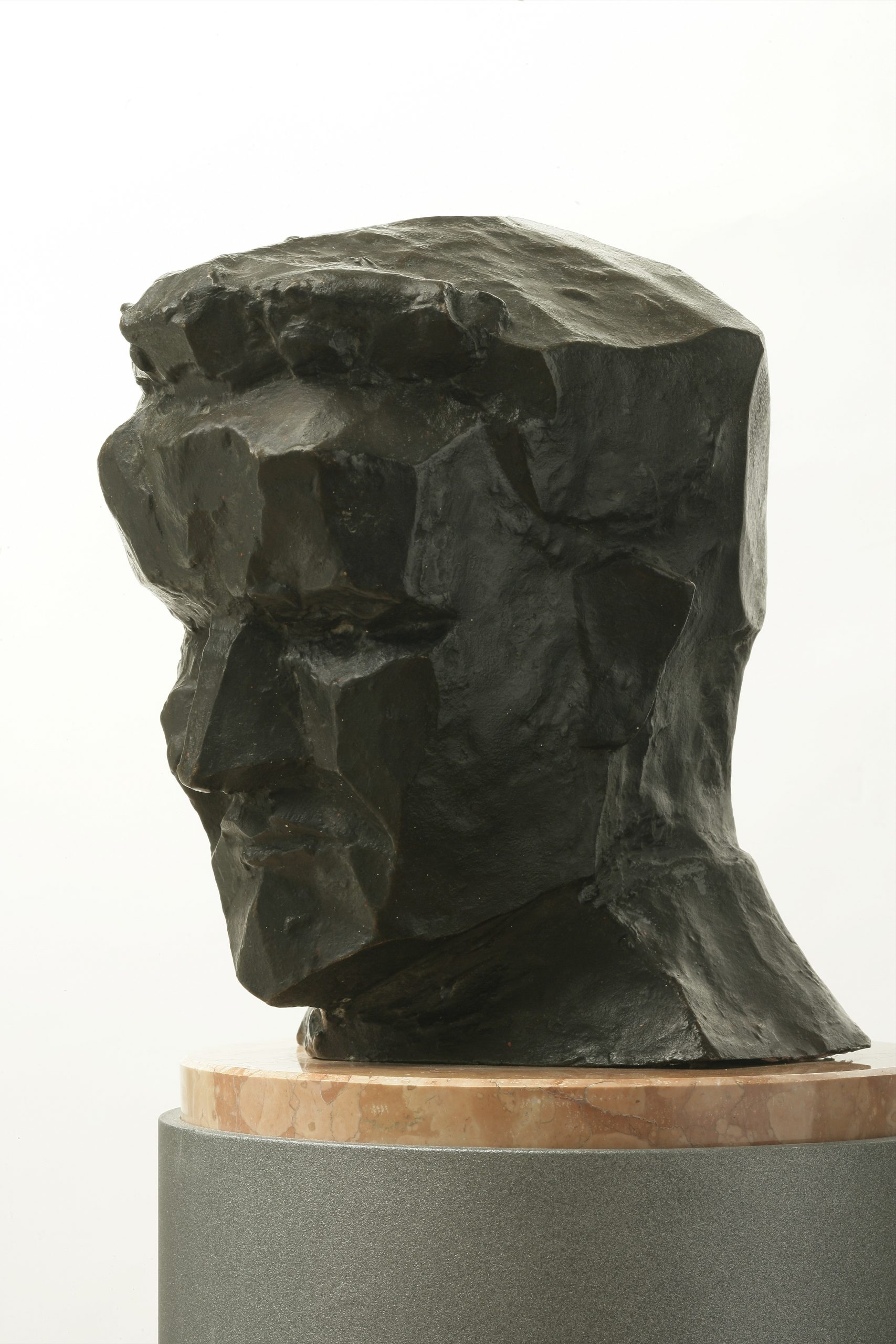
Ksenija Kantoci, Head of a Woman (Portrait of Aja Kantoci?), c. 1953

Ksenija Kantoci
Head of a Woman (Portrait of Aja Kantoci?), c. 1953
bronze
41 × 16 × 16 cm
MG-7141

Ksenija Kantoci (1909–1995) graduated from the Academy of Fine Arts in Zagreb in 1937 as its first female sculptor, and continued her studies in France, Italy and Germany. Her work is distinguished by a consistent reduction of form and a concentration on the essential structural and psychological qualities of the figure. She developed a distinctive sculptural idiom based on compact volumes and restrained modelling. Rather than accentuating anatomical detail, she condensed physiognomic features into cohesive forms, achieving a balance between naturalism and abstraction. Alongside portraiture, she created female figures and animal motifs in bronze, stone and wood.
This portrait intensifies the reduction visible in Kantoci’s earlier work. The head is structured as a closed, almost spherical mass, with facial features compressed into the surface rather than projected outward. The volume appears self-contained, firmly anchored to its base by the neck. Eyes and mouth are rendered minimally, yet effectively convey identity and presence. Kantoci approaches a near-archetypal representation, where individuality is distilled into structural clarity. The portrait exemplifies her ability to balance psychological depth with formal economy.

Text: Marta Radman, curator at the National Museum of Modern Art, Zagreb
Translated by: Marta Radman
Photo: Goran Vranić © National Museum of Modern Art, Zagreb
Vojin Bakić, Self-Portrait, 1952

Vojin Bakić
Self-Portrait, 1952
bronze
28 × 21 × 22 cm
MG-2596
Vojin Bakić (1915–1992) studied in Zagreb under Frano Kršinić and drew inspiration from both classical and modernist traditions. During the 1950s, his work progressively abandoned descriptive detailing in favour of structural unity and formal abstraction in both small-scale works and monumental commemorative sculptures that brought him international recognition.
Self-Portrait demonstrates Bakić’s shift toward pronounced reduction and cubist stylisation. Facial features are condensed into simplified planes and integrated into a compact, structurally unified mass. The emphasis is no longer on psychological likeness but on the geometric articulation of volume. The work marks an early stage in his systematic pursuit of purified sculptural form, anticipating the increasingly abstract volumes that would define his mature phase.

Text: Marta Radman, curator at the National Museum of Modern Art, Zagreb
Translated by: Marta Radman
Photo: Goran Vranić © National Museum of Modern Art, Zagreb
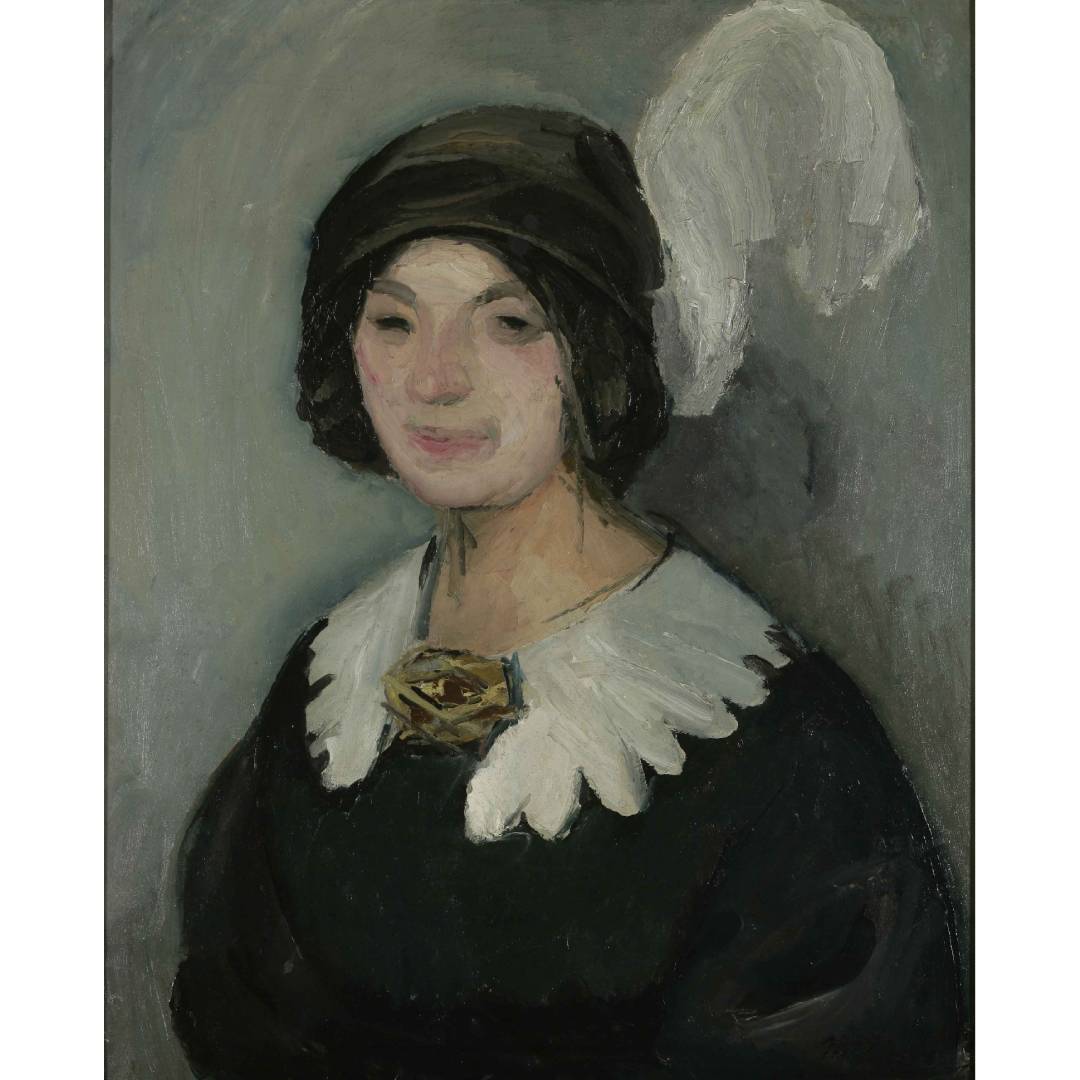
Miroslav Kraljević, Portrait of a Lady with a Hat, 1912

Miroslav Kraljević
Portrait of a Lady with a Hat, 1912
oil on canvas
60.1 × 48.7 cm
MG-2253

After completing his education in Zagreb and Gospić, Miroslav Kraljević enrolled in law studies in Vienna, which he abandoned in order to study painting. In 1906/07 he attended the private school of graphic artist Moritz Heymann in Munich, and in May 1907 he was admitted to the Munich Academy, studying under Hugo von Habermann, where he associated with Josip Račić and Vladimir Becić (the Munich Circle).
After graduating, Kraljević returned to Požega in 1910, where he painted intensively until September 1911, when he moved to Paris. There he enrolled at the Académie de la Grande Chaumière, which he soon left. In 1912 he held his first — and during his lifetime, only — solo exhibition at the Ulrich Salon in Zagreb. He died of tuberculosis in 1913.
The vertically oriented painting depicts a woman portrayed down to the chest. The background is neutral grey, rendered with pronounced, energetic impasto brushstrokes. The palette is dark, dominated by shades of grey, black, and brown, with white accents on the collar and decorative feather on the hat, as well as the flesh tones of the face and neck. The emphatic and energetic brushwork, together with the deformation of the sitter’s facial features, creates the expressive intensity of the composition.

Text: Ivana Rončević Elezović PhD, Museum Advisor at the National Museum of Modern Art © National Museum of Modern Art, Zagreb
Photo: Goran Vranić © National Museum of Modern Art, Zagreb

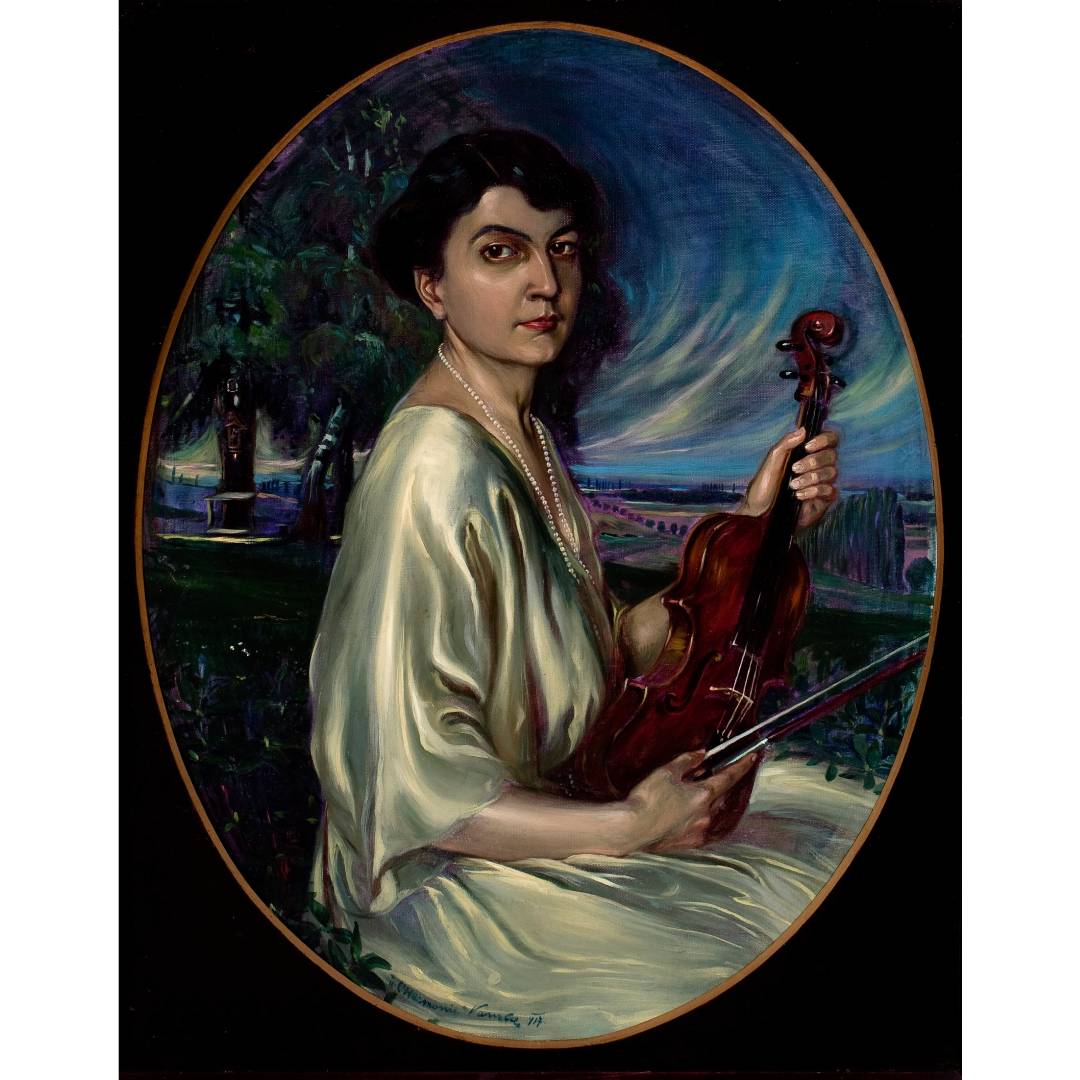
Maksimilijan Vanka, Portrait of Dora Pejačević, 1917

Maksimilijan Vanka
Portrait of Dora Pejačević, 1917
oil on canvas
114 × 95 cm
MG-7179

Maksimilijan Vanka studied painting in Zagreb under Bela Čikoš Sesija and in Brussels. He worked as a professor at the Academy of Fine Arts in Zagreb until 1934, after which he emigrated to the United States. His membership in the Group of Four, alongside Ljubo Babić, Vladimir Becić, and Jerolim Miše from 1926 to 1929, was particularly significant; after Vanka’s departure, the group transformed into the renowned Group of Three. He became a member of the Yugoslav Academy of Sciences and Arts in 1929.
A prominent place in his oeuvre is occupied by large-format compositions with folkloric and religious themes, colouristic watercolour landscapes, portraits, and self-portraits. He also worked in fresco painting and sculpture. Particularly noteworthy are Vanka’s designs for the stage sets and costumes of Krešimir Baranović’s ballet Licitarsko srce (The Gingerbread Heart).
Rendered in shades of blue, brown, and beige with touches of grey, the painting depicts the seated figure of composer Dora Pejačević (her body shown in profile and her face in three-quarter view) holding a violin and bow in her lap. She is dressed in a flowing beige silk gown that falls loosely along the body, while long strands of white pearls adorn her neck. The sitter’s gaze is directed toward the viewer. The expressive quality of the surrounding landscape is achieved through long, curved brushstrokes of golden and grey-blue tones in the sky, creating a swirling atmosphere charged with a distinctive emotional intensity.

Text: Ivana Rončević Elezović, PhD, Museum Advisor at the National Museum of Modern Art © National Museum of Modern Art, Zagreb
Photo: Goran Vranić © National Museum of Modern Art, Zagreb

Kosta Angeli Radovani, Portrait of Vuk Gozze, 1946

Kosta Angeli Radovani
Portrait of Vuk Gozze, 1946
bronze
37 × 22 × 18 cm
MG-1456

Kosta Angeli Radovani (1916–2002) was educated at the Brera Academy in Milan and was a professor of sculpture at art academies in Zagreb and Sarajevo. He was a central figure of moderate modernism in the post-war period who developed a figurative language marked by stylisation, volumetric reduction and a gradual shift away from descriptive realism toward structural simplification.
This early post-war portrait marks Angeli Radovani’s transition from academic realism toward a more condensed and structurally simplified treatment of form. Depicting jurist and public figure Vuk Gozze, the bust concentrates on stability and intellectual composure, signalling a departure from strict Socialist Realist conventions. Created during a period when public figures were being incorporated into the symbolic framework of the new state, the bust represents an acceptance of reduction and volumetric clarity.
Text: Marta Radman, curator at the National Museum of Modern Art, Zagreb

Translated by: Marta Radman
Photo: Goran Vranić © National Museum of Modern Art, Zagreb
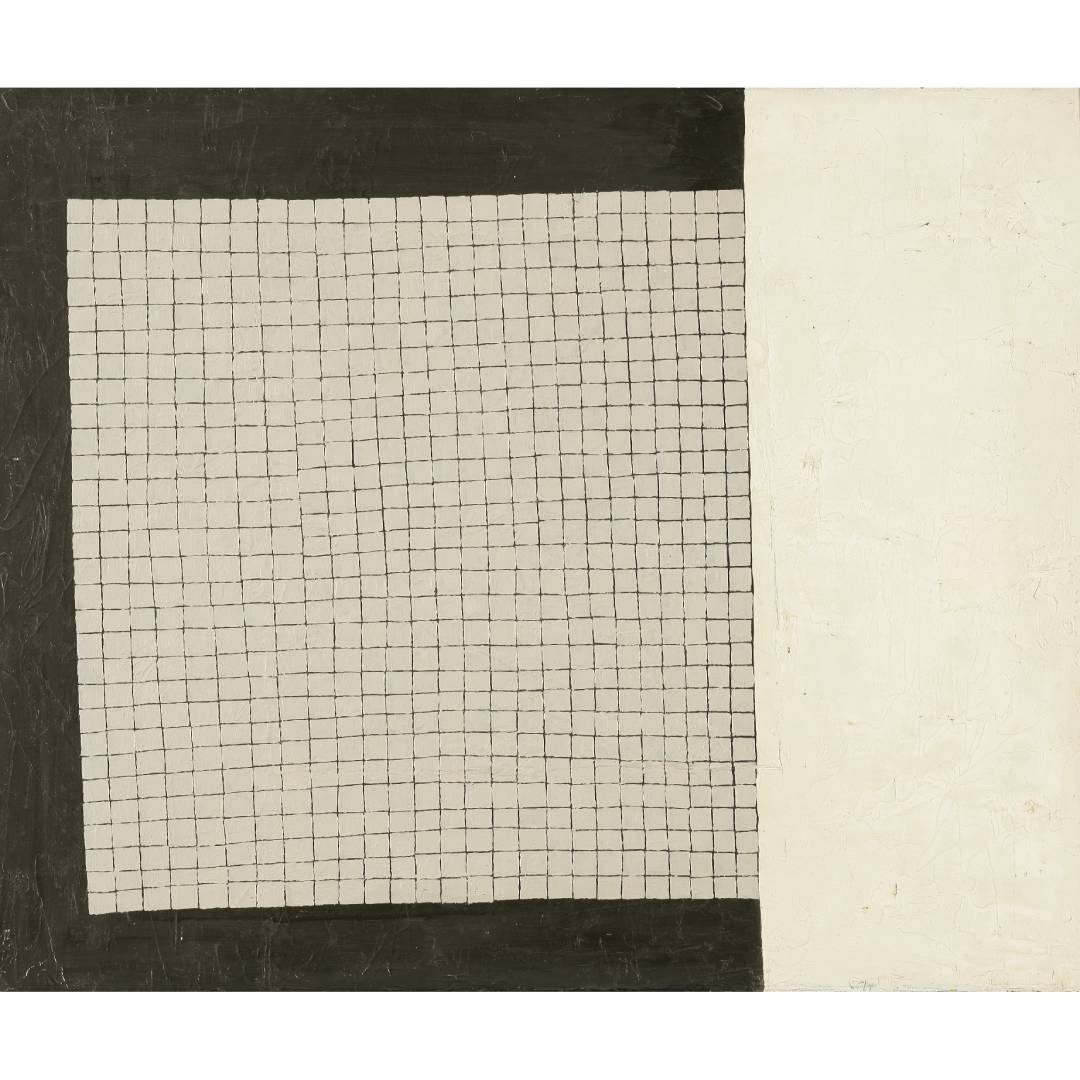
Vladimir Kristl, Variation, 1958

Vladimir Kristl
Variation, 1958
oil on canvas
59.4 × 72.8 cm
MG-2579

Vladimir Kristl (1923–2004) was a painter, filmmaker, animator, illustrator, and writer, and one of the founding members of EXAT 51 (1951–1956), the group that programmatically advocated for geometric abstraction and the synthesis of art and design. In the early 1950s, Kristl emerged as one of the most rigorous proponents of orthogonal geometric abstraction in Croatia. His paintings from this period are characterised by strict compositional discipline, reduction of colour and structural clarity. By the late 1950s, however, he began destabilizing geometric order through the use of irregular grids and material experimentation. Kristl increasingly devoted himself to animated and experimental film, becoming one of the key figures in the Zagreb School of Animated Film. Later disputes with cultural institutions prompted him to relocate to West Germany, where he became a major force in avant-garde cinema. Across all media, his work consistently embodied a resistance to authority and aesthetic orthodoxy.
Variation belongs to Kristl’s late EXAT 51 phase, when strict geometric order begins to fracture. The painting is structured around a reduced, nearly achromatic tripartite division, yet the surface resists perfect regularity. Subtle deviations in the grid and deliberate irregularities in execution introduce tension into what initially appears as a rational system. Even amid the canvas’s apparent austerity, a sense of instability persists, with geometry rendered provisional rather than absolute.
In the context of the exhibition, Kristl represents the internal radicalization of EXAT 51’s abstraction: from constructive clarity toward material doubt and structural subversion. His work signals both the culmination and the dissolution of the 1950s geometric orthodoxy.

Text: Marta Radman, curator at the National Museum of Modern Art, Zagreb
Translated by: Marta Radman
Photo: Goran Vranić © National Museum of Modern Art, Zagreb
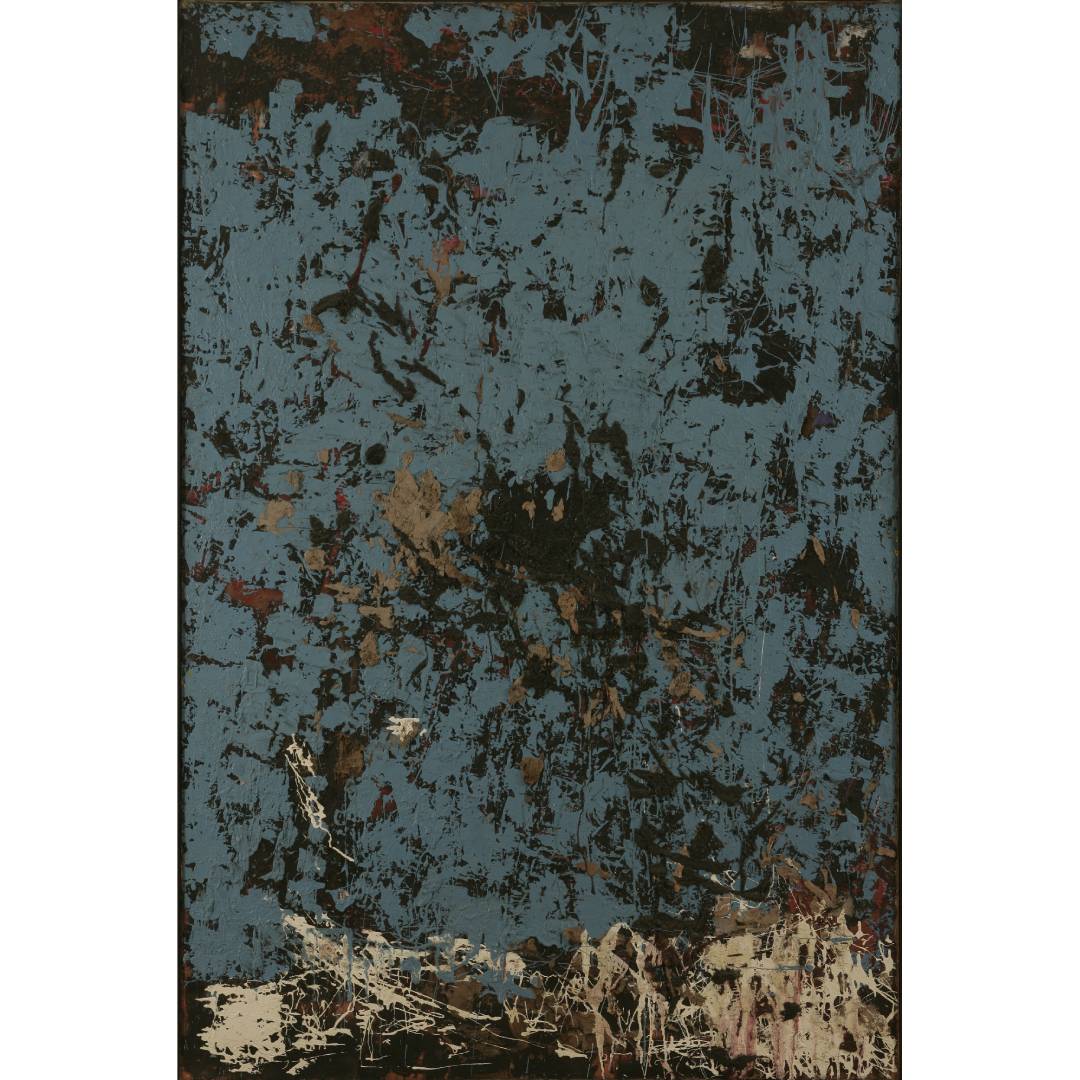
Ferdinand Kulmer, Blue Painting, 1959–1960

Ferdinand Kulmer
Blue Painting, 1959–1960
oil on canvas
195 × 130 cm
MG-3516

Ferdinand Kulmer (1925–1998) studied at the Academy of Fine Arts in Budapest before graduating from the Academy of Fine Arts in Zagreb in 1948. During the 1950s, he spent extended periods in Rome, Venice, Florence and Paris, where he encountered contemporary European abstraction. Kulmer’s early work was rooted in expressive figuration reminiscent of Fauvism. By the mid-1950s, however, he had decisively turned toward abstraction. He explored Tachism and gestural painting, then moved toward richly textured surfaces associated with Art Informel. During the 1960s, he developed a highly personal expressive abstraction marked by calligraphic signs and dynamic chromatic contrasts. In the 1980s, he became one of the leading figures of the local postmodern New Painting movement, embracing a renewed focus on figurative art.
Blue Painting belongs to Kulmer’s early abstract phase, when he was balancing between Tachism and Art Informel. The surface is created with layered pigment and subtle, relief-like accumulation, forming a dense, materially active field. Dominated by deep tonal variations of blue, the gestural structures emerge from within the chromatic mass, oscillating between spontaneity and control. The painting does not dissolve into pure automatism; instead, gestures are restrained by compositional discipline that prevents dispersion.
In contrast to the constructive clarity of EXAT 51, Blue Painting affirms material presence, chromatic depth and painterly density, signalling the shift from geometric order to expressive surface that defined the late 1950s.

Text: Marta Radman, curator at the National Museum of Modern Art, Zagreb
Translated by: Marta Radman
Photo: Goran Vranić © National Museum of Modern Art, Zagreb
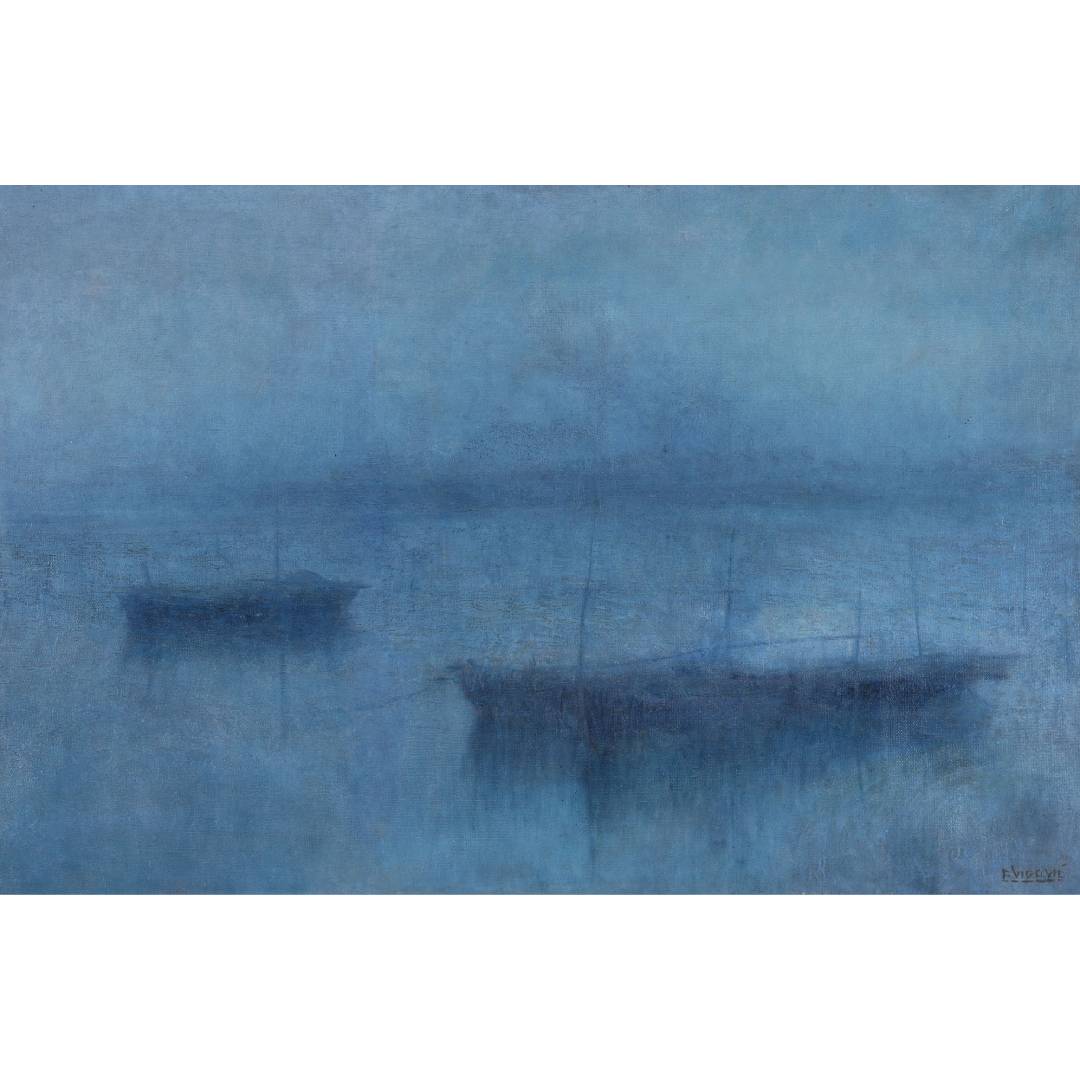
Emanuel Vidović, From the Lagoon, c. 1909

Emanuel Vidović
From the Lagoon, c. 1909
oil on canvas, 63 × 82 cm
MG-6715

Temporarily leaving Venice and Chioggia during his formative years, Emanuel Vidović (1870–1953) moved in 1892 to the entirely different environment of the industrial metropolis of Milan, dominated by the spirit of modernist progress. There, the Split-born painter supported himself through restoration work and by producing drawings for the furniture manufacturing industry. Every evening, he attended the Milanese society Famiglia Artistica, where he practiced drawing the nude and figures in costume.
Among the most significant events of Vidović’s Milan period were his participation in the exhibitions Esposizioni Riunite in 1894 and Esposizione Permanente in 1895, where he exhibited paintings depicting scenes from Venetian fishing life. At the Esposizioni Riunite exhibition, Vidović presented the painting Venezia peschereccia in what art historian Duško Kečkemet described as “a prominent gallery, beside two paintings by Segantini,” and alongside works by Ettore Tito and Angelo Dall’Oca Bianca. Vidović returned to his native Split in October 1895. This marked the beginning of his role as a central and unifying figure of Dalmatian art at the turn of the nineteenth and twentieth centuries, distinguished by the quality of his painting, his exhibition activities, and his numerous organizational contributions to cultural life. Despite this, he remained deeply connected to the Italian milieu throughout his life through regular visits to the fateful Chioggia and the Venice Biennale.
Painted around 1909, From the Lagoon is another example of an abstracted landscape conceived as a “state of mind.” Vidović’s affinity for the intellectual and sophisticated—for the ineffable existing beyond visible reality—predestined him for an obsession with Venice, a city whose shimmering outlines emerge from the sea like an apparition or mirage. Vidović’s encounter with Venice was decisive and provides the key to interpreting his entire oeuvre.

Text: Ivana Rončević Elezović Phd, Museum Advisor at the National Museum of Modern Art
Photo: Goran Vranić © National Museum of Modern Art, Zagreb