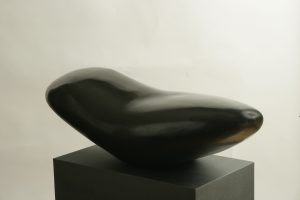
Vojin Bakić
Reclining Torso, 1957
bronze
20 × 30 × 65 cm
MG-2447
Vojin Bakić (1915–1992) studied in Zagreb under Frano Kršinić and drew inspiration from both classical and modernist traditions. During the 1950s, his work progressively abandoned descriptive detailing in favour of structural unity and formal abstraction in both small-scale works and monumental commemorative sculptures that brought him international recognition.
By the mid-1950s, Bakić had achieved a synthesis of organic and abstract form. In Reclining Torso, the human body is condensed into a smooth, continuous volume, with anatomical details largely absorbed into the whole. Subtle indentations and barely perceptible protrusions suggest the figure without explicitly describing it. The sculpture abandons narrative and symbolism, focusing instead on the concentration of energy within its core volume. This transformation reflects a broader shift in Yugoslav art after 1948, when abstraction became a state-endorsed aesthetic program.
Text: Marta Radman, curator at the National Museum of Modern Art, Zagreb
Translated by: Marta Radman
Photo: Goran Vranić © National Museum of Modern Art, Zagreb