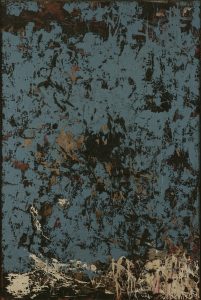
Ferdinand Kulmer
Blue Painting, 1959–1960
oil on canvas
195 × 130 cm
MG-3516
Ferdinand Kulmer (1925–1998) studied at the Academy of Fine Arts in Budapest before graduating from the Academy of Fine Arts in Zagreb in 1948. During the 1950s, he spent extended periods in Rome, Venice, Florence and Paris, where he encountered contemporary European abstraction. Kulmer’s early work was rooted in expressive figuration reminiscent of Fauvism. By the mid-1950s, however, he had decisively turned toward abstraction. He explored Tachism and gestural painting, then moved toward richly textured surfaces associated with Art Informel. During the 1960s, he developed a highly personal expressive abstraction marked by calligraphic signs and dynamic chromatic contrasts. In the 1980s, he became one of the leading figures of the local postmodern New Painting movement, embracing a renewed focus on figurative art.
Blue Painting belongs to Kulmer’s early abstract phase, when he was balancing between Tachism and Art Informel. The surface is created with layered pigment and subtle, relief-like accumulation, forming a dense, materially active field. Dominated by deep tonal variations of blue, the gestural structures emerge from within the chromatic mass, oscillating between spontaneity and control. The painting does not dissolve into pure automatism; instead, gestures are restrained by compositional discipline that prevents dispersion.
In contrast to the constructive clarity of EXAT 51, Blue Painting affirms material presence, chromatic depth and painterly density, signalling the shift from geometric order to expressive surface that defined the late 1950s.
Text: Marta Radman, curator at the National Museum of Modern Art, Zagreb
Translated by: Marta Radman
Photo: Goran Vranić © National Museum of Modern Art, Zagreb