Nikola Mašić Poppy, last quarter of the 19th century

Nikola Mašić
Poppy, last quarter of the 19th century
oil on canvas
30.7 × 53.8 cm
MG-205

After attending the Munich Academy, where in 1877 he encountered the painting approach of Primamalerei under the tutelage of Wilhelm von Lindenschmit, the oeuvre of Nikola Mašić (1852–1902) can be divided into three phases. The first was his stay in Paris, with sources variously citing 1877, 1879, and most often 1878 as the year of his initial visit. Periodical publications and literature to date generally mention the Académie Julian and the studio of Adolphe William Bouguereau as the main venues of Mašić’s artistic training, although this has been disputed by Kršnjavi and Babić. Even so, both authors acknowledge that Bouguereau “reviewed Mašić’s sketches and studies,” despite the fact that Mašić was never officially enrolled as his pupil. In any case, his time in Paris is associated with the growing influence of the artistic legacy of the late Mariano José María Fortuny y Marsal on his painting.

The second phase was the so-called Posavina and Italian intermezzo, from the autumn of 1878 to the autumn of 1880. Although Mašić had already visited Posavina and sketched there earlier (from 1876 onward), this period is defined by the dating of his studies painted directly from nature. The third phase began after his return from Italy in 1880, when he eventually settled permanently in Zagreb a few years later. In 1884 he was appointed a teacher at the School of Crafts, where he remained—with short interruptions—until the end of his life, serving also as director of the Strossmayer Gallery from 1894 onward.

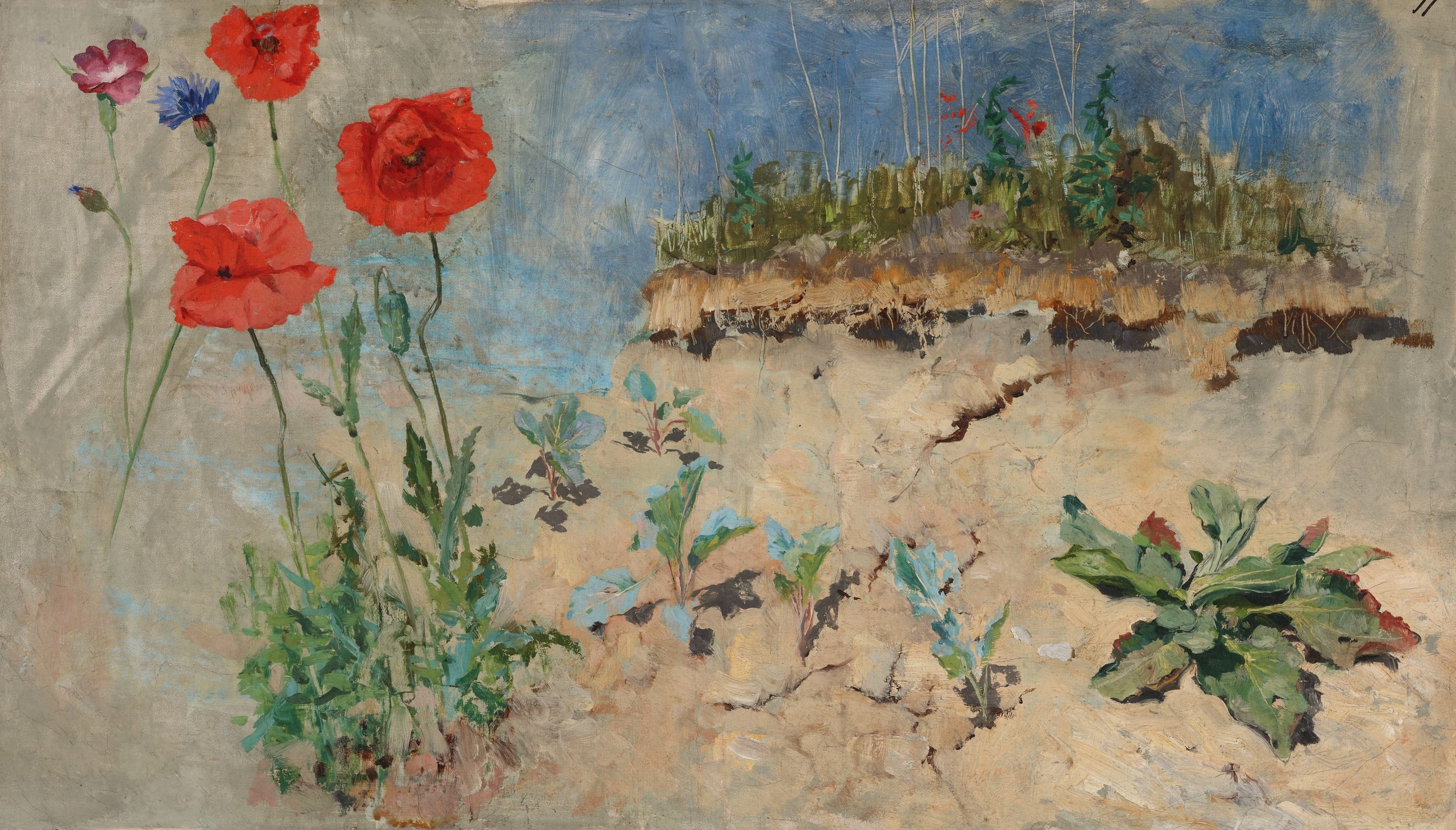
Mašić’s studies created in Posavina and Italy, mostly in the 1870s, can be understood within the tradition of the academic canon, in which travel to Italy and plein-air sketching formed an integral part of painterly education typical of the 19th century. This approach had particular resonance in the work of the international school of painting in Italy, epitomized by Jean-Baptiste Camille Corot. A crucial component of Mašić’s painting of this period is the Italian ‘inflected’ influence of Fortuny, the Catalan painter who had spent significant periods in Paris and Naples. Fortuny’s chromatic virtuosity and brilliance encountered the tradition of the international school and the Scuola di Resina in Naples and its surroundings, creating captivating and seductive hybrids. Fortuny’s impact is also discernible in selected examples of Mašić’s animal studies, as well as in studies featuring recurring motifs such as pumpkins, flowers, or boats—for instance, in his study of poppies from the final quarter of the 19th century. In this work, on a horizontal format, a fresh rendering of a rural landscape with red poppies appears along the left edge of the canvas, while the rest of the composition is devoted to the study of earthen ground and meadow vegetation.

Text: Ivana Rončević Elezović PhD, Senior Curator at the National Museum of Modern Art
© National Museum of Modern Art, Zagreb

Photo: Goran Vranić © National Museum of Modern Art, Zagreb

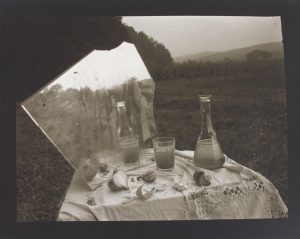
Josip Klarica, Still Life with Red Onion, 1979

Josip Klarica
Still Life with Red Onion, 1979
Contact Print, Camera Obscura
35.2 × 44.4 cm
MG-8597

Josip Klarica (Belgrade, 1946 – Zagreb, 2020) was one of the most important Croatian art photographers. He studied photography at the School of Applied Arts in Zagreb and film cinematography at the prestigious FAMU in Prague, where he became close to photographer Josef Sudek (Kolín, Czech Republic, 1896 – Prague, 1976). Klarica was renowned for his black-and-white images of still lifes, portraits, and landscapes, infused with a surreal and meditative atmosphere. In his work he employed antique cameras, including a camera obscura and a panoramic camera he reconstructed himself after an 1845 model by Friedrich von Martens (Venice, 1806 – Paris, 1885). He produced contact prints from his negatives, emphasizing the manual and authentic nature of the process. In addition to photography, he also engaged with film, propaganda, and the study of early photochemical techniques.
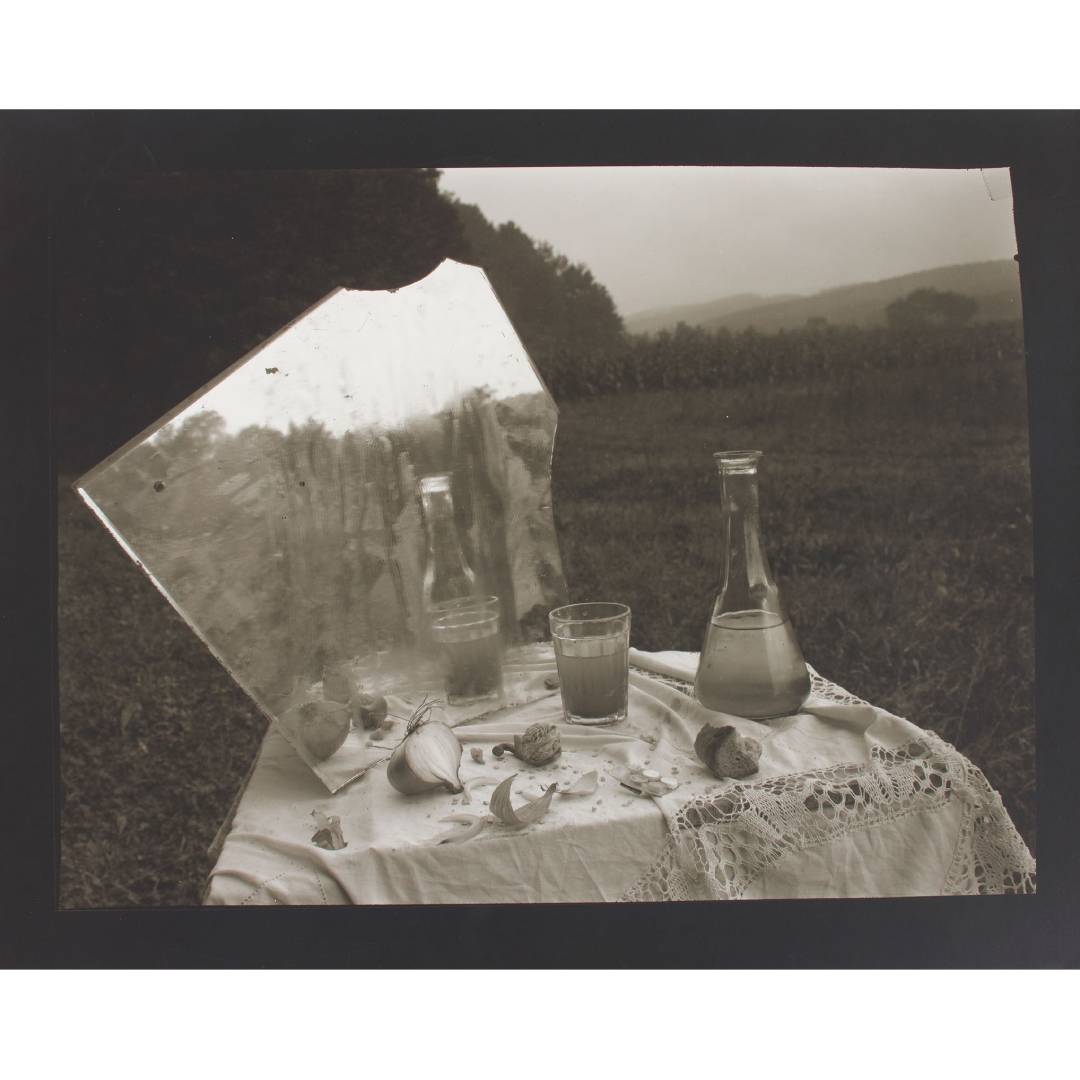
The Still Life cycle, created between 1976 and 1984, consists of sixteen meticulously conceived photographs in which classical still-life motifs intertwine with elements of landscape and metaphysical reflections on space. Among the most significant works is Still Life with Red Onion (1979). Everyday objects—a glass, bottles, walnuts, and garlic skins—are arranged on a table covered with a lace tablecloth, while a tilted mirror reflects fragments of the composition and the surrounding landscape, creating a multilayered play of perception, light, and space. The photograph conveys a quiet surrealism, subtle symbolism, and a contemplative atmosphere, underpinned by Klarica’s deliberate exploration of space, time, and materiality.

Text: Luciana Fuks, Trainee curator at the National Museum of Modern Art © National Museum of Modern Art, Zagreb
Reproduction copy: Goran Vranić © National Museum of Modern Art, Zagreb

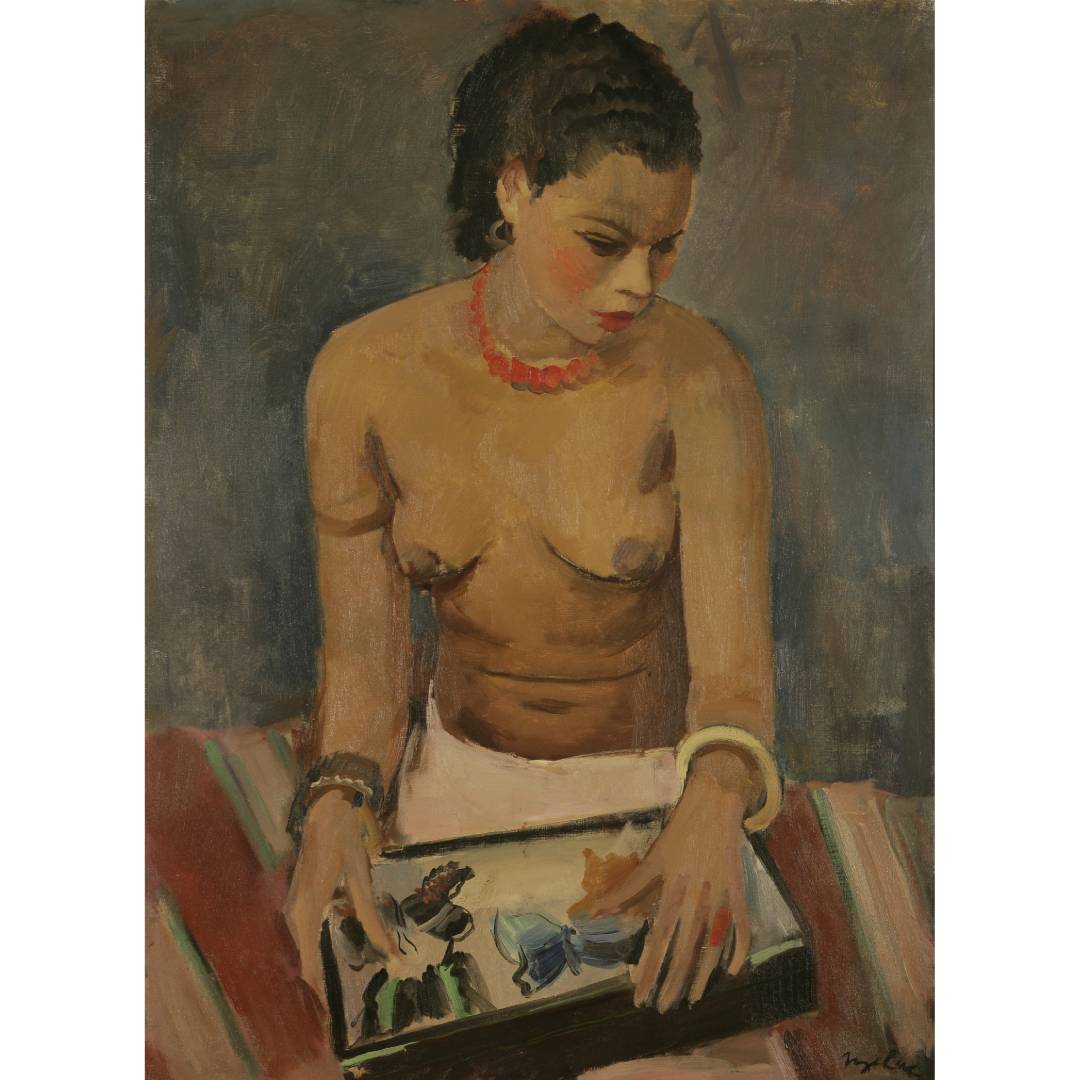
Milivoj Uzelac, Black Woman with Butterflies, 1932

Milivoj Uzelac
Black Woman with Butterflies, 1932
oil on canvas
108 × 81 cm
MG-998

Milivoj Uzelac (1897–1977) arrived in Zagreb in 1912, briefly studying printmaking with Tomislav Krizman, and between 1912 and 1914 attended the Temporary School for Arts and Crafts, studying painting under Oton Iveković. His studies were interrupted by the war, but in 1915 he fled military service and went to Prague, where he occasionally studied at the academy and worked in the studio of Jan Preisler. He returned to Zagreb in 1919, but not for long—by 1923 he had moved to Paris, where he spent most of his life until 1963, when he relocated to the estate of Pasto Sobre in southern France, where he remained until his death. Uzelac produced numerous drawings, book illustrations, murals (including the decorations for the Yugoslav Pavilion at the 1937 International Exposition in Paris), tapestry designs, posters, and theatre sets.
The painting Black Woman with Butterflies was inspired by his close relationship with African American pianist Alice Nardale. The painting depicts a semi-nude Black woman adorned with a large coral necklace and bracelets that accentuate the exoticised features of her appearance. Her serious facial expression and slightly lowered head suggest a state of introspection. Her hands rest on a table on which colourful butterflies are scattered, creating a visual contrast between the stillness of the figure and the dynamic, vibrant presence of the butterflies. The butterflies symbolise the fragility and transience of beauty, as well as transformation, reinforcing the exotic atmosphere. Their presence may also allude to the themes of freedom and entrapment—particularly resonant within the historical context of slavery and colonialism.
Uzelac developed a specific iconography of Black female bodies, producing numerous paintings and decorative panels for interiors, including Semi-Nude Black Woman (1932), Screen with Black Women (1934), and Black Dancer (1938). His figures are often de-individualised and typified, reflecting the racial stereotypes of the period with an emphasis on eroticism and the plasticity of bodies rendered into sculptural forms.

Text: Marta Radman, curator of the National Museum of Modern Art © National Museum of Modern Art, Zagreb
Translated by: Marta Radman
Photo: Goran Vranić © National Museum of Modern Art, Zagreb

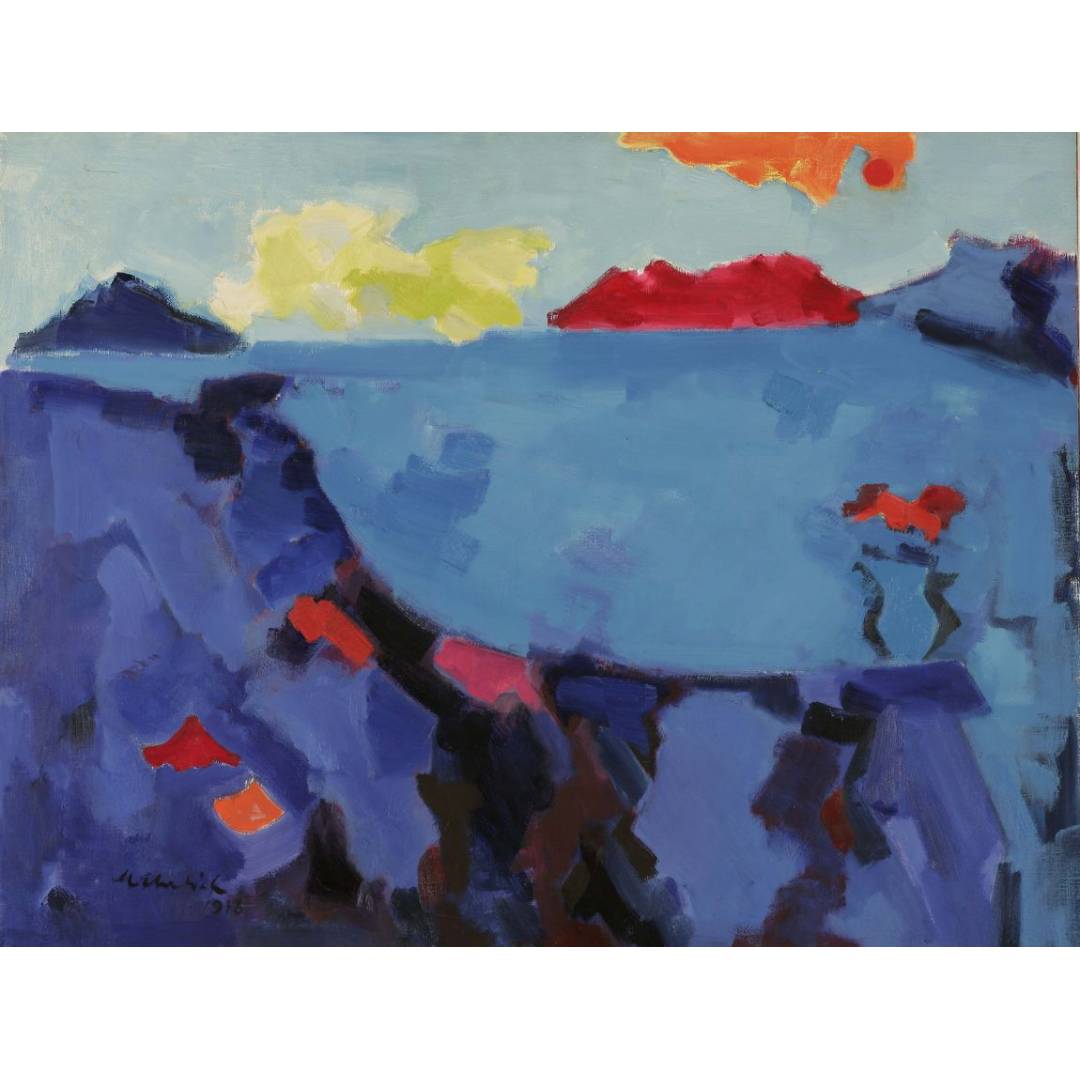
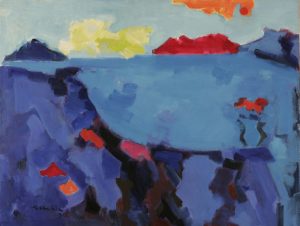
Marta Ehrlich, Early Morning on the Path by the Sea, 1978

Marta Ehrlich
Early Morning on the Path by the Sea, 1978
oil on canvas
65 × 85.3 cm
MG-4601

Marta Ehrlich (Zagreb, 1910 – 1980) was a prominent Croatian painter of the 20th century. She graduated in painting from the Academy of Fine Arts in Zagreb in 1934, having studied privately under Vladimir Becić, and spent the following year in Paris on a study visit. In the early phase of her career, she drew on Becić’s painterly influence, but in later years gravitated towards a surrealist poetics. Her work most often depicted cityscapes, landscapes, interiors, and still lifes, through which she developed an intimate and imaginative artistic expression.
During the 1960s, Ehrlich increasingly turned to ceramics, producing small-scale sculptures, painted tiles, and plates, while in her painting she embraced an abstract mode in the style of art informel.
The painting Early Morning on the Path by the Sea encapsulates the oeuvre of this Zagreb-born artist, who, during the 1970s, moved closer to abstract forms and pure, simplified planes rendered predominantly in shades of blue. The composition is dominated by blue tones that suggest a landscape motif with a marine horizon, while red and yellow surfaces introduce a powerful chromatic contrast. Fragmented planes are separated by thick applications of paint, creating a dynamic rhythm. Through free and almost gestural brushstrokes, the artist sought to interpret emotion and atmosphere, aligning herself with the aesthetics of lyrical abstraction. The work thus becomes a reflection of the artist’s inner, spiritual landscape.

Text: Luciana Fuks, Curatorial Assistant, National Museum of Modern Art © National Museum of Modern Art, Zagreb
Photo: Goran Vranić © National Museum of Modern Art, Zagreb
Menci Clement Crnčić, Marina, 1906

Menci Clement Crnčić
Marina, 1906
oil on canvas
44.5 × 65 cm
MG-440

Menci Clement Crnčić (Bruck an der Mur, Austria, 1865 – Zagreb, 1930) was a Croatian painter and printmaker trained in Vienna and Munich, where he embraced the realist principles of the Munich School. Upon his return to Zagreb, he co-founded a painting school with Bela Čikoš Sesija, which would form the foundation of the future Academy of Fine Arts. He remained a professor there until his death and, between 1920 and 1928, also served as Director of the Strossmayer Gallery of Old Masters.
Crnčić’s early work consists of psychologically nuanced portraits and figurative compositions. He later developed a distinctive approach to landscape painting, particularly in his views of Adriatic marinas. As the first Croatian artist to systematically explore the marina as a subject, his primary focus lay in capturing the sea bathed in daylight, framed within a realist sensibility.
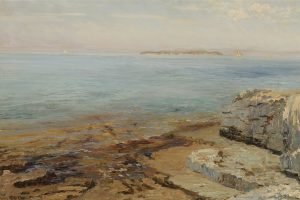
The 1906 painting Marina exemplifies this vision. Composed horizontally, it emphasises open space and the tranquil expanse of the sea. Muted yet true-to-life colours evoke the natural atmosphere: blue and turquoise tones dominate the water, while the foreground blends earthy browns, greys, and reddish hues of coastal rocks and the seabed. The brushwork is free yet deliberate, with visible layers of pigment enriching the surface texture. The perspective unfolds gradually—from the precisely rendered foreground to the softened silhouettes of islands and sailboats in the distance. Stripped of narrative elements, the work is dedicated entirely to the visual exploration of light, space, and atmosphere.

Text: Luciana Fuks, Curatorial Trainee, National Museum of Modern Art © National Museum of Modern Art, Zagreb
Photo: Goran Vranić © National Museum of Modern Art, Zagreb
Henryk Siemiradzki, Study of a Woman’s Head, 1874

Henryk Siemiradzki
Study of a Woman’s Head, 1874
oil on canvas
26 × 19.2 cm
MG-145

Henryk Siemiradzki (Novogrudok near Kharkiv, 1848 – Strzałkowo near Częstochowa, 1902) was one of the foremost Polish painters of the late 19th century, celebrated for his monumental figurative compositions inspired by themes from ancient history, mythology, and the Bible. After completing studies in natural sciences in 1864, he turned entirely to art, graduating in painting from the Imperial Academy of Arts in St Petersburg in 1871. Following a brief period in Munich, he settled permanently in Rome, where he produced the majority of his most significant works. Siemiradzki’s oeuvre reflects the ideals of classical beauty, academic precision, and a rich, nuanced palette, firmly establishing him as a leading figure of late academicism.
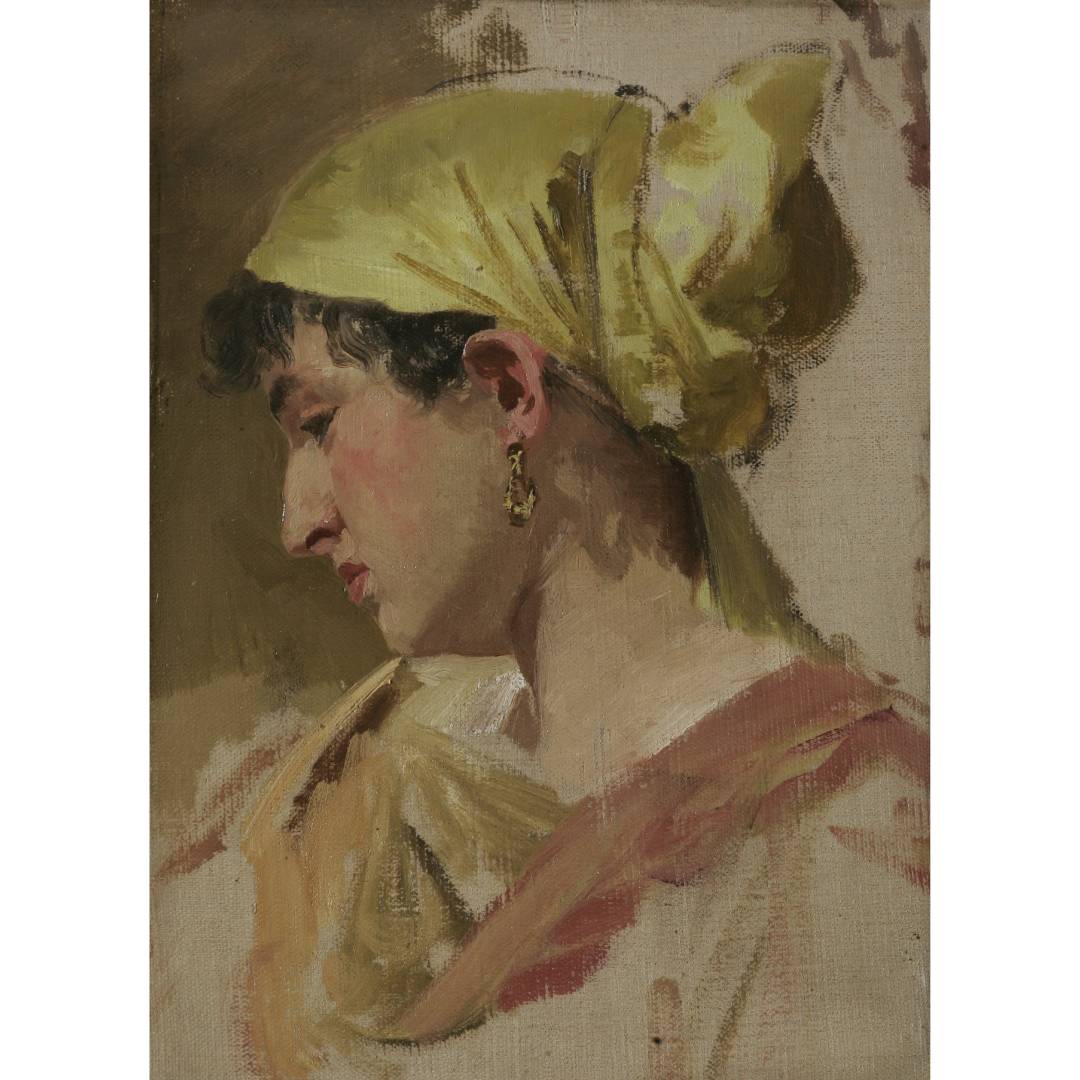
Alongside his grand historical and mythological scenes, Siemiradzki also produced landscapes and portraits, among which Study of a Woman’s Head occupies a distinctive place. Though modest in scale and conceived as a study, the work reveals his technical virtuosity and refined sense of visual expression. The profile of a young woman, her head wrapped in a yellow-green scarf, emanates both simplicity and understated psychological depth. The face is modelled with soft yet assured brushstrokes, while the fabric and background remain partly sketch-like, lending the composition an immediacy and freshness. This portrait encapsulates the artist’s sensitivity to atmosphere and the quiet beauty of everyday subjects, as well as his mastery of form, light, and texture. The synthesis of classical discipline and painterly vitality makes the work a rare and intimate glimpse into his creative process and artistic vision.

Text: Luciana Fuks, Curatorial Trainee, National Museum of Modern Art © National Museum of Modern Art, Zagreb
Photo: Goran Vranić © National Museum of Modern Art, Zagreb
Gustav (Haueise) Likan, Memory of Dalmatia, 1990

Gustav (Haueise) Likan
(1910–1998)
Memory of Dalmatia, 1990
acrylic on canvas
50 × 71 cm
MG – 6231

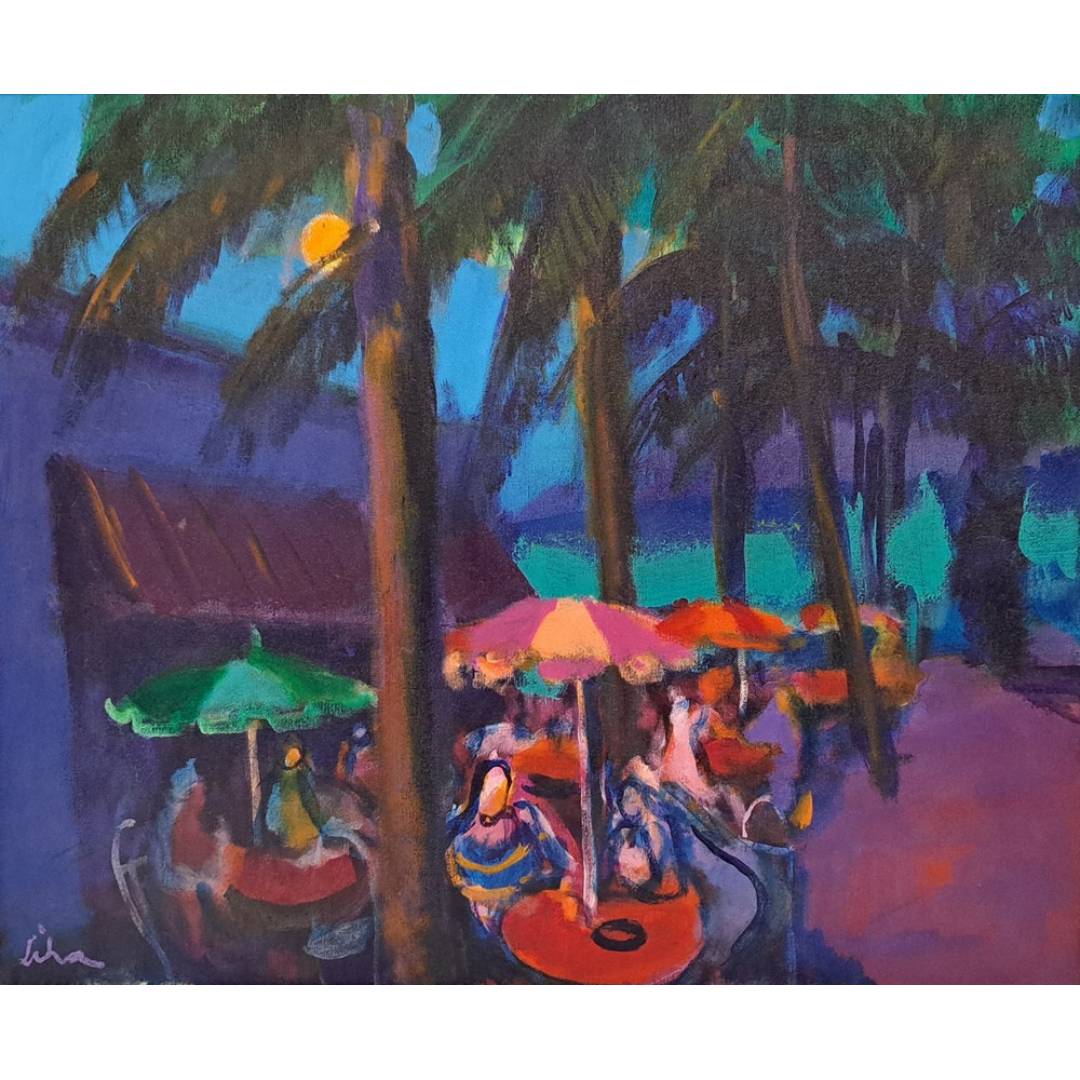
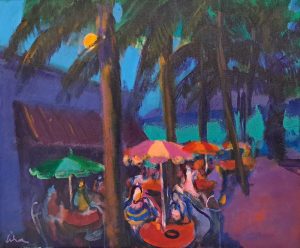
In Memory of Dalmatia, Gustav Likan evokes a Mediterranean atmosphere through a decoratively composed depiction of a summer seaside terrace. Dominant motifs such as tables under umbrellas, palm trees, and human figures are rhythmically arranged in a space that suggests tranquility and nostalgia. Intense colors, simplified forms, and strong contrasts are characteristic of Likan’s mature period. The palette is dominated by purples, reds, greens, and blues, while stylized figures and objects contribute to the atmosphere of imagined memory.
The painting retains a narrative potential and figurative clarity, yet its flattened space and decorative use of color bring it close to the poetics of coloristic expressionism. Likan does not depict a scene as a literal record of what is seen, but rather as an emotional echo of the space of childhood and belonging. Hovering between dream and reality, this work evokes the Mediterranean identity and warmth of a place that remained an inexhaustible source of inspiration for the artist.
Gustav Likan studied at the Academy of Fine Arts in Munich and worked in Zagreb, Salzburg, Buenos Aires, and the United States. In his early work, he drew on the painting traditions of the old masters, while after moving to America he developed a distinctive colorist style based on acrylic surfaces of vivid colors and stylized forms. He was active as a painter, educator, and illustrator, and his works are preserved in numerous Croatian and international collections.

Text: Lorena Šimić, curator / museum educator at the National Museum of Modern Art © National Museum of Modern Art, Zagreb
Photo: Goran Vranić © National Museum of Modern Art, Zagreb
Petar Dobrović, Fisherman (Worker), 1921

Petar Dobrović
Fisherman (Worker), 1921
oil on canvas
77 × 69 cm
MG-1472

Petar Dobrović (1890–1942) studied painting in Budapest from 1909 to 1911. In his hometown of Pécs, he maintained close ties with the writer Miroslav Krleža, whose influence proved formative for his artistic development. From 1912 to 1914, Dobrović lived in Paris, where he produced a series of drawings marked by Cézannesque and Cubist influences. In 1926, he co-founded the art group Oblik in Belgrade and later participated in the establishment of the Academy of Fine Arts, where he began teaching in 1937. His summer stays on the Adriatic coast, particularly on Hvar and in Dubrovnik, resulted in numerous landscapes and portraits in oil and watercolour. Dobrović’s painting is especially shaped by the colourist realism of the 1930s.
The painting Fisherman (Worker) from 1921 depicts a young man seated in an armchair, hands folded in his lap, positioned in an interior setting. The figure is rendered in a muted palette, with soft transitions between tones, creating a calm, meditative atmosphere. Dobrović’s approach blends stylistic elements of Realism and Expressionism, and within the context of representing otherness, the work may be viewed as a portrayal of the “other” within the social fabric- of a worker, a fisherman, whose life and labour were often marginalized in art.

Text: Marta Radman, curator of the National Museum of Modern Art © National Museum of Modern Art, Zagreb
Translated by: Marta Radman
Photo: Goran Vranić © National Museum of Modern Art, Zagreb

Franz Jaschke Trsat / View of the Ruins and the Franciscan Monastery on Trsat, 1st quarter of the 19th century

Franz Jaschke
Trsat / View of the Ruins and the Franciscan Monastery on Trsat, 1st quarter of the 19th century
gouache on paper
44.2 x 63 cm
MG-3

Franz Jaschke (Rosenthal near Klodzko, 1775 – Vienna, 1842), an Austrian painter born in Rosenthal, left a significant mark in the artistic depiction of Croatian landscapes and urban scenes in the early 19th century. He studied at the Academy of Fine Arts in Vienna from 1794, where he adopted the solid foundations of Classicist aesthetics, particularly within the framework of Austrian topographical-veduta painting. As a court painter to Archdukes Ludwig and Rainer, Jaschke traveled through various parts of Croatia on several occasions — notably in 1807, 1808, and 1810. During these journeys, he recorded landscapes, towns, and people in watercolors and drawings characterized by exceptional documentary and artistic value. His works include views of the fortresses in Gradiška and Brod, panoramas of Trsat and Rijeka, as well as natural beauties such as the source of the Una River.
Jaschke stayed in Rijeka during the 1830s, and his interest in the local environment was translated into meticulously crafted compositions that combine topographical accuracy with the harmonious balance of Classicist composition. This approach is evident in his veduta depicting the Franciscan monastery on Trsat, situated on a hilltop and surrounded by a terraced landscape and a valley with a winding river. In addition to the monastery, the ruins of the Trsat Castle are also shown, making this a historically valuable portrayal of the area at the time. By including a figure in traditional folk costume, the painting further captures the identity and spirit of the region.

Text: Luciana Fuks, trainee curator at the National Museum of Modern Art © National Museum of Modern Art, Zagreb
Photo: Goran Vranić © National Museum of Modern Art, Zagreb
Robert Auer, Love, 1912

Robert Auer
(1873 – 1952)
Love, 1912
oil on canvas
249.6 x 184.8 cm
MG-361

In the painting Love, Robert Auer presents a group of figures in an almost surreal, densely packed composition where youth and old age, beauty and grotesqueness, life and death intertwine. At the center of the painting is a pair of young lovers, whose tender touch and closed eyes suggest emotional intimacy as well as detachment from reality. Around them unfold a variety of characters and expressions, ranging from seductive, smiling women to distorted faces and aged bodies, through which the artist constructs an allegorical narrative about the transience of life.
Auer employs a rich, dark palette in contrast with the light tones of the sky and the upper figures’ garments, creating a dynamic atmosphere filled with symbolic depth. The rendering of bodies and faces reveals the influence of Art Nouveau and the Viennese school of painting, while the layered composition and psychological tension point toward a symbolist approach. Particular attention is given to expression, movement, and the texture of fabrics, all of which demonstrate Auer’s exceptional technical skill and eye for detail.
Robert Auer was one of the leading Croatian painters of the late 19th and early 20th centuries, and a professor at the Royal Higher School for Art and Applied Arts (today the Academy of Fine Arts in Zagreb). His works often explore themes of beauty, sensuality, and inner spiritual states. This painting reveals Auer’s ability to unite classical painterly excellence with modern spiritual and existential concerns.

Text: Lorena Šimić, curator / museum educator at the National Museum of Modern Art © National Museum of Modern Art, Zagreb
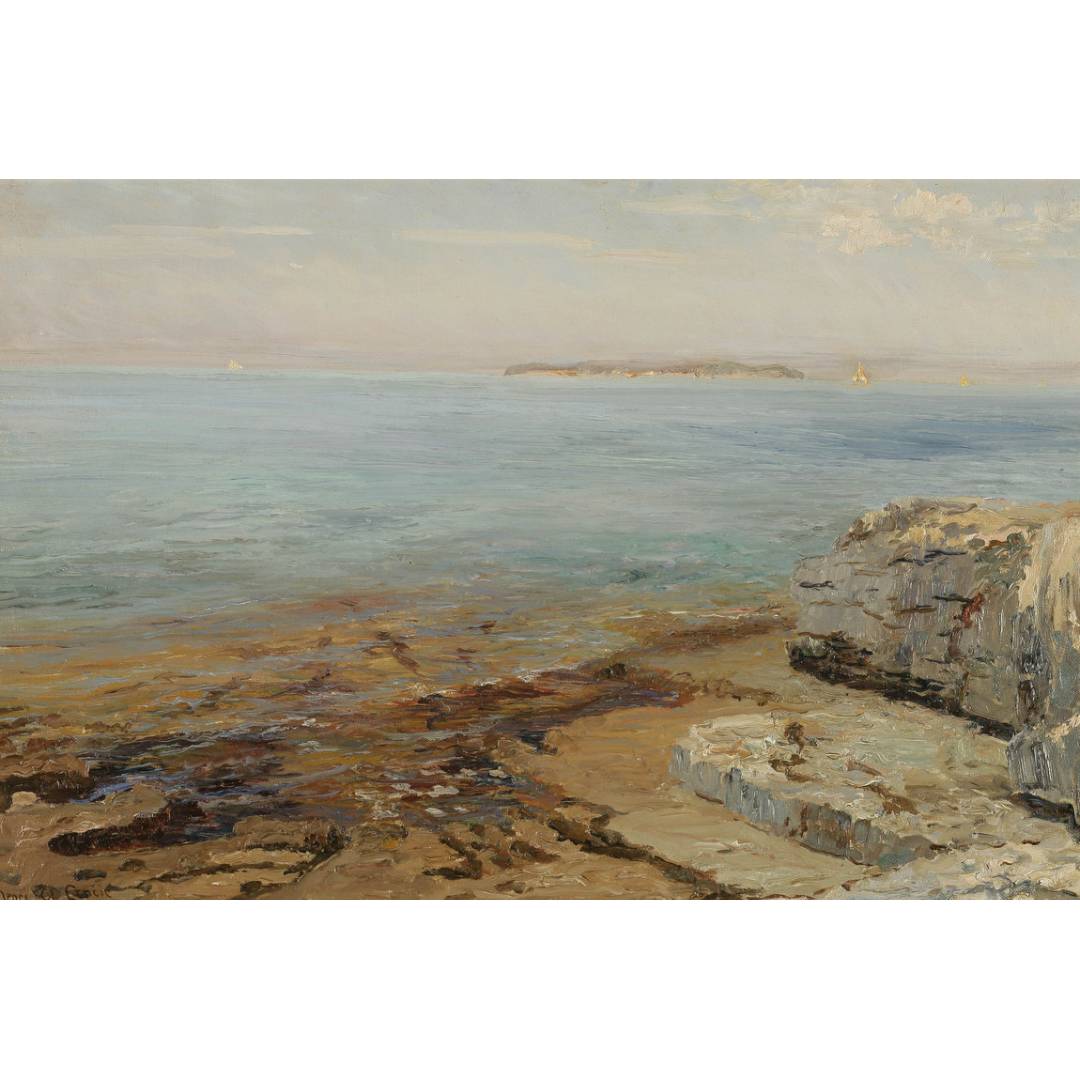
Photo: Goran Vranić © National Museum of Modern Art, Zagreb