Henryk Siemiradzki
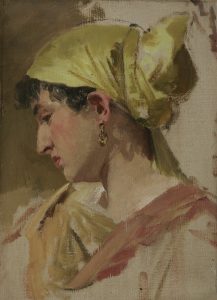
Study of a Woman’s Head, 1874
oil on canvas
26 × 19.2 cm
MG-145
Henryk Siemiradzki (Novogrudok near Kharkiv, 1848 – Strzałkowo near Częstochowa, 1902) was one of the foremost Polish painters of the late 19th century, celebrated for his monumental figurative compositions inspired by themes from ancient history, mythology, and the Bible. After completing studies in natural sciences in 1864, he turned entirely to art, graduating in painting from the Imperial Academy of Arts in St Petersburg in 1871. Following a brief period in Munich, he settled permanently in Rome, where he produced the majority of his most significant works. Siemiradzki’s oeuvre reflects the ideals of classical beauty, academic precision, and a rich, nuanced palette, firmly establishing him as a leading figure of late academicism.
Alongside his grand historical and mythological scenes, Siemiradzki also produced landscapes and portraits, among which Study of a Woman’s Head occupies a distinctive place. Though modest in scale and conceived as a study, the work reveals his technical virtuosity and refined sense of visual expression. The profile of a young woman, her head wrapped in a yellow-green scarf, emanates both simplicity and understated psychological depth. The face is modelled with soft yet assured brushstrokes, while the fabric and background remain partly sketch-like, lending the composition an immediacy and freshness. This portrait encapsulates the artist’s sensitivity to atmosphere and the quiet beauty of everyday subjects, as well as his mastery of form, light, and texture. The synthesis of classical discipline and painterly vitality makes the work a rare and intimate glimpse into his creative process and artistic vision.
Text: Luciana Fuks, Curatorial Trainee, National Museum of Modern Art © National Museum of Modern Art, Zagreb
Photo: Goran Vranić © National Museum of Modern Art, Zagreb