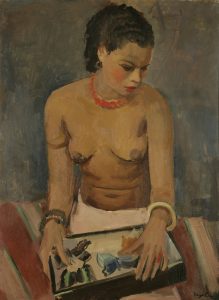
Milivoj Uzelac
Black Woman with Butterflies, 1932
oil on canvas
108 × 81 cm
MG-998
Milivoj Uzelac (1897–1977) arrived in Zagreb in 1912, briefly studying printmaking with Tomislav Krizman, and between 1912 and 1914 attended the Temporary School for Arts and Crafts, studying painting under Oton Iveković. His studies were interrupted by the war, but in 1915 he fled military service and went to Prague, where he occasionally studied at the academy and worked in the studio of Jan Preisler. He returned to Zagreb in 1919, but not for long—by 1923 he had moved to Paris, where he spent most of his life until 1963, when he relocated to the estate of Pasto Sobre in southern France, where he remained until his death. Uzelac produced numerous drawings, book illustrations, murals (including the decorations for the Yugoslav Pavilion at the 1937 International Exposition in Paris), tapestry designs, posters, and theatre sets.
The painting Black Woman with Butterflies was inspired by his close relationship with African American pianist Alice Nardale. The painting depicts a semi-nude Black woman adorned with a large coral necklace and bracelets that accentuate the exoticised features of her appearance. Her serious facial expression and slightly lowered head suggest a state of introspection. Her hands rest on a table on which colourful butterflies are scattered, creating a visual contrast between the stillness of the figure and the dynamic, vibrant presence of the butterflies. The butterflies symbolise the fragility and transience of beauty, as well as transformation, reinforcing the exotic atmosphere. Their presence may also allude to the themes of freedom and entrapment—particularly resonant within the historical context of slavery and colonialism.
Uzelac developed a specific iconography of Black female bodies, producing numerous paintings and decorative panels for interiors, including Semi-Nude Black Woman (1932), Screen with Black Women (1934), and Black Dancer (1938). His figures are often de-individualised and typified, reflecting the racial stereotypes of the period with an emphasis on eroticism and the plasticity of bodies rendered into sculptural forms.
Text: Marta Radman, curator of the National Museum of Modern Art © National Museum of Modern Art, Zagreb
Translated by: Marta Radman
Photo: Goran Vranić © National Museum of Modern Art, Zagreb