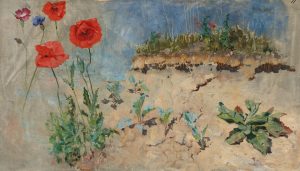
Nikola Mašić
Poppy, last quarter of the 19th century
oil on canvas
30.7 × 53.8 cm
MG-205
After attending the Munich Academy, where in 1877 he encountered the painting approach of Primamalerei under the tutelage of Wilhelm von Lindenschmit, the oeuvre of Nikola Mašić (1852–1902) can be divided into three phases. The first was his stay in Paris, with sources variously citing 1877, 1879, and most often 1878 as the year of his initial visit. Periodical publications and literature to date generally mention the Académie Julian and the studio of Adolphe William Bouguereau as the main venues of Mašić’s artistic training, although this has been disputed by Kršnjavi and Babić. Even so, both authors acknowledge that Bouguereau “reviewed Mašić’s sketches and studies,” despite the fact that Mašić was never officially enrolled as his pupil. In any case, his time in Paris is associated with the growing influence of the artistic legacy of the late Mariano José María Fortuny y Marsal on his painting.
The second phase was the so-called Posavina and Italian intermezzo, from the autumn of 1878 to the autumn of 1880. Although Mašić had already visited Posavina and sketched there earlier (from 1876 onward), this period is defined by the dating of his studies painted directly from nature. The third phase began after his return from Italy in 1880, when he eventually settled permanently in Zagreb a few years later. In 1884 he was appointed a teacher at the School of Crafts, where he remained—with short interruptions—until the end of his life, serving also as director of the Strossmayer Gallery from 1894 onward.
Mašić’s studies created in Posavina and Italy, mostly in the 1870s, can be understood within the tradition of the academic canon, in which travel to Italy and plein-air sketching formed an integral part of painterly education typical of the 19th century. This approach had particular resonance in the work of the international school of painting in Italy, epitomized by Jean-Baptiste Camille Corot. A crucial component of Mašić’s painting of this period is the Italian ‘inflected’ influence of Fortuny, the Catalan painter who had spent significant periods in Paris and Naples. Fortuny’s chromatic virtuosity and brilliance encountered the tradition of the international school and the Scuola di Resina in Naples and its surroundings, creating captivating and seductive hybrids. Fortuny’s impact is also discernible in selected examples of Mašić’s animal studies, as well as in studies featuring recurring motifs such as pumpkins, flowers, or boats—for instance, in his study of poppies from the final quarter of the 19th century. In this work, on a horizontal format, a fresh rendering of a rural landscape with red poppies appears along the left edge of the canvas, while the rest of the composition is devoted to the study of earthen ground and meadow vegetation.
Text: Ivana Rončević Elezović PhD, Senior Curator at the National Museum of Modern Art
© National Museum of Modern Art, Zagreb
Photo: Goran Vranić © National Museum of Modern Art, Zagreb