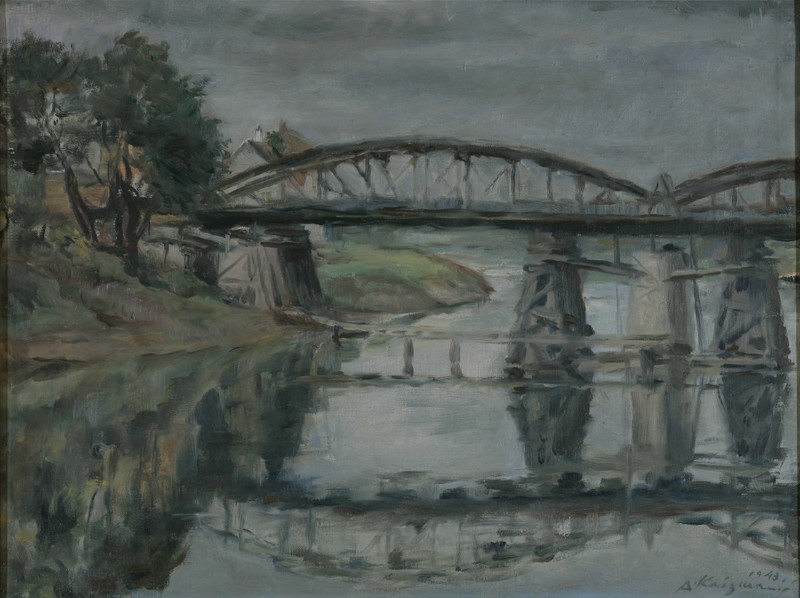
Anka Krizmanić, Bridge in Karlovac, 1943.

Anka Krizmanić
Bridge in Karlovac
1943
oil, canvas
45,5 x 58,6 cm (67 x 81 cm)
inv. br. MG-1208

Anka Krizmanić (1896-1987) attended Tomislav Krizman’s private painting school (1910-13) at the age of fourteen and she exhibited with Medulić Group. She studied at Kunstgewerbeschule in Dresden (1913-17) where she was introduced to lithography, modern dance and Expressionism and in Paris during her study stay (1920-30). Her work consisted of made paintings, graphic arts, tapestries, fashion design and sketches for puppet theater.

Prior to World War II and then again from 1946 to 1951, she worked as illustrator at the Faculty of Medicine at the Institute for Anatomy. She was a member of the Association of Fine Artists of Croatia (ULUH) from 1945. Her Complete Catalogue of Works, in which she wrote down all her works since 1908, concluded with the number 5761 in 1971. Her retrospective exhibition was held in Zagreb in 1986.

“Bridge in Karlovac” from 1943 was created during the period when the artist lived in Karlovac during the wartime with the German painter Ludwig Weninger, painting landscapes in Karlovac and the surrounding towns. In it we see the influence of her Dresden schooling, especially by Margaret Junge who encouraged Anka to pain in plein air. Nature left a big mark on her and Anka brought back magical realism to Croatian Art - represented by landscapes in big dimensions, monumental forms, clear constructions and deep green hues.

Text: Stella Baki, curator / museum educator at the National Museum of Modern Art Zagreb
Photo: Goran Vranić © National Museum of Modern Art, Zagreb
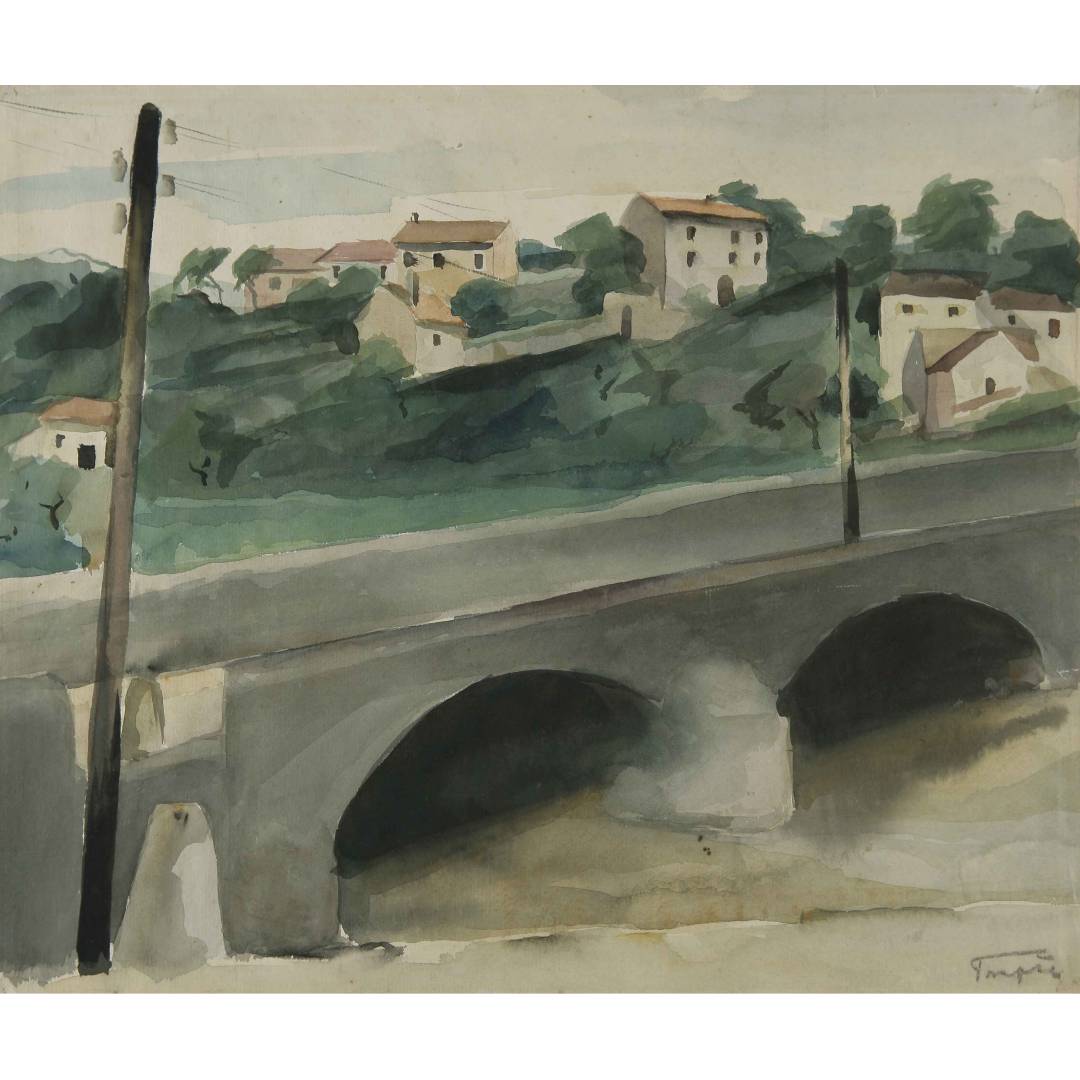
Marijan Trepše, Landscape with Bridge, 1919

Marijan Trepše
Landscape with Bridge, 1919
watercolor on paper
31,9 x 37,9 cm (50 x 70 cm)
inv. br. MG-1098

Marijan Trepše (1897-1964) is one of the key artists in Croatian Expressionism and Modernism between two world wars. He got a degree in painting in Zagreb in 1918 and later on went to Prague where he created works under the influence of Expressionism, Cubism and Cézanne. He was one of the ‘Prague Four’ including Miliboj Uzelac, Vilko Gecan and Vladimir Varlaj with whom he exhibited at the Spring Salon that radically changed Croatian art. Trepše was also a famous set designer for the National Theatre in Zagreb.
“Landscape with Bridge” from 1919 depicts a bridge surrounded by buildings in the foreground. The Expressionist approach is visible in the depiction of the space and the rhythm of the composition. Using watercolor to define the space and light for the atmosphere, the painting is reduced to basic elements and wide brush strokes. The stylised treatment of volume indicates a high mastery in the medium of watercolors and the use of colors which are cold gray and green with beige details.

Text: Stella Baki, curator / museum educator at the National Museum of Modern Art Zagreb
Photo: Goran Vranić © National Museum of Modern Art, Zagreb
📍 This artwork is currently on display as part of the exhibition Bridges of Promise, from the NMMU on Tour series, at Gradska galerija Striegl

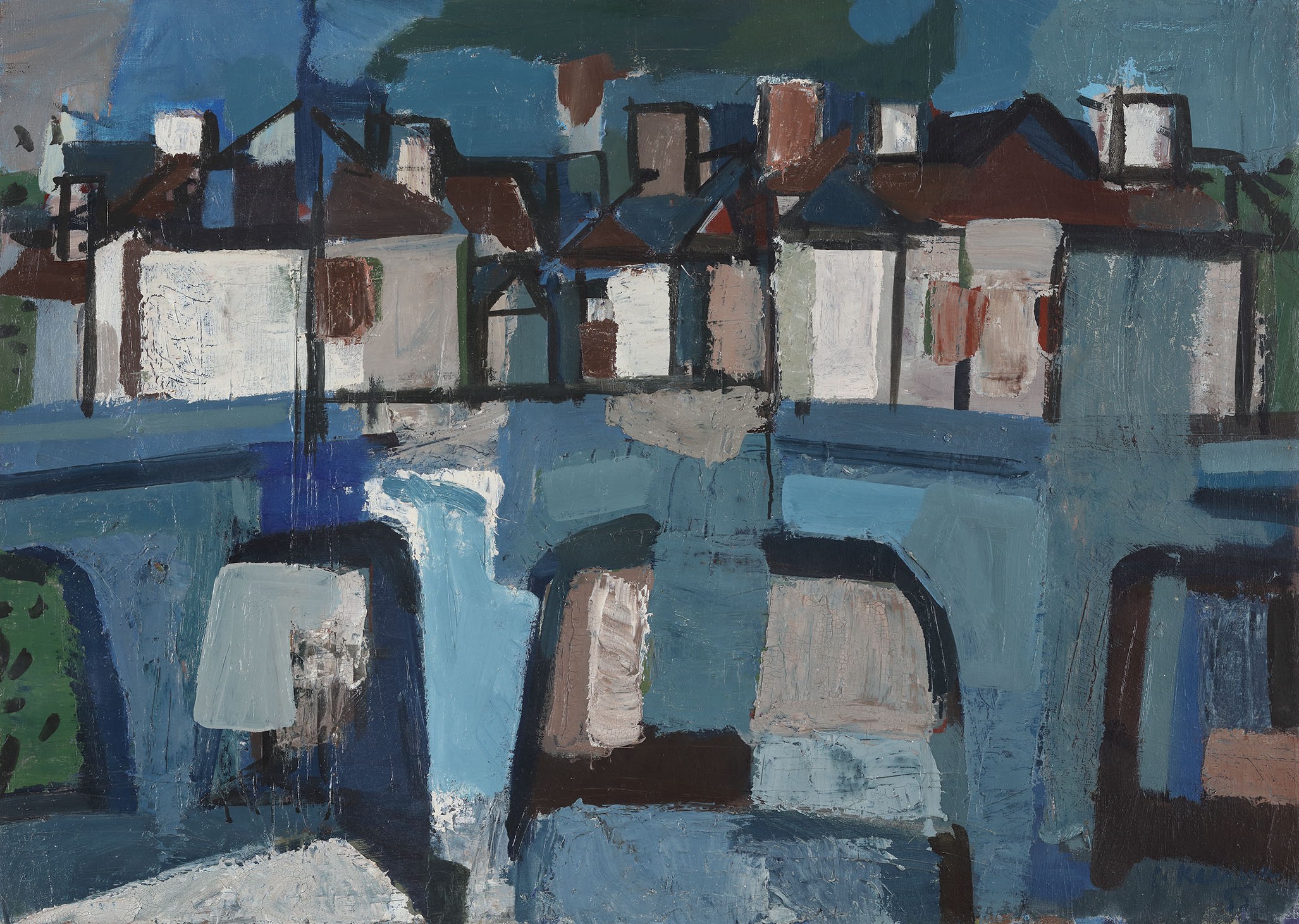
Ivo Kalina, Underpass, 1955

Ivo Kalina
Underpass, 1955
oil, canvas
71,1 x 97,9 cm (72 x 99 cm)
MG-2255

Ivo Kalina (1925-1995) graduated at the Academy of Arts in Zagreb, was part of Kristo Hegedušić’s master workshop and founder of the Mart Group and the Group of Six. One of the first painters painting in the Abstract Expressionist style and Art Enformel. He created unique collages in contemporary Croatian art followed by black and white landscapes.
Painting “Underpass” from 1955 is characteristic of its voluminous, reduced painting Kalina developed during the 1950s right before his period in Geometric Abstraction. Wide brushstrokes and strong gestures set within a wide shot were characteristic of Kalina’s oeuvre.
His first exhibition was held in 1958 at the Student Club in Zagreb. He lived in Rijeka from 1963 where Berislav Valušek arranged a retrospective exhibition in 1994. His second retrospective exhibition was held in the Art Pavillion in Zagreb in 2006.

Text: Stella Baki, curator / museum educator at the National Museum of Modern Art Zagreb
Photo: Goran Vranić © National Museum of Modern Art, Zagreb

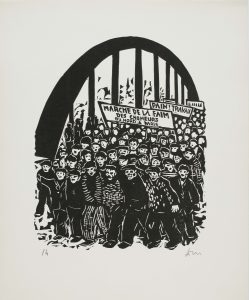
Marijan Detoni, Print Portfolio “People from Seine” / Sheet 14, 1934

Marijan Detoni
Print Portfolio "People from Seine" / Sheet 14, 1934
linocut, paper
30 x 25 cm (46 x 33 cm)
MG-6728-14

Marijan Detoni (1905-1981) graduated at the Academy of Arts in Zagreb in 1928 under Ljubo Babić, further specializing in graphic art under Tomislav Krizman. He was a professor at the Academy of Arts in Zagreb and is considered one of the most important graphic artists of his time.
He was a member of Earth Group and he was one of the most famous artists creating socially charged art. During his stay in Paris during the 1930s he depicted the decrepit state of the metropolis, especially the lives of the poor living near the Seine. Using simple compositions and colors he portrayed the poor, homeless, hungry and the jobless. The print portfolio “People from Seine” was published in 1934 and contains 30 linocut sheets. Sheet 14 depicts a hunger strike in Paris in 1933 from fired miners from the north of France, holding transparents demanding employment and food.
The composition of the work is defined by the bridge looming over the bodies of the strikers freezing in thin coats with haggard faces that resemble faces of dead men or skeletons with crudely indicated cheekbones, hollow sockets for eyes and slashes for mouths.

Text: Stella Baki, curator / museum educator at the National Museum of Modern Art Zagreb
Photo: Goran Vranić © National Museum of Modern Art, Zagreb
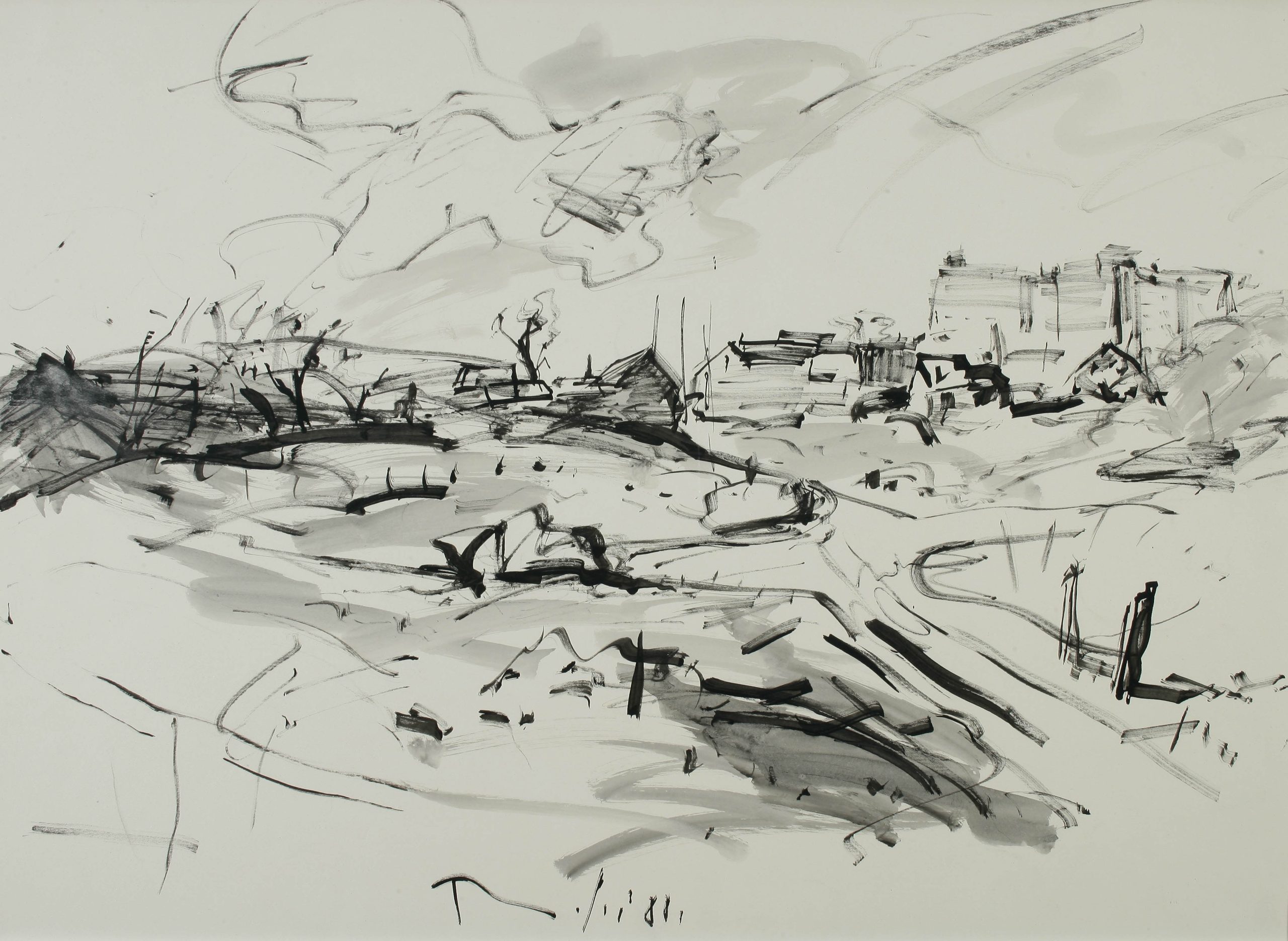
Looking towards Prečko, 1988.

Davorin Radić
Looking towards Prečko, 1988.
ink wash on paper
50 x 70 cm (63 x 81,8 cm)
inv. br. MG-7156

Davorin Radić (1957) became part of the master workshop of Ljubo Ivančić and Nikola Reiser after graduating at the Academy of Arts in Zagreb in 1983 under Vasilije Jordan. He has been teaching painting at the School of Applied Arts and Design in Zagreb.
He founded the group Contra in 1998 and Đuro Vanđura wrote his art monograph in 1997 while Ivana Reberski wrote another in 2016. His first works were influenced by Old Masters but he continued creating in the Neo-Expressionist style, painting landscapes, portraits, still lives and mythological scenes.
In his work “Looking towards Prečko” he depicts the atmosphere of an urban scene, capturing it with ink on paper in an authentic way. The shapes are set inside a perspective while the water and sky are depicted with splotchy, watery brushstrokes. The landscape is depicted from a higher viewing point with fast brushstrokes.

Text: Stella Baki, curator / museum educator at the National Museum of Modern Art Zagreb
Photo: Goran Vranić © National Museum of Modern Art, Zagreb
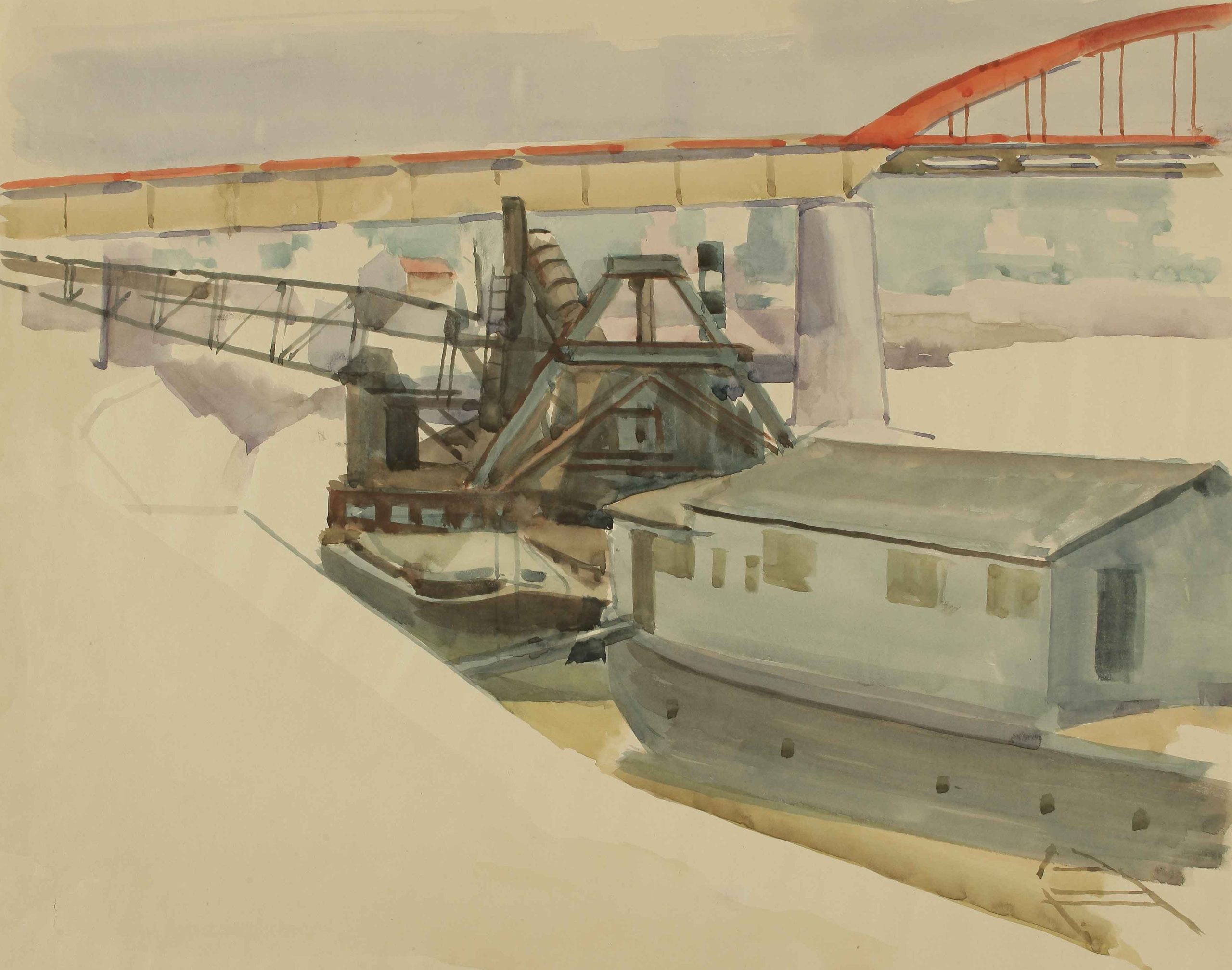
Đuro Tiljak, Under the Bridge, s.a.

Đuro Tiljak
Under the Bridge, s. a.
watercolor on paper
35,2 x 44,1 cm (50 x 70 cm)
MG-3558

Đuro Tiljak (1895– 1965) attended the Academy of Arts in Moscow in 1919 under Vasily Kandinsky and graduated in 1923 under Ljubo Babić in Zagreb. His first introduction to French Post-Impressionists in the Tretyakov Gallery was the reason he continued his studies in Paris during 1928.
After his studies in Paris he started exhibiting with Earth Group (1930-1933), creating socially engaged artworks. In 1942 he joined the Partisans and created posters and newspapers for the movement. Tiljak’s expressive drawings were created in the south of Italy, documenting the suffering of displaced civilians. He taught at the Academy of Arts in Zagreb from 1945.
His paintings varied from early watercolors, paintings of magical realism during the 1930s, dramatic wartime depictions to later poetic landscapes made in watercolor. The unfinished look of the watercolor “Under the Bridge” depicts an everyday scene broken down to geometric shapes tonally defined with color. In the foreground boats on the river are depicted in cold blue and green tones while the red color of the bridge breaks the simplicity of the background.

Text: Stella Baki, curator / museum educator at the National Museum of Modern Art Zagreb
Photo: Goran Vranić © National Museum of Modern Art, Zagreb
Emanuel Vidović, Giudecca (Venice), circa 1905 (?)

Emanuel Vidović
Giudecca (Venice), circa 1905 (?)
oil on canvas
92,2 x 130 cm (104,5 x 143 cm)
inv. br. MG-578

One of most important painters of Croatian Modernism, Emanuel Vidović (1870-1953) started his artistic education in Split with painter Emilio Vecchietti. In 1887 he started his studies in sculpture at the Accademia di Belle Arti in Venice, changing to painting but then shortly leaving in 1890 disappointed by the conservative approach. He completely dedicated himself to painting Venetian canals and lagoons. After ten years spent in Venice, Milano and Chioggia Vidović returned to Split in 1907 and remained there for the rest of his life. He created constantly while teaching in School of Crafts from 1909 and was one of the founders of group Medulić which impacted our artistic and cultural scene.
The ambience of Venetian canals and the picturesque fisherman’s village Chioggia had a big impact on the art of Emanuel Vidović. The influence of Venetian landscapes like those of Guglielmo Ciardi and the plein air works of macchiaiola painters (Tuscan artists painting in short patchy brushstrokes) are visible in his formative stage.
“Giudecca (Venice)” depicts a classic motif from Vidović - Venetian gondolas tied to the edge of the canal, the bridges and recognisable Venetian architecture. One thing that stands out is the reflection in the canal water that does not match the painted architecture. It is probable that the painter changed one part of the painting and then intentionally or not forgot to match the reflection in the canal water. The mystical atmosphere and the dark colors marked with a deep dark red of the building’s facade and the tree tops reflect in the dark blue canal water. The brush strokes are applied thickly and fast.

Text: Stella Baki, curator / museum educator at the National Museum of Modern Art Zagreb
Photo: Goran Vranić © National Museum of Modern Art, Zagreb
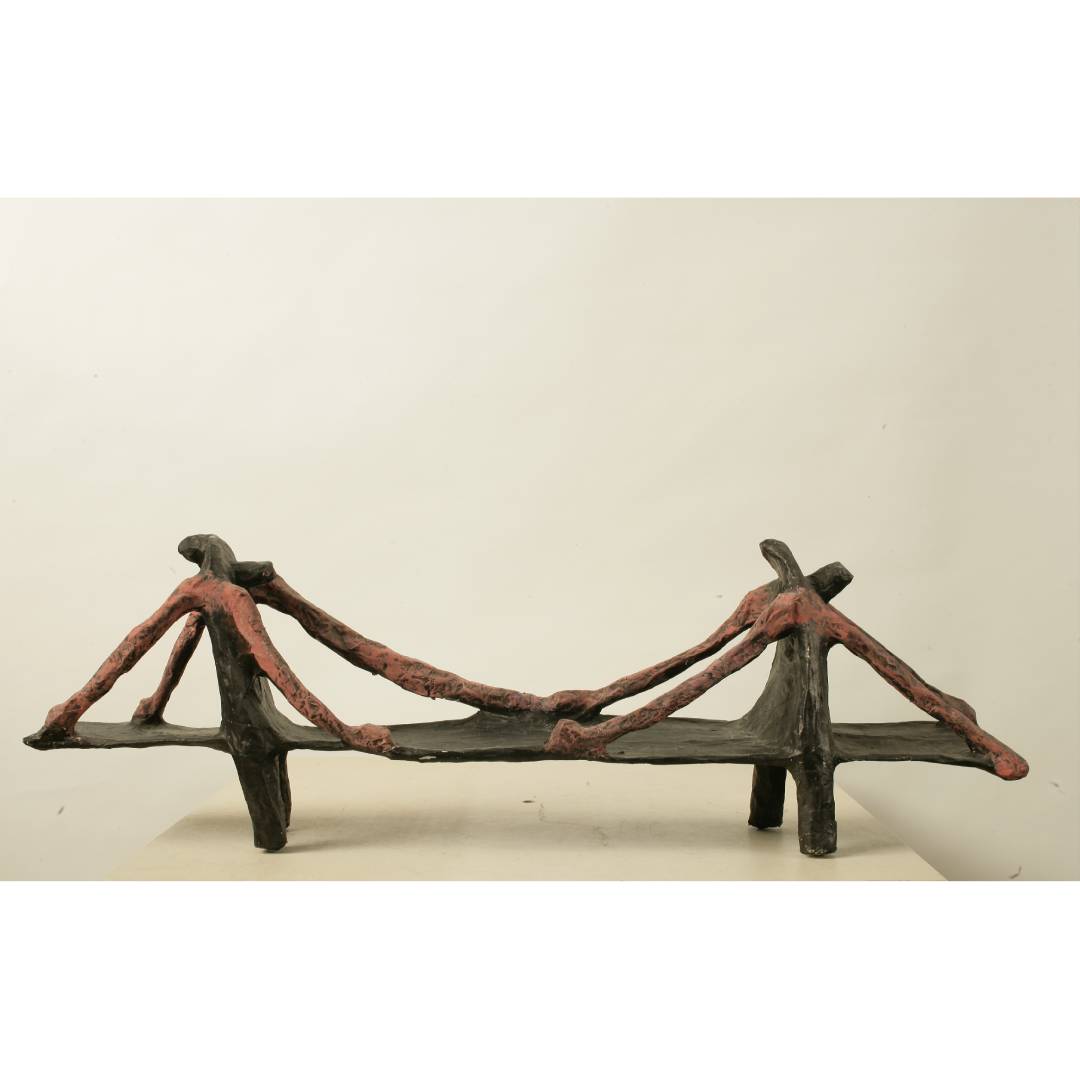
Branko Ružić, Bridge I, 1989

Branko Ružić
Bridge I, 1989
color, papier mâché cardboard
79 x 15 x 26 cm
MG-5890

Branko Ružić (1919-1997) was a famous Croatian sculptor, getting a degree for sculpture in 1944 under professor Frane Kršinić and a degree for painting in 1948 under professor Marino Tartaglia at the Academy of Arts in Zagreb. He was teaching sculpture from 1961 until 1985 after which he continued with his pedagogical work and writing about art.
With Stojan Ćelić and Riko Debenjak he represented Yugoslavia at the 32nd Biennale at Venice in 1964 where he received the David E. Bright award, an accomplishment for Yugoslavian sculpture that never happened again. His sculpture “River Boat” was exhibited in front of the Yugoslavia’s pavilion at the Montreal's 1967 World EXPO.
“Bridge I” is a sculpture created in 1989 from colored papier mâché cardboard which he started to use after a car accident in 1988 which left him bedridden for six months and unable to work with wood, his primary material, because it was too heavy. At this time he also started using clay and his wife even suggested embroidering his drawings (a series of works now called ‘With Needle on Canvas’). He compared this period of creating to prisoners using bread instead of real, sturdy materials to create.
Made from organic shapes with a simplified, hand shaped texture that resembles tree bark. The rudimentary, unfinished look can be traced to his inspirations - prehistoric and traditional art, children’s paintings and travelling but most importantly, the current state of the artist’s body at the time of making the work.

Text: Stella Baki, curator / museum educator at the National Museum of Modern Art Zagreb
Photo: Goran Vranić © National Museum of Modern Art, Zagreb
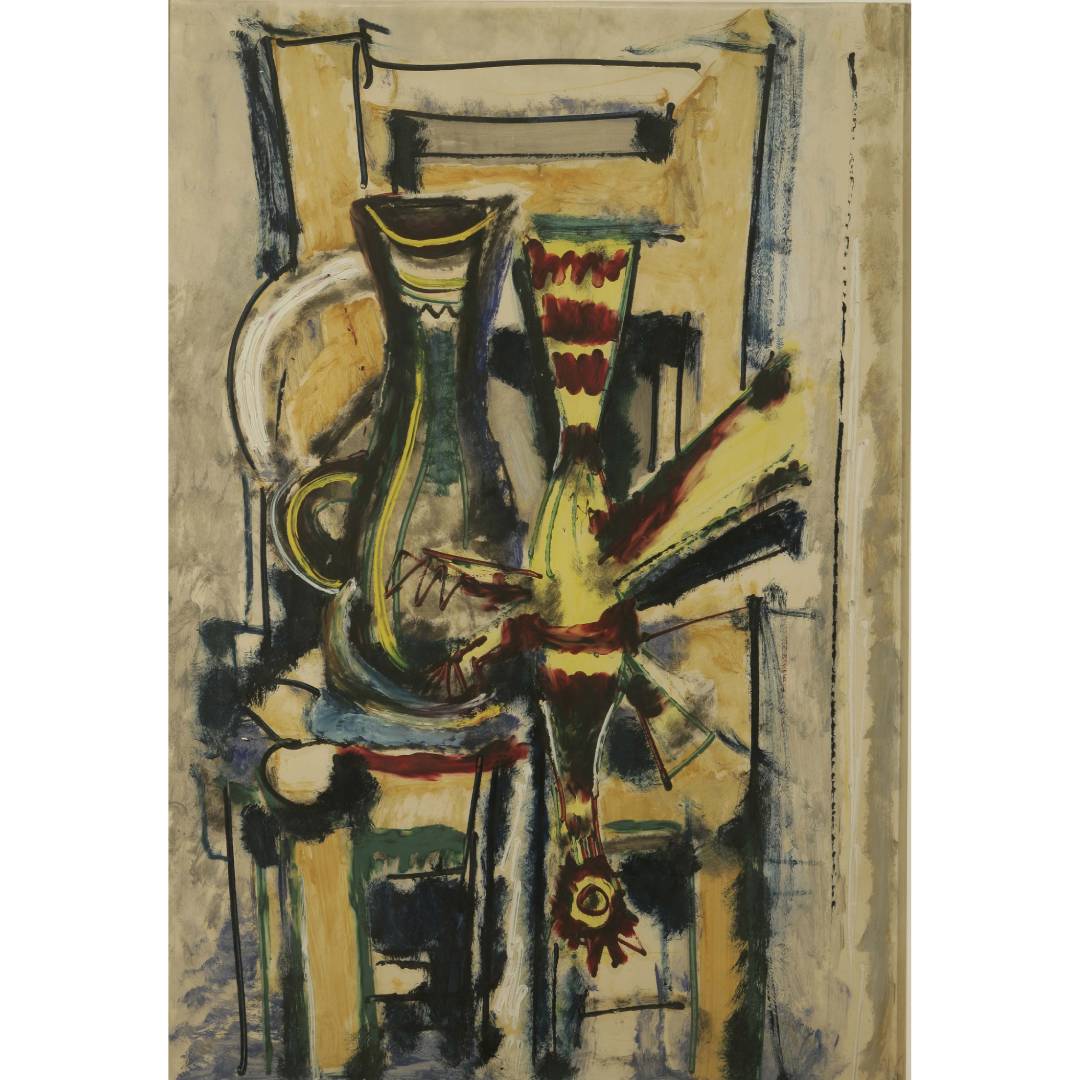
Antun Motika, Still Life with a Rooster, 1957

Antun Motika
Still Life with a Rooster, 1957
oil on cardboard
99 × 69 cm
MG-2282

Antun Motika (1902–1992) was both a classically trained painter and an experimental modernist. From 1921 to 1926, he studied sculpture at the Academy of Fine Arts in Zagreb under Rudolf Valdec, and subsequently painting under Marino Vanka, Tomislav Krizman, Vladimir Becić and Ljubo Babić, with whom he continued his postgraduate studies. In 1928–1929, he drew caricatures for the satirical magazine Koprive, signing one of them with the pseudonym Lopata.
In 1930, Motika continued his studies in Paris, where he was deeply impressed by the work of the Post-Impressionists, particularly the lyricism of Pierre Bonnard and the vibrancy of Raoul Dufy. Inspired by these artists, he developed a Post-Impressionist form of intimacy through paintings of interiors and views from windows.
During his Mostar period in the 1930s, Motika moved closer to abstraction, exploring the interplay between planes and motifs positioned on the threshold between two and three dimensions. His characteristically white ground is already evident, while the presence of drawing can also be sensed in his watercolours and gouaches. He experimented with collage, smoke paintings, decalcomania, organic materials, photograms and frottage. His work was also inspired by music and by the Surrealist principle of controlled automatism, as demonstrated by the graphic quality of the Post-Impressionist scene in Still Life with a Rooster, 1957.
Here, the surreal effect is heightened by the presence of a colourful rooster, floating upside down in the densely filled space alongside a chair and a vessel placed upon it. Motika’s exhibition Archaic Surrealism (1952) is regarded as one of the most radical rejections of the doctrines of Socialist Realism. It provoked strong reactions among Croatian critics, while receiving notable support from Radoslav Putar and D. Bašičević.
From the early 1950s, Motika also worked on glass sculpture, and from the 1960s he began shaping works in iron. He received the Vladimir Nazor Lifetime Achievement Award in 1969. He became a corresponding member of the Yugoslav Academy of Sciences and Arts (JAZU) in 1975. His significant teaching career at the School of Applied Arts (1941–1961) also encouraged his experimental approach. From 1982 onwards, he increasingly withdrew into an intimate inner world.

Text: Željko Marciuš, Museum Adviser, National Museum of Modern Art, Zagreb © National Museum of Modern Art, Zagreb
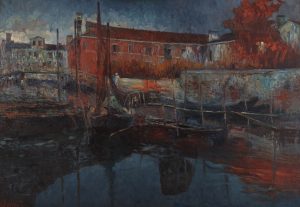
Photo: Goran Vranić © National Museum of Modern Art, Zagre

Marino Tartaglia, Motif from Brist I, 1962

Marino Tartaglia
Motif from Brist I, 1962
oil on canvas
46 × 61 cm
MG-2408

Marino Tartaglia (1894–1984) was a universal painter of historical and High Modernism. His oeuvre represents a synthesis of diverse influences and styles, ranging from El Greco and Tintoretto, Primitivism, and Cézannism to Cubism, Expressionism, Futurism, Neoclassicism, Colourism, and lyrical and reductive abstraction. Tartaglia’s references are often difficult to discern, while his painting is grounded in the rationalization of pictorial procedures. Through these means, he reconciles the principles of plastic order with an emotive approach to the image (T. Maroević). Tartaglia’s use of sfumato correlates with that of Emanuel Vidović. In Marginalia, he resolves these oppositions through the following dictum: “A painting must reconcile all opposites; in its own time, it must be a timeless archaeological find.”
From 1912, Tartaglia studied in Florence under Giacometti and subsequently at the Instituto Superiore di Belle Arti in Rome. He befriended the Futurists gathered around the journal Lacerba. In 1918, as the only foreign participant, he exhibited in Rome at the Exhibition of Independent Artists, alongside eminent representatives of the Italian avant-garde, including Carlo Carrà, Giorgio de Chirico, Enrico Prampolini, and Ardengo Soffici.
After the First World War, from 1918 to 1921, he lived and worked in Split, Vienna, Belgrade, and France. From 1947, he was a full professor at the Academy of Fine Arts in Zagreb, and from 1948 a full member of the Yugoslav Academy of Sciences and Arts (JAZU).
Motif from Brist I, 1962 (Makarska Littoral) is a painting in which the motif has been reduced to the fundamental elements of the composition. The landscape is rendered in an exceptionally condensed form, stripped down to its essential features. What emerges is a synthesized and highly distilled vision of Brist.
Tartaglia was awarded the Vladimir Nazor Lifetime Achievement Award in 1964. Retrospective exhibitions of his work were held in 1975 at the Art Pavilion in Zagreb and in 2003–2004 at the Klovićevi Dvori Gallery.

Text: Željko Marciuš, Museum Advisor, National Museum of Modern Art
Photo: Goran Vranić © National Museum of Modern Art, Zagre