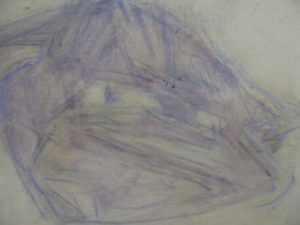
Marino Tartaglia
Motif from Brist I, 1962
oil on canvas
46 × 61 cm
MG-2408
Marino Tartaglia (1894–1984) was a universal painter of historical and High Modernism. His oeuvre represents a synthesis of diverse influences and styles, ranging from El Greco and Tintoretto, Primitivism, and Cézannism to Cubism, Expressionism, Futurism, Neoclassicism, Colourism, and lyrical and reductive abstraction. Tartaglia’s references are often difficult to discern, while his painting is grounded in the rationalization of pictorial procedures. Through these means, he reconciles the principles of plastic order with an emotive approach to the image (T. Maroević). Tartaglia’s use of sfumato correlates with that of Emanuel Vidović. In Marginalia, he resolves these oppositions through the following dictum: “A painting must reconcile all opposites; in its own time, it must be a timeless archaeological find.”
From 1912, Tartaglia studied in Florence under Giacometti and subsequently at the Instituto Superiore di Belle Arti in Rome. He befriended the Futurists gathered around the journal Lacerba. In 1918, as the only foreign participant, he exhibited in Rome at the Exhibition of Independent Artists, alongside eminent representatives of the Italian avant-garde, including Carlo Carrà, Giorgio de Chirico, Enrico Prampolini, and Ardengo Soffici.
After the First World War, from 1918 to 1921, he lived and worked in Split, Vienna, Belgrade, and France. From 1947, he was a full professor at the Academy of Fine Arts in Zagreb, and from 1948 a full member of the Yugoslav Academy of Sciences and Arts (JAZU).
Motif from Brist I, 1962 (Makarska Littoral) is a painting in which the motif has been reduced to the fundamental elements of the composition. The landscape is rendered in an exceptionally condensed form, stripped down to its essential features. What emerges is a synthesized and highly distilled vision of Brist.
Tartaglia was awarded the Vladimir Nazor Lifetime Achievement Award in 1964. Retrospective exhibitions of his work were held in 1975 at the Art Pavilion in Zagreb and in 2003–2004 at the Klovićevi Dvori Gallery.
Text: Željko Marciuš, Museum Advisor, National Museum of Modern Art
Photo: Goran Vranić © National Museum of Modern Art, Zagre