Antun Motika
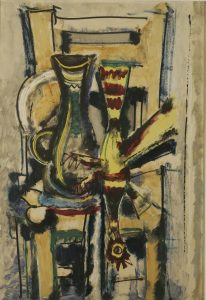
Still Life with a Rooster, 1957
oil on cardboard
99 × 69 cm
MG-2282
Antun Motika (1902–1992) was both a classically trained painter and an experimental modernist. From 1921 to 1926, he studied sculpture at the Academy of Fine Arts in Zagreb under Rudolf Valdec, and subsequently painting under Marino Vanka, Tomislav Krizman, Vladimir Becić and Ljubo Babić, with whom he continued his postgraduate studies. In 1928–1929, he drew caricatures for the satirical magazine Koprive, signing one of them with the pseudonym Lopata.
In 1930, Motika continued his studies in Paris, where he was deeply impressed by the work of the Post-Impressionists, particularly the lyricism of Pierre Bonnard and the vibrancy of Raoul Dufy. Inspired by these artists, he developed a Post-Impressionist form of intimacy through paintings of interiors and views from windows.
During his Mostar period in the 1930s, Motika moved closer to abstraction, exploring the interplay between planes and motifs positioned on the threshold between two and three dimensions. His characteristically white ground is already evident, while the presence of drawing can also be sensed in his watercolours and gouaches. He experimented with collage, smoke paintings, decalcomania, organic materials, photograms and frottage. His work was also inspired by music and by the Surrealist principle of controlled automatism, as demonstrated by the graphic quality of the Post-Impressionist scene in Still Life with a Rooster, 1957.
Here, the surreal effect is heightened by the presence of a colourful rooster, floating upside down in the densely filled space alongside a chair and a vessel placed upon it. Motika’s exhibition Archaic Surrealism (1952) is regarded as one of the most radical rejections of the doctrines of Socialist Realism. It provoked strong reactions among Croatian critics, while receiving notable support from Radoslav Putar and D. Bašičević.
From the early 1950s, Motika also worked on glass sculpture, and from the 1960s he began shaping works in iron. He received the Vladimir Nazor Lifetime Achievement Award in 1969. He became a corresponding member of the Yugoslav Academy of Sciences and Arts (JAZU) in 1975. His significant teaching career at the School of Applied Arts (1941–1961) also encouraged his experimental approach. From 1982 onwards, he increasingly withdrew into an intimate inner world.
Text: Željko Marciuš, Museum Adviser, National Museum of Modern Art, Zagreb © National Museum of Modern Art, Zagreb
Photo: Goran Vranić © National Museum of Modern Art, Zagre