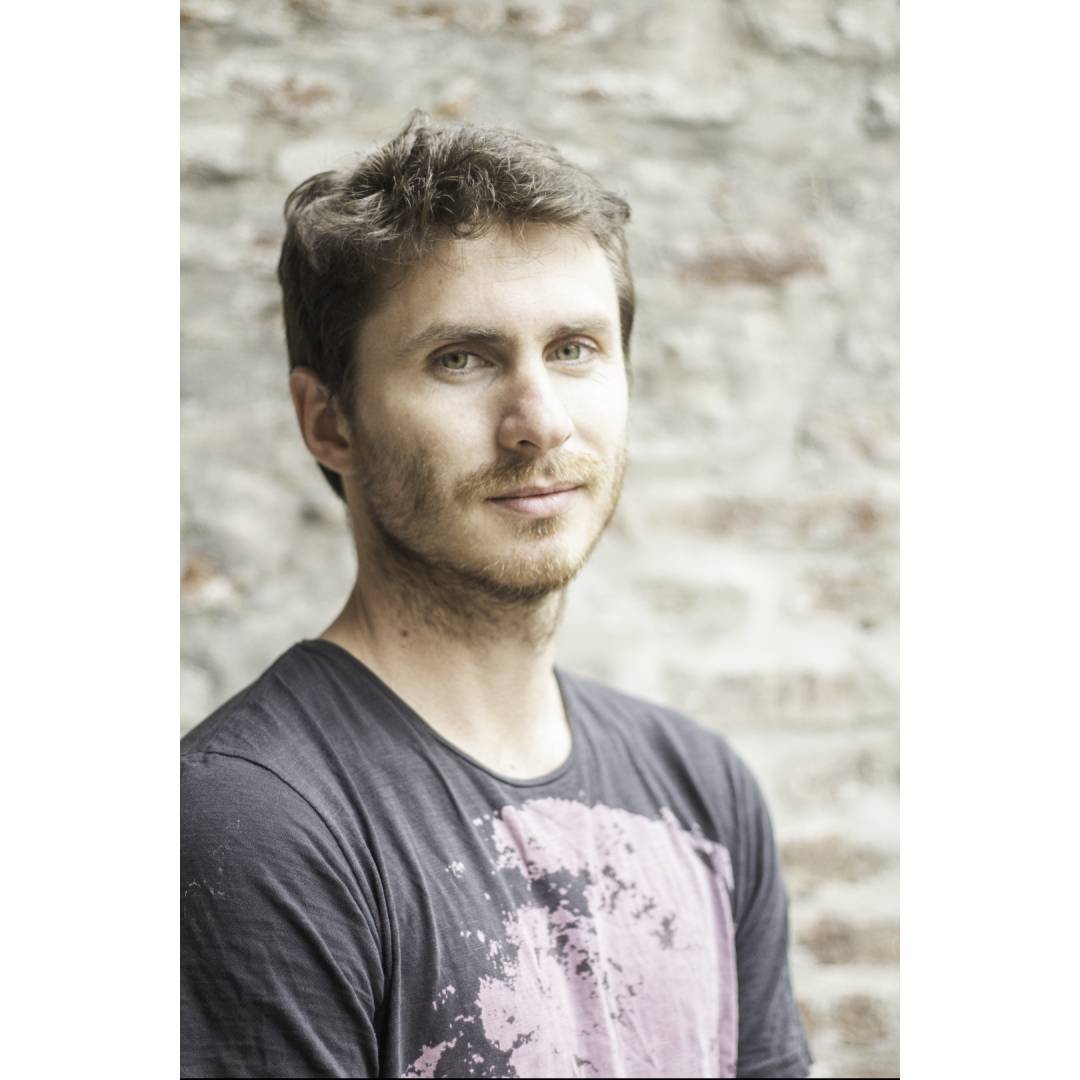
Site-specific light installation Wanderers, the uncertain integration of public space by Argentinian artist Juan Ignacio Cabruja presented in collaboration with the National Museum of Modern Art, on the façade of the NMMU / Vranyczany-Dobrinović Palace, as part of this year’s International Biennial of Contemporary Art, Bienalsur

All those who happened to be in Zagreb’s Zrinjevac on 6 December were able to enjoy a light spectacle presented by Argentine artist Juan Ignacio Cabruja, in collaboration with the National Museum of Modern Art, on the façade of the NMMU / Vranyczany-Dobrinović Palace, as part of this year’s International Biennial of Contemporary Art, Bienalsur https://bienalsur.org/en .
This striking visual experience was preceded by a press conference, which took place in the Croatian School Museum Gallery due to the comprehensive renovation of the NMMU. At the conference, the discussions revolved around the site-specific light installation Wanderers, the uncertain integration of public space, and the International Biennial of Contemporary Art of the South, Bienalsur. The event was introduced for the first time in Croatia in collaboration with the NMMU. The speakers at the conference included Branko Franceschi, the director of the National Museum of Modern Art, Benedetta Casini, the project curator and member of the Bienalsur curatorial team, and the artist Juan Ignacio Cabruja.
The façade of the temporarily relocated National Museum of Modern Art will be illuminated with captivating artistic light every day until 31 December, from the onset of dusk at 4:30 PM until 7:00 AM.

Translated by: Robertina Tomić
Photo: Goran Vranić and National Museum of Modern Art's archive © National Museum of Modern Art, Zagreb

Prior to presentation of the light installation on the facade of the Vranyczany – Dobrinović Palace on December 6 as part of the international biennial of contemporary art BIENALSUR
NMMU presents the Argentinian artist Juan Ignacio Cabruja


Is this your first visit to Zagreb and Croatia in general?
This is my first visit to Zagreb and Croatia, and my first impression is very positive, people have received me very kindly and always with a smile. I really like the openness to the sky that the city has and the clarity of its air.

Can you tell us something about the concept of your site-specific light installation, which you are presenting at the facade of the NMMU / Vranyczany - Dobrinović - Palace as part of this year's BIENALSUR?
After several conversations with me, Benedetta, the curator, explains it better in the curatorial text, but in short it is a work that intervenes in the architectural lighting system located on the public road. When night comes and with it the public lighting is turned on, a score of orchestrated lights that are turned on and off on the façade of the Museum is activated. These are controlled by a customized computer code and the electronics that mediate them in order to replicate the flickering failures that we see every night in the streets.
This appropriation of lighting devices, an industrialized and massive product, invites us to problematize and to reflect on the ways in which they are used and their different consequences. Emphasizing the strong influence of this materiality in the spaces that belong to all of us.

How do your coloured light installations affect the audience?
Each colour/light of the chromatic spectrum is in a certain wavelength range, which varies the way it affects other bodies when they collide. As for the people who witness my different works, it will depend on the one hand on the socio-historical context in which they have been raised, their personal experiences and on the other hand, the context where the pieces are placed. I suppose that based on the psychological/emotional moment, each individual will be able to perceive each installation and their colours in different ways. The only thing I hope is that you have an experience beyond mere entertainment, there is already a lot of that.

Can you tell us something about the collaboration with the curator Benedetta Casini?
It is our first collaboration with Benedetta, for me it has been a great pleasure and privilege to work with her, she is a very serious, intelligent and responsible person, at the same time, very kind, attentive and funny, a combination of very beneficial qualities for teamwork.

Does your inspiration come from silence, music or some specific situations?
My work is enriched by the reflection on different readings that I come across, as well as by the dialogue with different materials I work with. But above all different human relationships and their affections is what inspires me the most when thinking and creating different situations in art.

You made the audiovisual performance intervention Experimental 8 in collaboration with the musician Coco Etcheverry in 2019. What kind of project is it and how often do you include music and dance in your art?
It was a very fun experience! I work as a VJ and lighting designer from time to time, so many times I do activations of the light installations in real time with musician friends and we have a lot of fun. Other times I do some work for friends and their parties or musical projects. I enjoy it a lot, it's a space where we can have a moment of free expression and generate community, which I value a lot.

What kind of Argentine Tango dancer are you?
I never danced Tango, I really like to dance Cumbia and Reggaeton, I also enjoy dancing to Techno music.

You were born in Rosario, in the province of Santa Fe, Argentina in 1992. When did you realize that you wanted to become an artist and who influenced your artistic development the most?
I began to understand that my personal search was in the field of art when I was 19/20 years old, studying Architecture at the National University of Rosario, where we studied architects such as Luis Barragán and Peter Zumphtor, who understand space as a sensitive area.

Have you visited the Perito Moreno glacier? And how much natural beauty inspires you in your work?
I was lucky to know this glacier and other places of similar impact in Argentina. Whenever I find myself in places of such magnitude and beauty, there’s an energy that can only be explained by being present in the place. That certainly inspires me and makes me want to be a better person, kinder and more friendly, it makes you understand that we are one with the otherness and that life is not only the heritage of humanity.

Since you are coming from the country of football greats like Lionel Messi, Diego Maradona, Gabriel Batistuta, Alfredo di Stéfano, do you follow football and have you ever seen yourself in the jersey of a football team?
I was born in the neighbourhood of Arroyito, in the city of Rosario, the neighbourhood of Club Atletico Rosario Central, a soccer team whose fans are adept at partying and Carnival. That is a lot of fun and exciting.
Although I don't follow soccer very much, I enjoy it when it's World Cup time.

Are you familiar with the work of some of the Croatian contemporary artists?
I admit that due to the distance of our countries I don't know much about the local Croatian scene, but I came across Viktor Popovic's work, which I found very interesting and beautiful at the same time. I also came across the Fu:bar/Glitch Art Festival on the net, a platform of artists with a proposal that, as far as I could understand, consciously dialogues with the issues that encompass electronic/digital and that particularly attracted me.

Interviewed by: Lana Šetka
Photo: (2) Luciana Aldegani (3,4) from the Artist's arcive/ courtesy of the Artist

The exhibition Untitled (Archive of the Vranyczany-Dobrinović Palace) by Viktor Popović opened at the Josip Račić Gallery

The exhibition Untitled (Archive of the Vranyczany-Dobrinović Palace) https://nmmu.hr/en/2023/10/10/viktor-popovic-untitled-archive-vranyczany-dobrinovic-palace/ by Viktor Popović, a contemporary artist from Split, was opened this evening at the Josip Račić Gallery. On this occasion, Branko Franceschi, Director of the National Museum of Modern Art and the exhibition’s curator, spoke about the works on display.

We are grateful to Viktor Popović for his quick response that transformed the uncertain future of the National Museum of Modern Art into an artistic work, thus preserving it for eternity. Only time will tell whether this situation will one day seem incredible or be remembered as the beginning of the museum’s ultimate disintegration. With this theme, Popović has moved away from his customary anchoring in the familiar local context. However, to him, like any other visual artist, the museum of fine arts represents an extended home and homeland, the fate of which he personally, culturally, and existentially cares about. After the earthquake, but primarily due to a lack of vision and a sense of public welfare, the enriching cultural space has been narrowed. Perhaps only temporarily, perhaps in the long run, but steadfast in our mission, we are fighting alongside artists to ensure that this is by no means permanent.- as Branko Franceschi writes in the foreword to the exhibition catalogue.

The Head of the Directorate for Cultural and Artistic Development at the Ministry of Culture and Media of the Republic of Croatia, Nevena Tudor Perković, art historians and art critics Sandra Križić Roban and Iva Körbler, museum advisor and head of the Oskar Herman Collection at the Klovićevi Dvori Gallery, Jasmina Bavoljak, museum advisor and head of the Painting Collection at the Museum of Contemporary Art (MSU), Snježana Pintarić, the director of the Museum of Fine Arts in Split, Jasminka Babić, the director of the Museum of Modern and Contemporary Art in Rijeka, Branka Benčić, the director of the Technical Museum in Zagreb, Markita Franulić, art historian Krunoslav Kamenov, artist and jewellery designer Nenad Roban, academic painter and designer Saša Šekoranja, academic painter and writer Dimitrije Popović, academic sculptor Nika Radić, painter Nenad Marasović, contemporary Croatian photographers Boris Cvjetanović and Luka Mjeda, and cinematographer Darko Bavoljak were among the first to view the exhibition, which is open at the Josip Račić Gallery until 3 December.

Translated by: Robertina Tomić
Photo: Goran Vranić © National Museum of Modern Art, Zagreb, 2023

Presentation of Tatijana Gareljić, a Museum Consultant and the Head of the Sculpture Collection and Medal and Plaque Collection at NMMU at congress FIDEM in Florence


Exactly forty years after the congress in Florence, FIDEM (International Art Medal Federation) https://www.fidem-medals.org/index.html is returning to this historic city, which played an exceptionally important role in the history of the medal. As part of this year’s congress https://www.fidem-medals.org/XXXVII%20-%20Florence%20-%202023/XXXVII%20congress.html organised at the Grand Hotel Baglioni, among numerous distinguished speakers from around the world, the National Museum of Modern Art will be represented by Tatijana Gareljić, a Museum Consultant and the Head of the Sculpture Collection and Medal and Plaque Collection at NMMU. She will present a lecture on the topic of the Croatian sculptor Damir Mataušić and his half-century-long significant work in the field of medal art.

Also planned is a visit to the private coin mint Picchiani e Barlacchi, https://picchianiebarlacchi.com which was once located in Florence but is now situated in the Tuscan village of Barberino Tavarnelle, about a forty-minute drive away.

The installation of the international exhibition of contemporary medals, which will take place from 12 October to 9 November in the monumental Dante’s Room at the Biblioteca Nazionale, https://www.bncf.firenze.sbn.it/#  includes twelve works by Croatian medallists: Ana Divković, Karlo Gross, Marko Horvat, Maja Krstić-Lukač, Damir Mataušić, Duje Matetić, Jelena Mavrić Varga, Matko Mijić, Luka Petrinjak, Janko Petrović, Irena Podvorac, Judita Poljak Krajnović. Matko Mijić’s medal “Hommage to Sailor Smiljanić” by from 2022, donated by the artist to the National Museum of Modern Art, will also be presented at the aforementioned exhibition.

Reproductions:
Damir Mataušić, 14th Ivo Kerdić Memorial, 2022
Jelena Mavrić Varga, Ginkgo Biloba, 2022
Luka Petrinjak, Concerns, 2019
Matko Mijić, Hommage to Sailor Smiljanić, 2022
Photo: from the NMMU archive


“René Miković – Hallucinatory Melancholies” exhibition opened at the Josip Račić Gallery

I would like to thank the NMMU Director, Mr. Branko Franceschi, for extending this invitation of collaboration, and it is indeed a great honour and pleasure for me to be the first author of the exhibition and accompanying publication about the forgotten and rediscovered visual artist from Zagreb, René Miković, who studied, lived, and worked in the Netherlands. Miković’s art captivated me through his painting “Dead Bird,” which was presented in 2021 at the NMMU exhibition exploring the theme of death. In it, I recognized an artist who used a palette of earthy colours, wings deeply immersed in the dream of artistic immortality, to find a metaphor for one’s own transience measured in golden ratio. It is already evident from “Dead Bird” that Miković was inspired by Rembrandt and Flemish painting from a very young age. He therefore went to his spiritual homeland, where he became an equal protagonist of the Dutch new realist painting. Having honed his exceptional painting skills with the trompe l'œil technique, which involves optical illusion, his paintings often have a hallucinatory optical effect on the observer. In addition to this, he frequently quoted and paraphrased the works of his role models – Rembrandt, van Eyck, and van der Weyden – in a contemporary artistic context, thus achieving a meta-art interpretation of the entire history of Western art. I am pleased that with the visual set-up of this exhibition, co-authored by Director Franceschi and myself, we have brought Miković’s work back into the spotlight. Otherwise, the silent doll, a recurring motif throughout Miković’s exceptionally intriguing and powerful body of work, would have remained the sole witness to his refined melancholies – an injustice that, I hope, we have finally rectified. – said Mirna Rudan Lisak, PhD, during tonight’s opening of the exhibition “René Miković – Hallucinatory Melancholies” at the Josip Račić Gallery. In addition to the author of the exhibition and essay in the richly illustrated publication in both Croatian and English, Branko Franceschi, the Director of the National Museum of Modern Art and co-curator of the exhibition, addressed the numerous guests.

With the exhibition “Hallucinatory Melancholies,” which can be viewed at the Josip Račić Gallery until 29 October, the National Museum of Modern Art, for the first time posthumously, presents and values the hitherto completely unexplored work of René Miković. In addition to two oil paintings on canvas, “Dead Bird” and “Doll from a Box” (both from the collection of the National Museum of Modern Art, dated 1978), the interested public will have the opportunity to see around thirty works owned by the artist’s friends - cultural manager Ivan Maruna, musician Darko Petrinjak, and writer Sanja Pilić. Along with them, among the first to visit the exhibition were academic painter and writer Dimitrije Popović, visual artist Nenad Marasović, photographers Mario Kučera, Luka Mjeda, and Vladimira Spindler, internationally acclaimed guitarist Petrit Çeku, distinguished Portuguese classical guitarist Pedro Ribeiro Rodrigues, curator and gallery director Martina Marić Rodrigues of Trotoar Gallery, senior curator at the Museum of Contemporary Art (MSU) Leila Topić, museum advisor at MSU Nataša Ivančević, Rumjana Meštrović, daughter-in-law of sculptor Ivan Meštrović, musicologist Seadeta Midžić, theatre and film actress Lukrecija Brešković, choreographer and educator Tihana Škrinjarić, host and editor at Croatian Radio and Television Ivana Vilović, and Majda Bekić-Vejzović, the wife of the late painter Fadil Vejzović...

Photo: from the opening of the "René Miković - Hallucinatory Melancholies" exhibition at the Josip Račić Gallery / Goran Vranić and National Museum of Modern Art's archives © National Museum of Modern Art, 2023

National Museum of Modern Art


On Monday, 18 September 2023, the National Museum of Modern Art, by the decision of the Municipal Civil Court in Zagreb, handed over two paintings to Andrew Reichsmann. This marked the conclusion of a three-generation-long process of returning the paintings Still Life with a Bottle by André Derain and Landscape by the Water by Maurice de Vlaminck to their owners. These paintings were once owned by entrepreneur Dane Reichsmann, the father of Danica Ann Reichsmann Svoboda and the grandfather of Andrew Reichsmann. The fate of these paintings reflects the tragic and complex history of the Reichsmann family, the Jewish community, but also the quandaries of the Croatian society. In 1946, the Ministry of Science and Culture, on behalf of the State as the owner of the paintings, handed the paintings over to the Museum after they were acquired from Marijan Polić by the post-war Commission for the Collection and Preservation of Cultural Monuments and Antiquities. Marijan Polić had received the paintings for safekeeping from the Reichsmann family after their property was confiscated by the Independent State of Croatia (NDH). The Reichsmann spouses were tragically killed in Auschwitz.
At that time, the museum administration, guided by civic conscience and professional ethics, did not inventory the paintings into the museum’s collection but rather into a Storage Book. This significantly facilitated the legal process of returning the artworks at the request of the family. Unfortunately, the entire process lasted for over 70 years. The National Museum of Modern Art (NMMU) adheres to applicable regulations and laws and, on this occasion, emphasises the importance of the legal framework for the restitution of artworks unjustly seized during World War II and the post-war period as a fundamental civilizational, ethical, and professional obligation. To bring this process to a conclusion, museums throughout Croatia, in collaboration with numerous related heritage institutions and with the crucial support of the Ministry of Culture and Media, are now actively engaged in researching provenance, that is, determining the ownership of artworks for which there is reasonable suspicion that they were unjustly taken during World War II and its aftermath.

Translated by: Robertina Tomić
Images: (left) Maurice de Vlaminck, Landscape by the Water, undated, oil on canvas; 550 x 595 mm / (right) André Derain, Still Life with a Bottle, undated, oil on canvas; 595 x 725 mm Photo: From the National Museum of Modern Art's archives

Exhibition “Crumpled Objectlessness” by Mak Melcher opened at the Josip Račić Gallery

The National Museum of Modern Art opened its autumn exhibition season this evening at the Josip Račić Gallery with the exhibition “Crumpled Objectlessness” by Mak Melcher. On this occasion, Branko Franceschi, the director of the National Museum of Modern Art, addressed the guests with an introductory speech. Željko Marciuš, the NMMU museum consultant, and author of the exhibition set-up and the preface in the accompanying exhibition catalogue, spoke about the recent works on paper presented in the ninth solo exhibition of this multi-award-winning younger generation artist. Filip Miloloža, a senior expert associate for visual arts from the City Office for Culture, International Relations and Civil Society, attended the opening as the Representative of the City of Zagreb.
In addition to his wife, actress Mia, Mak Melcher received support from colleagues such as artists Nikola Vrljić, Fedor Fischer, Nikola Pjevačević, Igor Modrić, graphic designer Ana Zubić, actress and singer Nera Stipičević, and the musical couple Lara Antić and Hrvoje Prskalo, members of the Bang Bang group, among others.
Exhibition will remain open until October 1, 2023.

Find out more: https://nmmu.hr/en/2023/08/20/mak-melcher-crumpled-objectlessness/
Translated by: Robertina Tomić
Photo: Goran Vranić and National Museum of Modern Art's archives © National Museum of Modern Art,2023.

On the eve of tomorrow’s opening of the exhibition Encumbered Objectivity in the Josip Račić Gallery, the NMMU presents to you the multi-awarded artist of the younger generation, Mako Melcher

NMMU: Tell us something about the works you are showcasing at your ninth solo exhibition, Crumpled Objectlessness, at the Josip Račić Gallery?
MAK MELCHER: The works are part of a series that I’ve been creating over the past two years. Exploring the matter and materials led me to graphite, and later to ink. As a logical progression, paper emerged, which I subsequently began to crumple, giving it an entirely new dimension of volume, which feels natural to me. I refer to them as drawings; they are of large formats and have evolved from my previous cycle, “Drapery”.

NMMU: Why paper?
MAK MELCHER: I wouldn’t know. Graphite was interesting to me, ink as well. I started with these materials, and paper probably came naturally.

NMMU: Do you contemplate your creative process, or are the resulting works simply a product of the moment, emotion, and context?
MAK MELCHER: A combination of all of the above, and I would add experience and maturity. Spontaneity.

NMMU: Which of your works would you consider as the most challenging so far and why?
MAK MELCHER: All the clay works have been quite challenging. You don’t know what you’re doing, how it will turn out in the end, but you go with the feeling as if you do know. Given that they often involved large weights and formats, it was always demanding and challenging. Upon closer reflection, every new or future work is the most challenging for me.

NMMU: You graduated from the School of Applied Arts and Design. How does it feel to teach in the classrooms where you once sat as a student?
MAK MELCHER: It’s a school with 140 years of tradition in artistic education, with 140 years of memory of space, of all the students and professors who have shaped it. The hallways are adorned with murals, wrought iron fences, and all the other architectural elements crafted by those same students. I feel wonderful and also filled with a great sense of responsibility!

NMMU: Are you a strict teacher?
MAK MELCHER: I try to be fair.

NMMU: What would you like to be remembered for by your students?
MAK MELCHER: By name. ????

NMMU: Who has had the most significant professional influence on you?
MAK MELCHER: All of my life experiences and situations, of which there have been many and in a very wide spectrum, have equally influenced me and my understanding of the environment in which I live and create.

NMMU: How do you remember the recently deceased academician Marija Ujević Galetović, whom you worked with as an assistant?
MAK MELCHER: Marija was a wonderful person, humorous, strict and disciplined as a sculptor, an excellent cook, and a very warm individual. I loved listening to her; she was very straightforward in her approach. A great sculptor. A friend. Many beautiful memories remain.

NMMU: You graduated in 2008 in the class of Professor Miro Vuco at the Academy of Fine Arts in Zagreb. What were your expectations back then, and what did you dream about? How did you envision your career?
MAK MELCHER: I didn’t have any specific expectations. Throughout that time, I tried to absorb as much diverse knowledge, skills, and crafts from all the professors and colleagues. I never limited myself to just one mentor or source. As for how I envisioned my career? Well, I don’t know, I always just wanted to work, create, and I knew that through hard work and effort, I would find my place. Wherever that might be!

NMMU: Could you tell us something about your collaboration with sculptor Dalibor Stošić?
MAK MELCHER: Dalibor and I have been collaborating continuously for 13 years. His trust in me as a senior colleague speaks volumes about our relationship. When a renowned sculptor, who primarily works in traditional sculptural materials like wood and steel, entrusts you with something that is most important and sacred to him with complete confidence, it’s a significant and rare thing, not to mention the responsibility! Today, we are very close friends and continue to collaborate intensively.

NMMU: What memories do you have of Paris and your stay at the prestigious artistic residency at Cité Internationale des Arts?
MAK MELCHER: When you come from a small town where what you do is not felt, let alone appreciated, the feeling is special. You feel at home. You quickly adapt and receive, if you didn’t already have it, confirmation that what you do does make sense. In my case, after returning, I was even more inspired, and my ambitions grew. Regardless of the fact that we live in a different environment, you see that you are part of something that is global.

NMMU: Do you think artificial intelligence in various fields of art can be “more powerful” than human talent and creativity?
MAK MELCHER: It depends on the criteria. By my criteria, definitely not.

NMMU: How do you see your future?
MAK MELCHER: Bright and potent! As Miro Vuco would say, “BRILLIANT.”

NMMU: What is your favourite museum in the world?
MAK MELCHER: I’ve seen relatively few of them, but I felt most comfortable at the Giacometti Institute and the Centre Pompidou in Paris.

Interviewed by: Lana Šetka © National Museum of Modern Art 2023
Translated by: Robertina Tomić

The Dubrovnik artist Izvor Pende discusses his painting “Dedicated to the Sunny Side of the Street,” which is part of the collection of the National Museum of Modern Art in Zagreb. It is currently featured in the exhibition “One World” at Providur’s Palace in Zadar.


“After the first exhibition “Swimming Together” in 2017 at the Museum of Fine Arts in Split, where I showcased my work alongside those of the German artist Daniel Richter, it was agreed that the exhibition would also be presented at the Museum of Contemporary Art in Zagreb and the Museum of Modern and Contemporary Art in Rijeka. As this was a significant event for me, and an honour to exhibit with Daniel, and considering the success of the project in Split, I continued working. I painted “Dedicated to the Sunny Side of the Street” in 2018, and it is part of a series created specifically for that exhibition. It was a process in which I aimed to prove myself my producing artworks in large dimensions and formats, creating as much and as best as I could. Also, because the exhibition would be showcased in these two prominent museums, it was of great importance to me that the presentation be compelling. In essence, these two paintings are particularly dear to me, “Dedicated to the Sunny Side of the Street” and “The Sunny Side of the Street”. I am pleased that one of them is in the possession of the National Museum of Modern Art, as it will always be available for the public to view. I am especially proud that it has been selected for the temporary display of the NMMU collection, “One World,” at Providur’s Palace in Zadar.
In fact, the painting “Dedicated to the Sunny Side of the Street” signifies the beginning of something new in my work; it led to things starting to develop a bit further. I appreciate flat painting, but in this piece, a space emerged between the planes and the drawing. Significant depths emerged despite the fact that it is still an abstraction, a form of objective painting. In truth, we can’t quite label it as complete abstraction or objective painting. It is something in between, my own creation. One might say that these are objects that can be viewed as some sort of subject. Amidst these prominent planes that are always present, and thanks to the enormous format in which they simply have the space to breathe, these simple, small drawings added substantial depth. Typically, my enthusiasm for a work diminishes quickly, but I’m genuinely content with this painting, and I still love it. I painted it relatively swiftly, I believe within two weeks. There isn’t a lot of colour in it; it is painted quite transparently, unlike my works from the past three years where I use thick impasto layers with a spatula.
It is hard for me to talk about a single painting, as it never really is just one painting, but rather an entire series. And during the creation of “Dedicated to the Sunny Side of the Street,” in particular, my focus wasn’t solely on one painting but generally on the entire body of work.
My art is always really about the process. If we strip away all the concepts, the most important things happen within the process. I always work on numerous sketches and many paintings. Certain elements carry over into new works, to varying degrees of success, which I then attempt to arrange anew into a composition. Composition is truly the most vital aspect for me. As for inspiration itself, the work is my inspiration – the daily process through which development continues. Within the process, unpredictable and unexpected things occur that might pose challenges. While this might sound unfavourable, for the art itself, it’s actually quite beneficial.”

Image: Painting Dedicated to the sunny side of the street" from the holdings of the National Museum of Modern Art in the "One World" exhibition setup at the Providur’s Palace in Zadar / Photo: Goran Vranić © National Museum of Modern Art, Zagreb, 2023.

Iulian Plestiu, director of Artmark Croatia for the NMMU on the occasion of the “Summer Prelude” exhibition from the NMMU Collection in the Artmark Gallery

NMMU: Can you tell us something more about the cooperation between Artmark and the National Museum of Modern Art?
IULIAN PLESTIU: the collaboration between Artmark and NMMU gives a wider view over the necessity of collaboration between private and public entities, especially in the Cultural and Artistic realm. Artmark, as a private cultural endeavour in Central and Eastern Europe, knows about the importance of open channels of communication and collaboration with public cultural institutions, so we extended an invitation for an open platform for discussions. In such specific times and moments in Zagreb's cultural existence, NMMU's director, Mr. Branko Franceschi, was more than open and proactive for a joint collaboration between the most important Croatian Institution dedicated to Fine Arts and let's be honest, a new actor in Zagreb's cultural scene, so I take this occasion to thank him for his openness.

NMMU: What's the significance of this cooperation for your renowned auction house?
IULIAN PLESTIU: have to repeat myself and press on the importance of the collaboration between Cultural institutions and the private sector. An Art Market cannot be built without bridges and connections between professionals, experts and Academia on one side and Auction houses and commercial professionals on the other. This type of collaboration is one of the most important ones for us as a Gallery and Auction House because it creates an open platform for professionals to interact on both sides. As a museum needs to be alive in its connection with the cultural and art market, the same goes for a private gallery and auction house to be as professional and transparent.

NMMU: Is it the first Artmark's project of this kind?
IULIAN PLESTIU: Artmark, with its Romanian based background and 15 years of experience, had different types of collaborations throughout its existence, with its cultural division. Opening up towards the Croatian Cultural scene is a new endeavour, but its main goal is to establish a professional platform for the art market in Croatia, for the Croatian public, collectors, art historians and professionals. But the collaboration with NMMU specifically is the first of its kind here and hopefully many more are going to happen.

NMMU: Do you have plans for any future international cooperation / (in terms of presentation of Croatian art or artists in Romania)?
IULIAN PLESTIU: International connections would be a great result of course. Presenting Croatian art in a new market should be top of the list for everybody involved in the Art World here.

NMMU: Works of which Croatian artists are of particular interest on the Eastern European art market?
IULIAN PLESTIU: Artmark's main goal is to dedicate its energy into firstly organizing the local art market. A sturdy and established local art market can then be more relevant for the Central and Eastern European art market. But of course, the Croatian art "exports" can be found throughout the 20th Century up to contemporary days.

NMMU: Do you collaborate with any Croatian artists?
IULIAN PLESTIU: Auction houses usually represent the secondary market, so collaboration with contemporary artists is usually handled by gallerists and galleries. Of course, the auction plastform is here to give also contemporary artists an additional channel and means of selling and being represented.

NMMU:From your experience, how does the art market function in Croatia?
IULIAN PLESTIU: the art market in Croatia is full of opportunities. The rich history of art, collectionism, institutions, the old and new galleries. All of these, helped by the established names from modern, post-war and contemporary art offer a range of opportunities for all the actors in the Art Market, public and private alike. Of course, everybody should focus on the "end user": the visitor, the enthusiast or the Collector. Also, Artmark answers the need for a new model of business, transparent, professional, easily accessible, with a live and online platform for its auction events.

Interviewed by: Lana Šetka © National Museum of Modern Art, Zagreb, 2023.
Photo: Iulian Plestiu, director of Artmark's Croatia, in front of "The Cynic" Vilko Gecan's anthology work from 1921, from the collection of the National Museum of Modern Art in the "Summer Prelude" exhibition display at the Artmark Gallery. Photo: © Artmark