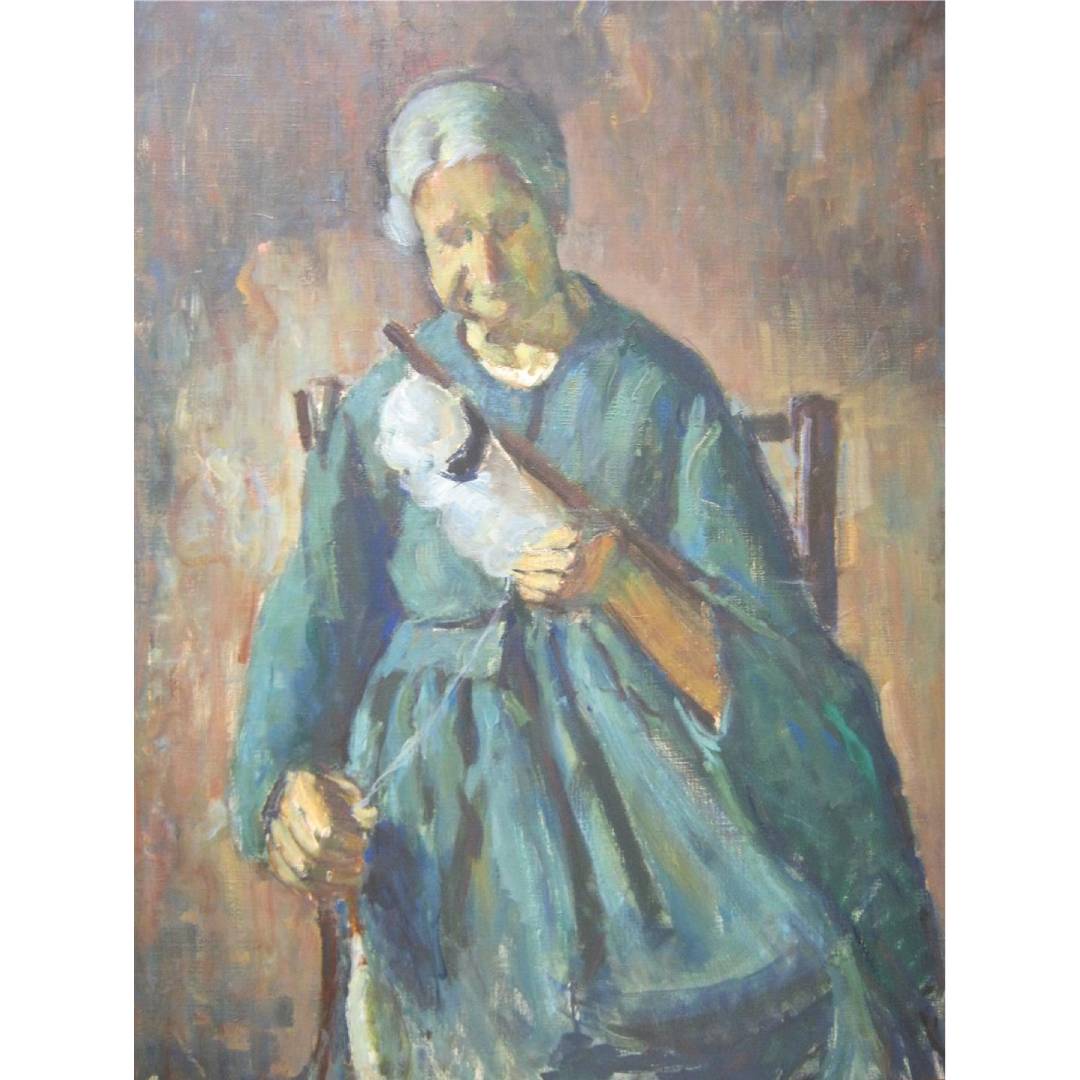
Jerolim Miše, An Old Woman, 1955

Jerolim Miše
An Old Woman, 1955
oil on canvas
87.5 x 67 cm
MG-2243

Jerolim Miše (Split, 1890 – 1970) was expelled from the Advanced School of Arts and Crafts in Zagreb in 1911 after openly criticising his teacher, Menci Clement Crnčić, and subsequently pursued further studies in Rome and Florence. Early in his career, his painting, influenced by Ivan Meštrović, was closely aligned with the linear style of the Secession. By the late 1920s, under the influence of French painting and contemporary German Expressionism, he developed a style of strongly geometrised forms, embodying both modernity and a sense of magical expressionism. As a member of the Group of Three, he played a role in shaping “our expression”. After the bold colourism and liberated gestures of the 1930s, he turned largely to intimate still lifes and landscapes in subdued tones, adopting a more realistic approach in the later decades of his life. Miše taught at the Academies of Fine Arts in Belgrade and Zagreb, wrote art criticism and theoretical essays, as well as poetry and short stories, and also worked in graphic design. He was a member of the Yugoslav Academy of Sciences and Arts.
Jerolim Miše’s portraiture of the 1930s resonated with contemporary bourgeois audiences and critics. While engaging with socially and politically relevant themes, he selected figures from the lower strata of society, yet presented them largely as clichés of hardship and poverty. In his works, poor children, women and the elderly, with their downcast, shadowed eyes, lose their individuality and serve primarily as symbols of the ‘other’ – the destitute, powerless and uneducated.
The socio-political undertone evident in many of Miše’s portraits continued into the 1950s. The hunched figure and downcast gaze of An Old Woman (1955) convey a profound sense of melancholy and the despair of the lower social classes.

Text: Lovre Mrduljaš © National Museum of Modern Art, Zagreb
Photo: Goran Vranić © National Museum of Modern Art, Zagreb

Iva Simonović, An Old Woman, 1920


Iva Simonović
(1890 – 1961)
An Old Woman, 1920
bronze
dia=108 mm
MG-2892-647

As the youngest student of professors Robert Frangeš-Mihanović and Rudolf Valdec at the newly established Provisional College of Arts and Fine Crafts in 1907, she has shown her work with Ljubo Babić in the prestigious Ulrich Salon as early as 1910. In 1914, she had a successful showing at the Salon des artistes francais in Paris. The committee was chaired by French sculptor Auguste Rodin. This is when the City of Paris bought her plaque for the Luxembourg Museum, which confirmed the quality of her work at the European level. Following her study visits to Munich (1911) and Paris (1914), her sculptural oeuvre will be dominated by medal making. She earned professional recognition in Zagreb in 1916, when she exhibited with painter Zdenka Pexider at the Second Exhibition of the Croatian Spring Salon, titled Intimate Exhibition. She exhibited fourteen busts and thirteen medal works dominated by children’s portraits. The National Museum of Modern Art has six of her portraits of boys and girls from this period in its collection. On one-sided medals, the artist skilfully brought to life a series of youthful personalities.

Skilful design with a direct understanding of the model is best achieved in portraits of the elderly and persons of character, whether she executes them as sculptures in the round or relief. The medal of An Old Woman shows a low bust of an older woman in profile to the left with a gentle smile on her face. She has a pleated collar around her neck with an ornate bow, and her combed hair is curled at the nape of her neck. Delicate wrinkles on her face are achieved with fine chiselling, creating a vibrant play of light on the surface. The medallist achieved a dynamic modelling with filigree treatment of the surface, revealing sensitivity towards the model. With fine interplay of light and shadow and application of impressionist procedures, she adds liveliness and dignified energy to the portrayed persons.

Text: Tatijana Gareljić, Museum advisor of the National Museum of Modern Art© National Museum of Modern Art, Zagreb
Photo: Goran Vranić©© National Museum of Modern Art, Zagreb