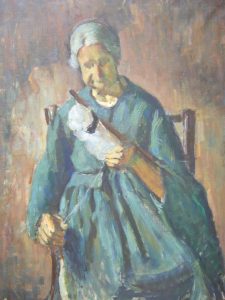
Jerolim Miše
An Old Woman, 1955
oil on canvas
87.5 x 67 cm
MG-2243
Jerolim Miše (Split, 1890 – 1970) was expelled from the Advanced School of Arts and Crafts in Zagreb in 1911 after openly criticising his teacher, Menci Clement Crnčić, and subsequently pursued further studies in Rome and Florence. Early in his career, his painting, influenced by Ivan Meštrović, was closely aligned with the linear style of the Secession. By the late 1920s, under the influence of French painting and contemporary German Expressionism, he developed a style of strongly geometrised forms, embodying both modernity and a sense of magical expressionism. As a member of the Group of Three, he played a role in shaping “our expression”. After the bold colourism and liberated gestures of the 1930s, he turned largely to intimate still lifes and landscapes in subdued tones, adopting a more realistic approach in the later decades of his life. Miše taught at the Academies of Fine Arts in Belgrade and Zagreb, wrote art criticism and theoretical essays, as well as poetry and short stories, and also worked in graphic design. He was a member of the Yugoslav Academy of Sciences and Arts.
Jerolim Miše’s portraiture of the 1930s resonated with contemporary bourgeois audiences and critics. While engaging with socially and politically relevant themes, he selected figures from the lower strata of society, yet presented them largely as clichés of hardship and poverty. In his works, poor children, women and the elderly, with their downcast, shadowed eyes, lose their individuality and serve primarily as symbols of the ‘other’ – the destitute, powerless and uneducated.
The socio-political undertone evident in many of Miše’s portraits continued into the 1950s. The hunched figure and downcast gaze of An Old Woman (1955) convey a profound sense of melancholy and the despair of the lower social classes.
Text: Lovre Mrduljaš © National Museum of Modern Art, Zagreb
Photo: Goran Vranić © National Museum of Modern Art, Zagreb