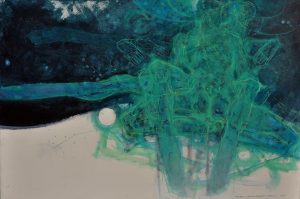
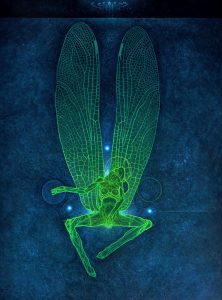
Hrvoje Marko Peruzović, Dragonfly

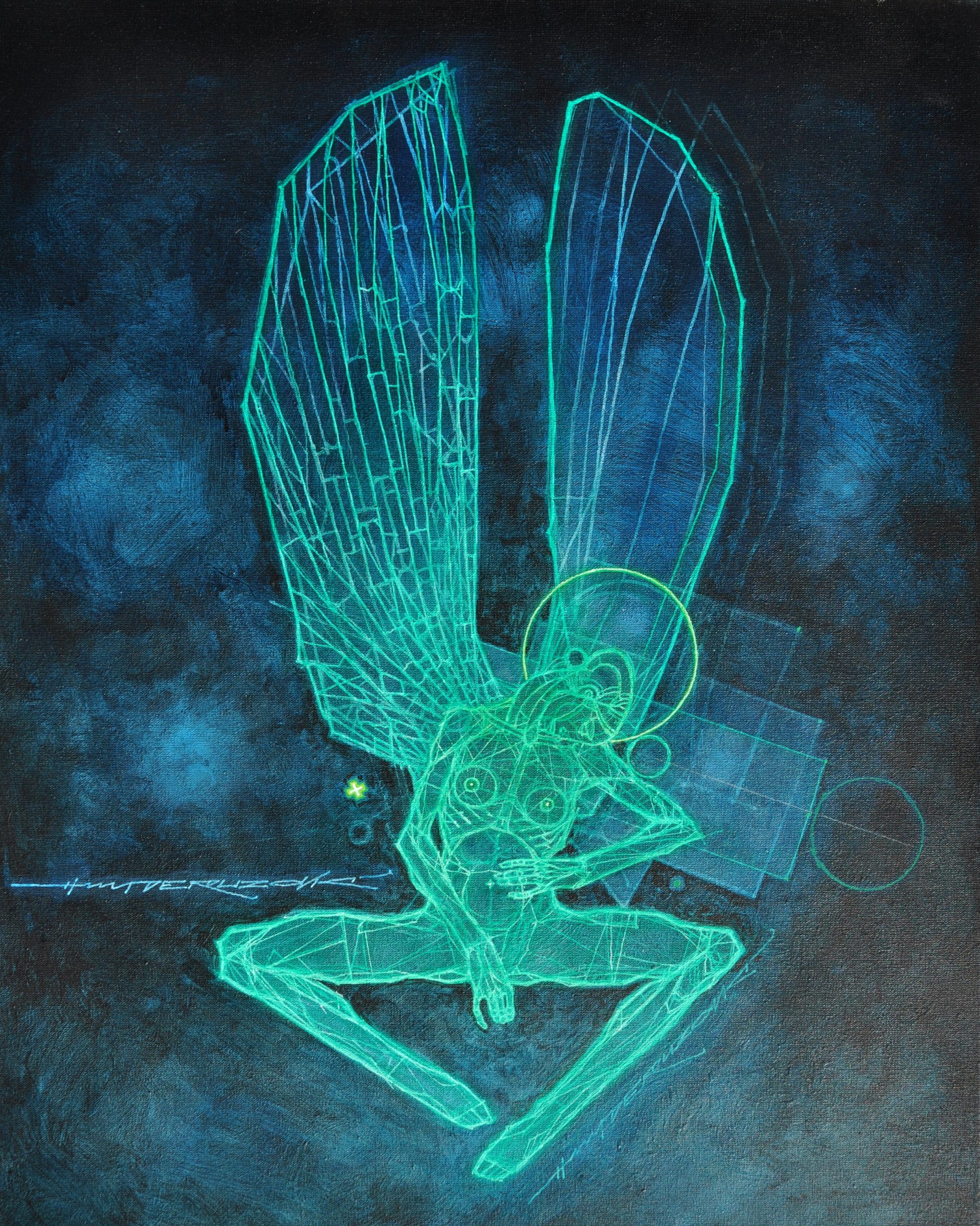
The exhibition Dragonfly presents the latest phase in the artistic practice of Hrvoje Marko Peruzović, in which the beauty of the body and light merges with natural forms and fantastical transformations. In these works, the artist constructs his own mythological world—a fusion of woman, angel, firefly, and dragonfly— a world where opposites are reconciled and in which painting becomes a “search for the philosopher’s stone.”

At the center of the curatorial concept by Romina Peritz Körbler is the painting Dragonfly (2025), a work that uniquely encapsulates the poetics and visual language of this artist. Elongated nudes in unusual poses, painted in vivid, almost fluorescent colors that glow like neon, are set against monochrome backgrounds in a distinctive shade of blue. Peruzović’s contemporary interpretation of the female body is accompanied by elements of surprise and unexpected combinations: he adds insect wings or geometric signs to the figure, creating scenes on the boundary between the real and the fantastical.

The exhibition, which remains open at the Josip Račić Gallery until November 30, was realized with the support of the Ministry of Culture and Media of the Republic of Croatia and the City Office for Culture and Civil Society of the City of Zagreb. Sponsor: HP – Hrvatska pošta d.d.

Biography
Hrvoje Marko Peruzović, was born in 1971 in Zagreb. He studied in the Graphic Arts Department at the School of Applied Arts and Design in Split and earned
a degree in painting from the Academy of Fine Arts in Zagreb in 1995 (in the class of Prof. Ðuro Seder). He has studied in Paris, Milan, Venice, and Vienna, and is a member of HZSU, HULU Split, and DHK. In addition to painting, his artistic practice encompasses classical printmaking, illustration, sculpture, and photography. He has held approximately seventy solo exhibitions and participated in numerous group shows in Croatia and abroad. He has also taken part in many art colonies and charitable projects, and has completed several public sacred commissions. Writings on his work have been contributed by Josip Depolo, Ive Šimat Banov, Stanko Špoljarić, Tonko Maroević, Vladimir Rismondo Jr., Andro Filipić, Darko Schneider, Ðuro Vanđura, Iva Koerbler, Tonči Šitin, Nevenka Nekić, Vinicije Lupis, Anamarija Stibilj Šajn, Nives Marvin, Toni Horvatić, Vlasta Tolić, Mirela Duvnjak, Sanda Bajzek Stanačev,
Elizabeta Wagner, Igor Brešan, Miona Muštra, Nela Žižić, Ante Žaja, and others. His works are held in numerous collections and museums in Croatia and abroad. He also writes poetry, aphorisms, and short essays on visual arts.
He lives and works in Zagreb as a freelance artist.

Reproductions
:
(1) Hrvoje Marko Peruzović, Dragonfly I, 2023 / acrylic on canvas, 50 × 40 cm
(2) Hrvoje Marko Peruzović, Conjunctio, 2010 / acrylic on canvas, 80 × 120 cm
(3) Hrvoje Marko Peruzović, Dragonfly II, 2025 / acrylic on canvas, 200 × 150 cm
Photo: Hrvoje Marko Peruzović
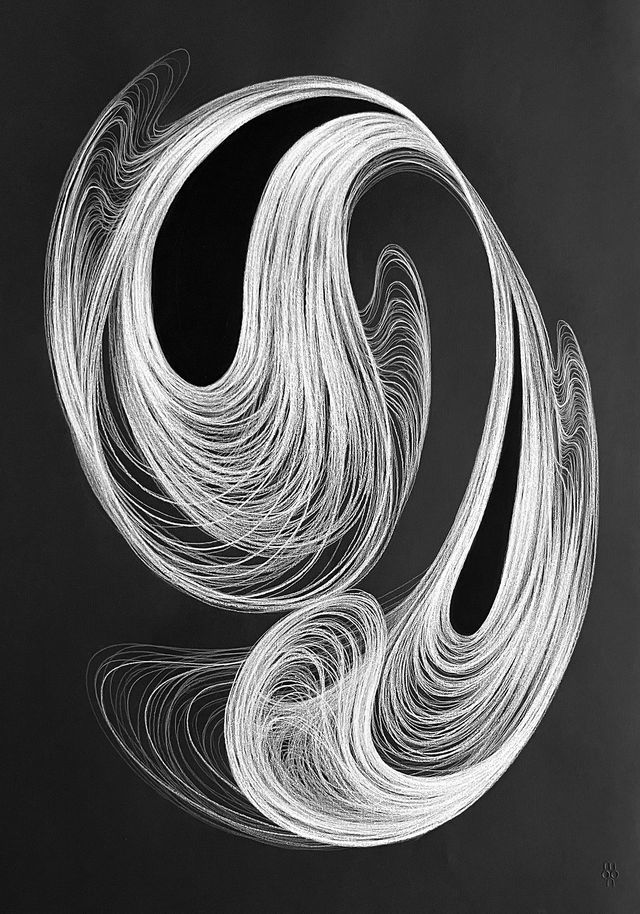
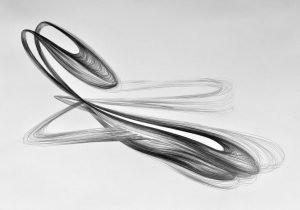
Martina Moon Zelenika, Vibrating in Chaos


Martina Moon Zelenika
Vibrating in Chaos
Josip Račić Gallery (Margaretska 3, Zagreb)
October 7 – November 2, 2025
Curator: Željko Marciuš

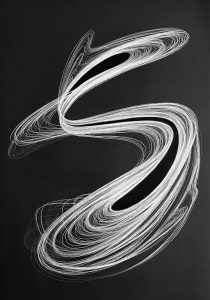
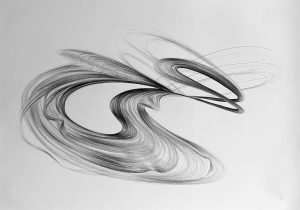
Visual artist Martina Zelenika presents a series of drawings at the Josip Račić Gallery — a body of work she has been developing for years and is now exhibiting in Zagreb for the first time. Through her artistic practice, Zelenika invites viewers into a space of shared reflection, exploring notions of existence and freedom in the posthuman age by merging art, science, and technology. Her work investigates human survival from a philosophical and theological perspective, with an emphasis on communication based on free interpretation.

She observes the world from the standpoint of a conscious witness, critically engaging with all aspects of society. Her art exists beyond traditional boundaries, embracing a variety of experiments, techniques, and tools. Zelenika visualizes the invisible and intangible, using drawing as her primary medium, while incorporating various technologies and data sonification — from X-ray imaging, biosensor signals, and satellite data to photographic imagery and more. With technical precision and playful curiosity, she dissolves the lines between the real and virtual, the traditional and digital, rendering rhythmic lines that form various kinds of attractors.

In her works, especially drawings, lines do more than represent tones or notes — they also express connections between the real and the virtual, past and present, technology and tradition, our world and the cosmos, the visible and the invisible, consciousness and the subconscious. By combining line and technology, Zelenika creates trans-lines, trans-surfaces, and trans-spaces — dimensions within us and around us.

Artist Biography
Croatian interdisciplinary artist and Associate Professor Martina Moon Zelenika (b. 1978) employs a highly innovative, almost alchemical approach to creating artworks that encompass a broad range of techniques and media. Her work bridges art, science, technology, spirituality, and theology. Martina Moon emphasises human experience, exploring questions of existence and human freedom in the context of posthumanism. Alongside its visionary aspects, her practice is distinguished by a synthesis of traditional art techniques and latest digital technologies. She investigates invisible and intangible realms, which she then visualises, forms auditory connections from, transforms into the material world. Combining technical precision with a playful sensibility, she blurs the lines between the real and the virtual, and between traditional and digital, evident in her drawings featuring rhythmic lines used to generate various types of attractors. She is a pioneer of New Media Art, creating works that merge augmented reality with traditional drawing, including the sonification of images. Her innovative projects also explore the sonification of data obtained from biosensors (“Receptilium, MSSS”), X-ray analyses (Nova Europa), signals from the Earth’s magnetosphere (“ChORUS,” “ChORUS2”), and drawings (“The Sixth Sense, MSSS”; “Particles – Simulation of Matter”), among others.
Martina has held over thirty solo exhibitions and taken part in more than thirty group exhibitions both in Croatia and abroad, including new-media festivals (in Germany, Belgium, Spain, South Korea, Denmark, Austria, Slovenia, the United Kingdom, and Italy). She has participated in numerous conferences on multimedia and science, such as the “RE:SOUND” conference at Aalborg University in Denmark in 2019 and the “POSTSENSORIUM-RIXC” festival in Riga, Latvia, in 2021. She graduated in 2001 with a degree in printmaking from the Academy of Fine Arts at the University of Zagreb, in the class of Prof. Ante Kuduz, and earned her Master’s degree in 2006 in video and new media at the Academy of Fine Arts and Design at the University of Ljubljana. She has received several scholarships, awards, and grants for her artistic work. Martina is a member of the Archive of Digital Art (ADA) in Austria and of ULUPUH in Zagreb. She currently lives in Zagreb and works as an Associate Professor of New Media at the Department of Digital Arts at Algebra University Bernays.

The exhibition remains open until January 4, 2026, and has been realized with the support of the Ministry of Culture and Media of the Republic of Croatia and the City Office for Culture and Civil Society of the City of Zagreb. The sponsor is HP–Croatian Post plc. It is accompanied by a bilingual catalogue, whose graphic design is authored by Ana Zubić.


Website: https://martinazelenika.com/
Instagram: @martinazelenika_moon
https://www.instagram.com/martinazelenika_moon/
Facebook: Martina Moon Zelenika
https://www.facebook.com/martinamoonzelenika/

Images: Martina Zelenika (1) Order from Chaos, attractor 4, 2023 – 2025 / drawing; graphite pencil on 230 g Academia paper / 108 x 78 cm original (1/1 ) (2) Order from Chaos 2, attractor 1, 2025 / drawing; white pencils on black 230 g Hahnemühle paper / 108 x 78 cm / original 1/1
(3) Order from Chaos, attractor 6, 2025 / drawing; graphite pencils on 230 g Academia paper, 78 x 108 cm / original 1/1
Cover Image: Order from Chaos 2, attractor 2 / 2025 / drawing; white pencils on black, 230 g Hahnemühle paper / 108 x 78 cm / original 1/1
Photo Martina Moon Zelenika

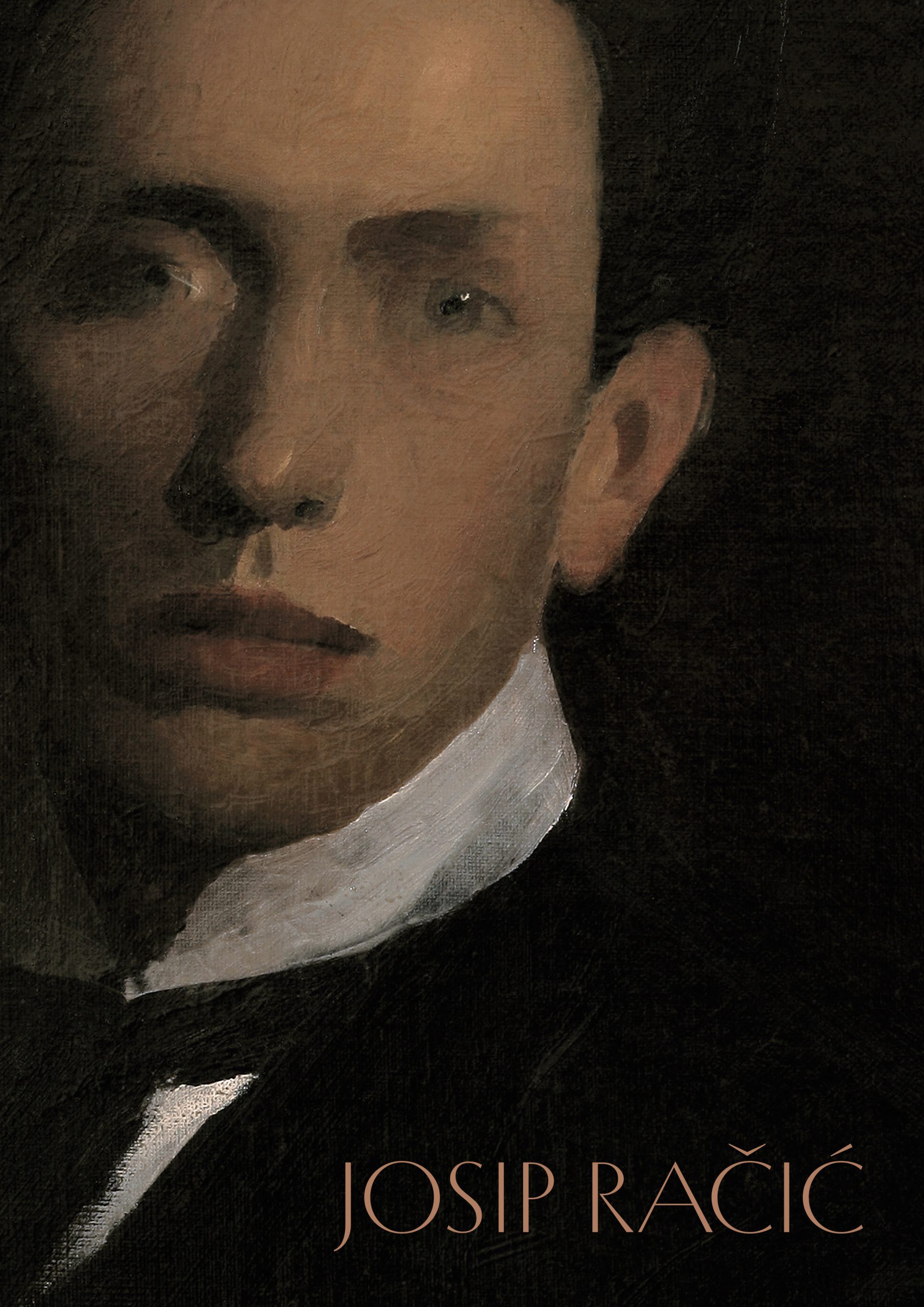
Josip Račić (1885 – 2025)
Exhibition from the Collection of the National Museum of Modern Art marking the 140th Anniversary of the Artist’s Birth


Josip Račić (1885 - 2025)
Exhibition from the Collection of the National Museum of Modern Art marking the 140th Anniversary of the Artist's Birth
Curator: Tihana Galić

This year marks two significant anniversaries associated with the name of Josip Račić – 140 years since the birth of one of the most important painters of Croatian modernism, and 50 years since the founding of the Josip Račić Gallery, an exhibition space that has fostered contemporary visual art for five decades and has been an integral part of the National Museum of Modern Art since 1992.

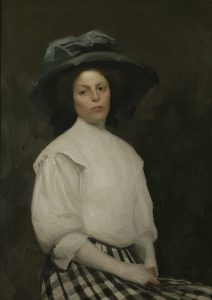
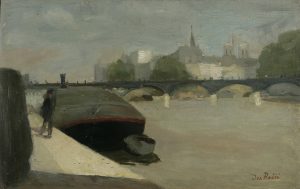
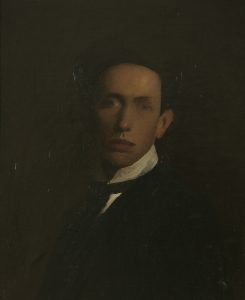
The exhibition, dedicated to Račić's life, work, and legacy—as well as to the gallery that has shaped Zagreb’s and Croatia’s visual arts scene over the years and bears his name—will feature the artist’s most renowned paintings created during his three years of study. Among the works that left a profound mark on the history of Croatian art are Lady in White (1907), Mother and Child (1908), Self-Portrait (1908), and Pont des Arts (1908), along with other notable pieces by the artist from the collection of the National Museum of Modern Art.

The exhibition remains open until January 4, 2026, and has been realized with the support of the Ministry of Culture and Media of the Republic of Croatia and the City Office for Culture and Civil Society of the City of Zagreb. The sponsor is HP–Croatian Post plc. It is accompanied by a bilingual catalogue, whose graphic design is authored by Ana Zubić.

Photos:
Josip Račić, Lady in White, 1907 / oil on canvas / 100 x 73 cm / MG-744
Josip Račić, Pont des Arts, 1908 / oil on canvas mounted on cardboard / 30.2 x 47 cm / MG-762
Josip Račić, Self-Portrait, 1908 / oil on canvas / 65 x 53.9 cm / MG-748
Photos: Goran Vranić © National Museum of Modern Art, Zagreb

Iva Zagoda, Record 245

From July 8 to August 29, the Josip Račić Gallery will host a solo exhibition by Iva Zagoda titled Zapis 245. The exhibition is presented by the National Museum of Modern Art as an award for Best Young Artist at the 7th Painting Biennial. Curated by NMMU’s Marta Radman, the show features ten recent works by the award-winning Zagreb-based visual artist. Zagoda graduated in 2019 from the Teaching Department of the Academy of Fine Arts in Zagreb, in the class of Damir Sokić. She has previously exhibited in seven solo and around ten group exhibitions.
The selected paintings and sculptures continue the artist’s exploration of the relationship between line, gesture, and fields of color in easel painting, as well as the interplay of everyday materials and color in sculpture. Rooted in the aesthetics of minimalism, the compositions emerge from a limited number of visual elements on a blank canvas. This same approach is reflected in the gallery space itself, through the careful balance of paintings and sculptures.
(...) In a manner similar to James Meyer’s concept of the “minimalist unconscious,” Zagoda approaches emptiness not as a void but as a place of tension.
What is suppressed does not disappear; it remains present – unspoken, yet active. Her paintings are silent not because they have nothing to say,
but because they maintain a tension that the surface only appears to ease. Gesture in her work is not a form but a measure of time, a trace that unfolds
in the rhythm of observation and the awareness of one’s own position. This relationship does not develop in a linear fashion, but through subtle shifts,
repeated observation, and a continual flickering. The intellectual clarity is perfectly balanced with emotional depth, which is what makes her work so
compelling. Like someone who speaks sparingly yet always finds the right tone, Iva skilfully avoids excess and creates a powerful sense of presence.
Rather than constructing an illusion of meaning, she establishes the conditions for its oscillation. -
Marta Radman, from the text in the accompanying bilingual Croatian-English catalogue, designed by Ana Zubić.

The exhibition has been made possible with financial support from the Ministry of Culture and Media of the Republic of Croatia and the City Office for Culture and Civil Society of the City of Zagreb.

An artist biography
Iva Zagoda (Zagreb, 1992) earned a degree from the Teacher Education Department at the Academy of Fine Arts, University of Zagreb, in the class of Professor Damir Sokić in 2019. She has held seven solo and around ten group exhibitions. She is the recipient of the Grand Prix at the 16th Erste Fragments, the Award of the 7th Painting Biennial, and the National Museum of Modern Art Award for a Young Artist, granted at the same biennial. She lives
and works in Zagreb.

Images: Iva Zagoda,Record_24, 2024./ tripod, plastic, metal, sponge, glass / height: 190 cm; Sketch_4, 2025. / mixed media on canvas / 60 x 80 cm; / Sketch_2, 2025. / mixed media on canvas, 60 × 80 cm
Cover Image: Iva Zagoda, Sketch_5, 2025. / mixed media on canvas, 60 × 80 cm Photo: Goran Vranić © National Museum of Modern Art, Zagreb

Mateo Perasović, Büyük Menderes

The National Museum of Modern Art is presenting an exhibition titled Büyük Menderes by renowned Split-based artist Mateo Perasović at the Josip Račić Gallery from June 4 to June 29, marking five decades of his exhibition activity. In honor of this important artistic milestone, the museum's director and exhibition curator Branko Franceschi, who also authored the introductory essay in the accompanying bilingual catalogue, has selected 13 recent works in mixed media created between 2023 and 2025.

Although formally trained in traditional printmaking, Perasović — an artist still relatively unknown to the Zagreb audience — has boldly dedicated his professional career to exploring visual phenomena through non-traditional techniques and materials essential to contemporary graphic art. These include laser and ink-jet prints on unconventional surfaces such as mirrors and plexiglass, through which he interprets classical visual motifs like the meander and circle.
Perasović is recognized for his meticulous craftsmanship and a distinctive artistic output that transcends conventional divisions between visual disciplines. As Franceschi notes, his conceptual focus extends beyond formal research to embrace philosophical and cosmic interpretations, expressed through elementary geometric forms, their combinations and stratifications.

The exhibition is realized with the support of the Ministry of Culture and Media of the Republic of Croatia and the City of Zagreb.
Sponsor: HP – Croatian Post Inc.

The bilingual catalogue (Croatian/English) was designed by Ana Zubić.

Image: Mateo Perasović, BÜYÜK MENDERES / GREAT MEANDER, 2024. / author’s note / painted glass (double-sided), acrylic mirror (gold)
140 x 70 cm / Cover Photo: Mateo Perasović, ACHROMATIC, 2025. / painted glass (double-sided), acrylic mirror (black) 100 x 100 cm /
Photo: Goran Vranić © National Museum of Modern Art, Zagreb
Installation view / Photo: Goran Vranić © Nacionalni muzej moderne umjetnosti, Zagreb

Georges Papazoff
From The Gueorgui Vassilev Collection
90 Years Later

Georges Papazoff
From the Gueorgui Vassilev Collection
90 Years Later

Curated by Maria Vassileva
May 6 – June 1, 2025

To mark the 90th anniversary of the exhibition of Bulgarian painter Georges Papazoff at the Modern Gallery (December 17, 1934 – January 4, 1935), which featured 57 works created between 1929 and 1934, the National Museum of Modern Art presents a selection of paintings from the Guergui Vassilev Collection at the Josip Račić Gallery. This exhibition also includes The Light Bearers, a work owned by the National Museum of Modern Art.

Croatian art critic Ivo Šrepel once described Papazoff as one of the most important and renowned European artists of the time:
"With the organization of Georges Papazoff's exhibition in Zagreb, the Croatian Art Society is presenting to the public one of the brightest representatives of the generation of idealistic painters from Western Europe. Papazoff’s powerful individuality continued to evolve and transform the Cubism of Picasso, Braque, Delaunay, Gris, and Léger, the Purism of Ozenfant and Jeanneret, the Dadaism of Picabia and Duchamp, as well as the Surrealism of Miró, Klee, and Hoerle.”

About the Artist
Georges (Georgi) Papazoff was born on February 2, 1894, in Yambol, Bulgaria, and passed away in 1972 in Vence, France. He lived in Prague, Vienna, Munich, and Berlin before settling in Paris in 1924. According to the Dictionary of Surrealism (1982) by writer and art historian Edouard Jaguer, “Papazoff is undoubtedly one of the forerunners of what we now call 'abstract surrealism' in the mid-1920s, alongside Miró, Ernst, Malkine, and Masson.”

Endowed with boundless imagination, Papazoff embarked on journeys through various stylistic directions and realms of consciousness. He embodied the spirit of discovery and experimentation that characterized the first half of the 20th century. A true exemplar of the universal artistic movements of the time, when borders were fluid and art served as a powerful unifying force, his oeuvre continues to transcend national boundaries and fosters a multilingual dialogue on authentic artistic values.

The exhibition has been made possible with financial support from the Ministry of Culture and Media of the Republic of Croatia and the City Office for Culture and Civil Society of the City of Zagreb.

Reproductions:
Georges Papazoff, Composition – La Famille, 1925, oil on canvas, 116 x 89 cm / © From the Gueorgui Vassilev Collection
Georges Papazoff, Passenger Boats, 1931, oil on canvas, 116 x 89 cm / © From the Gueorgui Vassilev Collection
Georges Papazoff, The Light Bearers, 1929, oil on canvas, 162.2 x 129.8 cm / National Museum of Modern Art, Zagreb, Inv. No. MG-1256 / Photo: Goran Vranić
© National Museum of Modern Art, Zagreb
Cover Image: Georges Papazoff, The Fish, 1946, oil on canvas33 x 47 cm / Photo / © From the Gueorgui Vassilev Collection
Installation View Photo Goran Vranić © National Museum of Modern Art, Zagreb

Andro Grdinić, Impressions of Action

The exhibition Impressions of Action by Andro Grdinić, curated by Željko Marciuš, museum advisor at NMMU, will open on April 8 at the Josip Račić Gallery. The artist presents a series of new paintings executed in mixed media on canvas, continuing his exploration of color and gesture in the tradition of domestic abstract expressionism. Compared to his previous cycles, there is a noticeable reduction and calming of gestures, with a focus on their dramatic effect. A collateral consequence of this approach is a reduced color palette, while maintaining the use of open, factory-set tonal values.

Grdinić works with enamel paints mixed with water, applying them through dripping and pouring techniques, which—alongside the interplay of color and gesture—create striking layers of paint with pronounced tactile qualities. Ultimately, the result is a series of dynamic compositions, rich in expressive energy yet firmly controlled in their tectonic structure.

Within the spectrum of action painting in Croatia—from the post-war period through high modernism to the present—Andro Grdinić has developed his own unique approach. Many characteristics of his style—scattered, floating compositions, dynamic visual structures achieved through splattering, dripping, staining, and color bleeding onto the canvas—suggest an affinity with action painting as a variant of (neo)abstract expressionism. Through these postmodern references—such as nods to Edo Murtić and, indirectly, Jackson Pollock—Grdinić forges his own independent painterly expression. - (...) Željko Marciuš, from the accompanying exhibition catalog in Croatian and English.

The exhibition will remain open until April 30, 2025, and has been realized with support from   

Artist Biography
Andro Grdinić graduated from the Academy of Fine Arts in Rome in 2006. He has been exhibiting in group shows since 2002 and has held solo exhibitions since 2009. He teaches at the School of Applied Arts in Zagreb, where he lives and works.

Reproductions: Andro Grdinić, from the Impressions of Action series / Photo: Goran Vranić © National Museum of Modern Art, Zagreb

Kruno Vrgoč, Rijeka Rains

From 6 to 30 March, the National Museum of Modern Art will present Kruno Vrgoč’s exhibition titled "Rijeka Rains" at the Josip Račić Gallery. Curated by Branko Franceschi, director of the National Museum of Modern Art, this Zagreb exhibition of the Rijeka-based artist will feature a painting cycle of the same name, which Vrgoč has been continuously developing since 2020. In addition to nine acrylic paintings on canvas, characterised by a muted colourway and simple horizontal compositions with two interwoven planes, visitors to the Josip Račić Gallery will also have the chance to see three metal sculptures.

(...) Unlike other cities along the Croatian coast, Rijeka is a predominantly modern urban complex, with a dense network of winding streets and a strong presence of port and industrial activity, even though its intensity has noticeably decreased in recent decades. Kruno Vrgoč’s Rijeka Rains nostalgically evoke the unique atmosphere, scents, and colours of the industrial surroundings and urban decay. As such, I paradoxically regard these abstract compositions as the most honest and compelling contemporary variation of the cityscape genre, even though they reference views, rhythms, smells, and colours that may no longer exist in Rijeka, yet still dominate the collective imagination. Naturally, their dystopian mood also makes them relevant within the wider context of global trends and the waning ecological drive to save the planet. In the end, they appear as the visual counterpart to the long-celebrated hard rains that are inevitably gonna fall. - writes Branko Franceschi in the exhibition catalogue designed by Ana Zubić.

Artist's biography
Born on 12 September 1957 in Strizirep near Sinj, Vrgoč obtained a degree in sculpture in 1989 from the Department of Fine Arts at the Faculty of Teacher Education in Rijeka, under the mentorship of Prof. J. Diminić and Ž. Violić. Although he initially focused on painting, he shifted his attention to sculpture in 1997. He has completed three large-scale public art projects: Musical Ox in Buzet (1997), Star Gate in Roč (1998), and Butterfly and Flower in Rijeka (1999). In 2007, he installed the Japanese Portal in a park in Poreč. In 1998, he created a site-specific ambient work titled Process at the Kortil Gallery in Rijeka, which he constructed over twelve days using one tonne of metal rods. His sculpture series Infinities (2001–2004) was highly praised by art critics and was exhibited in Opatija, Poreč, Pula, Grožnjan, Novigrad, Piran, and Rijeka.

The exhibition has been made possible with financial support from   

Kruno Vrgoč, works from the Rijeka Rains cycle, 2020 – 2025 / acrylic on canvas, 200 x 200 cm and Rijeka rain 0, 2020 / acrylic on canvas, 140 x 160 cm
Crown Vrgoč, He, 2024 / welded metal parts 96 x 10 cm / She, 2024 / welded metal parts, 94 x 10 cm / Crown Vrgoč, Ono, 2024 / welded metal parts, 60 x 10 cm

Translated by: Robertina Tomić

Matko Mijić, New Paintings

To 2 March, the Josip Račić Gallery presents an exhibition by Croatian sculptor Matko Mijić, featuring a series of paintings created using mixed media on canvas or wooden panels, each measuring 80 x 120 cm. These works were created after 2020 and the artist’s retrospective at the National Museum of Modern Art in 2018, curated by Margarita Sveštarov Šimat. For this retrospective, Mijić received the annual “Vladimir Nazor” Award for Visual and Applied Arts.
Curated by Branko Franceschi, director of the National Museum of Modern Art, the exhibition is accompanied by a bilingual catalogue in Croatian and English, designed by Ana Zubić.

(…) These works were first showcased at the Kaštela City Museum in 2024 and are also featured in his most recent monograph, which was recently presented to a packed audience at the Cata Dujšin Gallery of the Trogir City Museum, a place where Mijić has lived and worked contentedly for decades. The paintings represent a fusion of the old and the new Mijić. The “new” in terms of his medium, as he is traditionally known as a sculptor, and the “old” in their motifs, which originate from the sculptural compositions that have long formed the basis of his sculptural practice. (…) – Branko Franceschi from the foreword in the exhibition catalogue

MATKO MIJIĆ (Split, 1955) spent his childhood in Milna on the island of Brač, where he finished elementary school. He graduated from the High School for Applied Arts in Split. In 1981, he obtained a degree in sculpture from the Faculty of Applied Arts inBelgrade. After his studies, he returned to Milna and lived there until he moved to Trogir in 1985. From 1984 he was a member of the Croatian Association of Freelance Artists until he started working at the Arts Academy of the University of Split in 2004, where today he is a tenured full professor. Since 1985 he has been living and working in Trogir, where he has created most of his oeuvre. He has been exhibiting independently since 1976 and has had 45 solo exhibitions to date: Forum Gallery, Zagreb – 1992 and 2007, Gallery of St. Krševan, Šibenik – 1995, 2009 and 2011, Klovićevi Dvori Gallery, Zagreb – 1998 and 2002, Museum of Fine Arts, Split – 2003, Günzburg 1995, Treviso/Venice 1999, Institute of the Croatian Academy of Sciences and Arts – Milesi Palace, Split 2014, Ivo Kerdić Memorial, Osijek, 2016, National Museum of Modern Art, 2018)and more than 200 group exhibitions (Triennial of Croatian Sculpture continuously, Contemporary Croatian Sculpture 2009 – Vienna, Berlin, Bratislava, 2010 – Zagreb, Ljubljana, Trieste, Pécs; Art Medal World Congress, Sofia, 2014). Mijić’s works are part of the holdings of museum and private collections in Croatia and abroad: Museum of Contemporary Art in Dubrovnik, National Museum of Modern Art in Zagreb, Museum of Contemporary Art in Zagreb, Museum of Fine Arts in Split, Museum of Fine Arts in Osijek.

The exhibition has been made possible with financial support from     

Photo: From the exhibition set up / Photo: Goran Vranić © National Museum of Modern Art, Zagreb

Jelena Bando and Marija Ujević Galetović – Intersections

National Museum of Modern Art is set to open its 2025 exhibition season at the Josip Račić Gallery with the exhibition “Jelena Bando and Marija Ujević Galetović – Intersections,” organised in collaboration with Nomad – Croatian Office for Contemporary Art. After their initial presentation at the Frank Gallery in Vienna in November 2024, the works of these two Zagreb-based artists, representing different generations, are brought together in dialogue once more – this time at the Josip Račić Gallery in Zagreb. The exhibition include medium-sized oil paintings from the recent series (2023–2024) by academic painter Jelena Bando, alongside the acrylic on canvas titled “Supermici” (2004) and the bronze sculpture “You Silly Goat” (2015) by academic sculptor Marija Ujević Galetović. The latter has been specially loaned from a private family collection for this occasion. Art historian and exhibition curator Jelena Tamindžija Donnart describes the work as encapsulating the essence of one of Croatia’s most prominent sculptors, reflecting humour, sculptural precision, and a thoughtful cultural and philosophical message characteristic of her work.
(...) By positioning the two artists in a dialogue across different media, generations, and approaches, the aim is to create a unique experience that brings the legacy of one of Croatia’s most prolific sculptors to the forefront. (…) – notes Jelena Tamindžija Donnart in the bilingual exhibition catalogue.

The exhibition will be on view at the Josip Račić Gallery from 10 January to 2 February 2025.

JELENA BANDO
Jelena Bando is an academic painter who graduated from the Academy of Fine Arts in Zagreb in 2012. She has participated in study visits and residencies in Germany (Würzburg, Berlin, Leipzig), France (Paris), and Croatia (Kuberton). She has held around twenty solo exhibitions in various institutions,
including the Museum of Contemporary Art in Zagreb, Oris-House of Architecture in Zagreb, Ravnikar Gallery in Ljubljana, Museum of Modern Art in Dubrovnik, Fritzi Palace - Lošinj Museum in Mali Lošinj, Ring Gallery in Zagreb, Juste Gallery in Stockholm (Sweden), VN Gallery in Zagreb, Bravo
Gallery in Zagreb, Galženica Gallery in Velika Gorica, Greta Gallery in Zagreb, Nouvel Organon Gallery in Paris (France),and Ungeheuer Gallery in Berlin (Germany). Jelena Bando has received two awards for drawing and graphic arts (SKC Gallery, Belgrade; 15th Biennial of Drawing, Belgrade). She lives and works in Zagreb, Croatia.

MARIJA UJEVIĆ GALETOVIĆ
Marija Ujević Galetović, born in 1933 in Zagreb, studied at the Academy of Fine Arts in Zagreb, where she first obtained a degree in painting before pursuing further studies in sculpture. She made significant contributions to both sculpture and public art. In addition to paintings and graphic works, she also created sculptures that enriched public spaces. Among her most important public monuments are those dedicated to August Šenoa in Zagreb, Vlaho Paljetak in Zagreb, Miroslav Krleža in Opatija, Frane Petrić in Cres, Jakov Gotovac in Osor, Pope John Paul II in the Požega Cathedral crypt chapel,
and Juraj Križanić in Zagreb. These works are only a small selection of her vast body of work in sculpture and public art, which have significantly enriched Croatia’s cultural heritage. Her sculptures have become a vital part of the cultural landscape, noted for their originality, aesthetics, and profound cultural and philosophical messages. Her work continues to hold significance and remains an inspiration for new generations of artists, further enriching the nation’s cultural legacy.

Translated by Robertina Tomić

Images: 1 (left) (Exhibition Instalattion - Marija Ujević Galetović, Woman Goat, 2015 / bronze, 180 cm) Photo Goran Vranić © National Museum of Modern Art, Zagreb (right) Jelena Bando 74, 2024 (detail) oil on canvas / 180 × 130 cm / Photo: Damir Žižić
2 Jelena Bando, 105, 2024 (detalj) oil on canvas / 180 × 130 cm / Photo: Damir Žižić
3 (left) Jelena Bando, 51, 2024. / oil on canvas / 180 × 130 cm Photo: Damir Žižić (right) Jelena Bando 99a, 2024 / 99 a, 2024./ oil on canvas / 180 × 130 cm / Photo: Damir Žižić