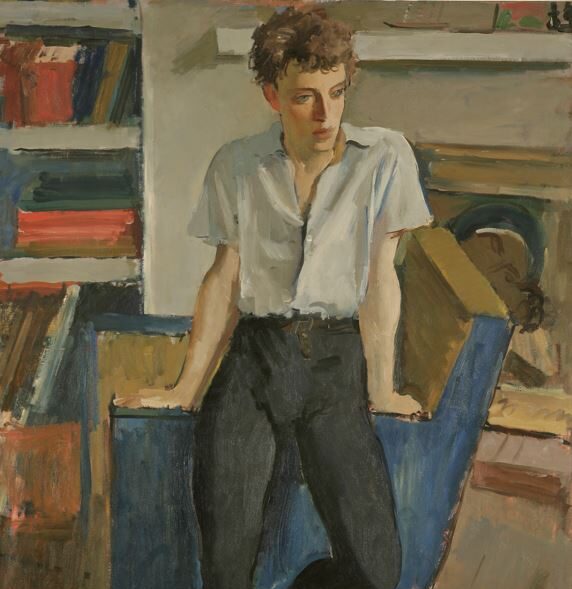
Milivoj Uzelac, Portrait of a Young Man, 1936

Milivoj Uzelac
Portrait of a Young Man, 1936
oil on canvas
162 x 115 cm
inv. no. MG-973

Intimate setting, intense colourway and a vigorous presence of the figure of a young man are characteristic of Milivoj Uzelac (Mostar, 1897 – Pasto Sobre, Cotignac, 1977) and his painting in the 1930s. Portrait of a Young Man depicts a dancer in a leotard, a short-sleeved shirt and ballet slippers leaning against an armchair. In the background to the left, we can see a bookshelf with red-bound books, and on the floor to the right is a framed painting leaning against the wall.

Uzelac’s painting education began in 1912 when he started attending T. Krizman’s paining school, after which he studied at the Provisional Advanced School of Arts and Fine Crafts (1913-1914). As a deserter in Prague, he worked in Jan Preisler’s studio and occasionally attended lectures at the Academy. After the end of World War I, he returned to Zagreb where he participated in the Spring Salon. The 7th Exhibition was the first time he showed his work together with Vilko Gecan, Marijan Trepše and Vladimir Varlaj. Since they all returned from Prague and represented the new, expressionist current in Croatian art, they are often called the Prague Four. Uzelac permanently moved to France in 1923, exhibited at the Salon d’Automne, and since 1924 was constantly active within the Parisian art circle. He nevertheless also staged regular exhibitions in his homeland. Initially, he was preoccupied with drawing and printmaking, but he soon abandoned Academicism. He is inspired by Kraljević and Paris, and his expression becomes increasingly freer, he experiments with cubist and expressionist styles and predominantly erotic themes. In terms of his style, it ranged from Expressionism through Neo-Cubism to Classicism.

Tekst: Marta Radman, curator apprentice © National Museum of Modern Art, Zagreb, 2022.
Foto: Goran Vranić © National Museum of Modern Art, Zagreb, 2022.


Albert Kinert, A Member of the Youth Organisation, 1948

Albert Kinert
A Member of the Youth Organisation, 1948
oil on canvas, 30 x 20 cm
MG-1547

Albert Kinert (1919 – 1987) had a multifaceted artistic personality. He was a painter, graphic artist, illustrator, comic book author and sculptor. Kinert’s unity of diversity, conditioned by his artistic existence, banished every other interest from his life and Kinert’s biography is therefore nothing more than his artistic oeuvre (J. Bučan). This also applies to the artist’s attitude towards his own socio-cultural milieu, its artistic tradition and fantastic artistic worlds. Kinert’s entire oeuvre is based on synchronicities between the media and the concrete (figurative) and abstract expression. Close to a kind of Post-Impressionism, his style was also inspired by Japanese prints, prehistoric painting and Archaic Greek art. The artist developed his painting form into unconventional visual complexes made from the lyrically intoned coloured dots. In the 1960s, he moved away from narration and expressed himself in an abstract manner, which gradually led to the harmonisation of the organically abstract and concrete signs (Wrath – In the Tavern, 1979, The Damned in His Paradise, 1980). He graduated from the Academy of Fine Arts in Zagreb in 1946 (T. Krizman), where he worked as an assistant professor since 1961, then a full professor, and since 1971 as an associate professor, as well as the head of the special graphic arts department. He produced numerous print and watercolour portfolios and received many awards for his work. In 1957, he participated in the exhibition of the Mart Group, and he was one of the founders of the Zagreb 58 Group. His painting A Member of the Youth Organisation (1948) is an unconventional work, belonging to the poetics of Socialist Realism because it represents a hidden figure-portrait, and the only references to the historical period are the title, the figure’s pose and attributes of clothing. Standouts among his many exhibitions are the retrospectives at the Modern Gallery (today the NMMU) in 1985 (D. Schneider) and 2018 (I. Körbler), which valorised and revalued Kinert’s place in Modern art in Croatia.

Text: Željko Marciuš, museum consultant of the National Museum of Modern Art © National Museum of Modern Art, Zagreb, 2023
Translated by: Robertina Tomić
Photo: Goran Vranić © National Museum of Modern Art, Zagreb, 2023

Željko Hegedušić, The Flag, the Devil and the Declaration 1969

Željko Hegedušić
(1906-2004)
The Flag, the Devil and the Declaration 1969
ink on paper,
470 x 360 mm
MG-3898

Hegedušić was born in 1906, in Tuzla, Bosnia and Herzegovina, but the artistic milieus of Zagreb, and later Paris, will be crucial for his development as an artist. As a member of the Earth Group, Hegedušić created several anthological works in the period from 1930 to 1941, which can be connected to New Objectivity, an art movement that used irony and grotesque to express criticism of the European society between the two wars. When the government of the Kingdom of Serbs, Croats and Slovenes banned the work of the Earth Group in 1935, the socially critical art almost completely disappeared from the culture. The need to present social reality, to talk about it, at least figuratively, still remained and many Croatian art critics will later connect this ban of the “real” with surrealist tendencies in art. Željko Hegedušić is one of the artists in whose work we can trace this phenomenon. After World War II, his works will no longer have the character of social criticism, although, especially in the later stages of development of the socialist society, criticism will be much needed (in Croatia, the artists congregated around Conceptual art tendencies will assume this function). Although the title of the drawing – “The Flag, the Devil and the Declaration” – plays with ambivalent meanings, it is difficult to read it as an open critique of the current social circumstances. We must bear in mind that in contemporary public opinion, the word “declaration” was most often associated with the so-called Declaration on the Status of the Croatian Language, that is taken as a symbolic beginning of the Croatian national awakening in the Yugoslav federation. In that sense, the questions ‘which flag?’ is not completely preposterous, especially since the drawing does not explicitly show any flag. Either way, Hegedušić concealed allusions to the socio-political situation, cloaked it in an imaginarium that invokes pre-modern painting, on the one hand, and the inevitable surrealist theme, eroticism, on the other. Text: Klaudio Štefančić, curator © National Museum of Modern Art, Zagreb

Text: Klaudio Štefančić, curator © National Museum of Modern Art, Zagreb, 2023
Translated by: Robertina Tomić
Photo: Goran Vranić © National Museum of Modern Art, Zagreb, 2023

Velibor Mačukatin, Combing, 1941

Velibor Mačukatin
(1919 – 2010)
Combing, 1941
bronze, 29.5 x 19 x 14 cm
MG-2225

A sculptor and medallist, Velibor Mačukatin obtained a degree in sculpture in 1946 in the class of F. Kršinić. He took a special course with A. Augustinčić and was his collaborator in the execution of monumental public sculptures.
He designed monuments with partisan themes, a pronounced heroic gesture, but also public monuments featuring stylised shapes and smooth surfaces. As a skilled portraitist, he produced numerous bronze reliefs and busts for public institutions, as well as tombstones. Medals with realistic portraits (Portrait of Marina Baričević, 1993) stand out in his notable medallist oeuvre. He also created medal works featuring original compositions dedicated to various events and anniversaries (Congress of Women in Paris, 1945).
His permanent preoccupation was the female nude, and he created a notable body of small-scale works, in classical poses, stylised, or in turn, female nudes with pronounced eroticism, interpreted more freely in numerous erotic drawings and coloured collages.
A nude girl in a relaxed seated pose, in suspended motion, is shown in an intimate moment of combing her hair. The vigour and strength of the physicality were achieved by forming summary rounded volumes with a solid form and an emphasised contour line.

Text: Tatijana Gareljić, museum consultant © National Museum of Modern Art, Zagreb, 2023
Translated by: Robertina Tomić
Photo: Goran Vranić © National Museum of Modern Art, Zagreb, 2023

Josip Račić, At the Café 1908

Josip Račić
At the Café 1908
watercolour on paper
28.5 x 22 cm
MG-2005

Josip Račić (1885 – 1908) was one of the founders of Modern art in Croatia, who achieved clear pictorial values in his painting. After having finished his lithography studies in 1903, he moved to Vienna in 1904 and then to Munich where he attended the Academy of Fine Arts and studied painting under H. v. Habermann. His education in A. Ažbe’s private studio, which emphasised the principle of the sphere and crystallisation of colour, also had a significant influence on the development of Račić’s personality. On the basis of this, Račić creates a visual synthesis characterised by solid structural design and pronounced voluminousness. Familiar with the most important currents of Modern art, Račić early on formed a pictorial poetics built on the appreciation of the art of Velazquez, Rembrandt and Manet, but he was also influenced by the work of W. Leibl. In 1905, he met Becić. Together with Herman and later Kraljević, they formed the so-called Die Kroatische Schule (Croatian School) within the Munich Academy. In 1906, he spent time in Zagreb where he drew caricatures for the Koprive satirical magazine. In 1908, he moved to Paris, produced copies at the Louvre, painted the motifs of parks, riverbanks, cafés, portraits and self-portraits. His mysterious death at a young age, lamentations on poverty through the observations of various interpreters: (…) his canvases speak the language (…) of the grave (M. Krleža), are recounted by I. Zidić in the study Račić or the Boyhood of a Genius. Račić appreciated the importance of visual sensation, which is expressed in his portraits and self-portraits, studies that are psychologically deep and northernly sombre. The pronounced appreciation of visual phenomena revealed to him the importance of the optical conception of impressionists and post-impressionists. The peculiar lighting in Pont des Arts (1908) suggested speculations of Impressionism, however, the palette based on silvery-grey and the synthetic elements of the composition are not characteristic of Impressionism. His Parisian impressionist watercolours are particularly important. One such filmic frame is his watercolour At the Café (1908). Composed as a painting within a painting, it reveals the emptiness and hollowness of the café’s interior as a counterpoint to the brighter depiction of a young man with a hat and drink labels inscribed atop the adjacent bar. Mother and Child (1908) and Self-Portrait (1908) are Račić’s iconic paintings. They are tonally condensed realistic studies. Račić’s painting received its appropriate valorisation as late as 1920, when Lj. Babić, in addition to the first display of the NMMU collection at the Museum of Arts and Crafts, organised his first solo exhibition.

Text: Željko Marciuš, museum consultant of the National Museum of Modern Art © National Museum of Modern Art, Zagreb, 2023
Translated by: Robertina Tomić
Photo: Goran Vranić © National Museum of Modern Art, Zagreb, 2023

Mirko Zrinšćak, Saint Aridotto Volcano Kozjak, 1992

Mirko Zrinšćak
Saint Aridotto Volcano Kozjak, 1992
mixed media
95 x 64 cm
MG-6388

Laon Istra apres Kunst, 1993
mixed media
95 x 64 cm
MG-6389

Mirko Zrinšćak is a painter, graphic artist and sculptor who, after having studied the organisation of cultural activities at the Faculty of Teacher Education in Rijeka, went on to obtain a degree in painting from the Academia di belle Arti in Venice in 1987 (E. Vedova). He then spent a year as an artist in residence in Kiel, in Kunstlerhaus, Germany. He is the founder of the Multimedia Research Centre Veprinac – Učka (C.M.I.V.U.). The mountain of Učka, as a natural environment and place where he chose to live, is a microcosm of the artist’s spiritual and material existence and an inexhaustible source of inspiration for his artistic work.

Early on, he painted in the spirit of Action painting, and then he introduced ready-made objects into the painting trying to reconcile and connect tradition and innovation. Later on, the refined, minimalist spatial structures, sculptural works and site-specific ensembles constituted a separate unit in his oeuvre. Coexistence with nature and its abundant changes and shapes have helped form his artistic worldview focused on flawlessly shaped organic forms, primarily the polished wooden structures that strive for a universal and contemporary understanding. The abstract minimalistic organic forms harmoniously convey the rhythm of inner and outer space, balance introspection and phenomenality, meditation and rationality, perfection, but also new correlations of postmodern premises.

The objectified paintings Saint Aridotto Volcano Kozjak and Laon Istra apres Kunst are conceived as assemblages of organic and inorganic elements, heritage and the present time, duration and transience, where the constructed elements form a new autonomous artistic context.

Text: Tatijana Gareljić, museum consultant © National Museum of Modern Art, Zagreb, 2022
Translated by: Robertina Tomić
Photo: Goran Vranić © National Museum of Modern Art, Zagreb, 2022

Edward Theodore Compton, Mountain Landscape (Dolomit Landschaft), s.a.

Edward Theodore Compton
(1849 – 1921)
Mountain Landscape (Dolomit Landschaft), s.a.
oil on canvas
149,6 x 93,2cm
MG-690

Edward Theodore Compton, a self-taught painter, was fascinated by nature as a child and it will remain his main painting motif throughout his life. He sporadically attended various art schools in England. In 1869, he travelled to Munich via Darmstadt, and from 1873 he lived and worked in Feldafing on Lake Starnberg. He visited the Alps and was fascinated by their harsh nature, not only as a painter but also as a skilled mountain climber, and Alpine scenery will become one of the most frequent motifs of his landscapes. As a prominent landscape painter, he was interested in different landscapes, so he travelled to various Mediterranean countries (north Africa, Corsica, Spain). He illustrated the publications of the German and Austrian Alpine Associations.
Compton’s painting oeuvre is prolific, it includes landscapes rendered in different techniques (oil, watercolour, ink drawings). He created several thematic landscape series. Initially painting in the English romantic tradition, Compton later developed a more realistic representation of nature. His work is also remarkable for its portrayal of atmospheric changes. With his painting style, he influenced his son, the famous painter Edward Harrison and his daughter Dora. Paintings of Compton father and son are often auctioned by European auction houses.
The Mountain Landscape painting from the museum collection is a representation of harsh Alpine peaks that the painter himself climbed, which enabled him to create an unusually unconventional framing of the jagged mountain range and a direct realistic approach. Left side of the painting provokes discomfort with its representation of an inaccessible mountain massif rendered in a gamut of brown hues ranging from bright to deeply disconcerting, almost black hues in the central part of the picture. As a counterpoint of sorts, a deep calming horizon of bluish peaks opens to the right, merging with clouds in its colouristic transparency.

Text: Dajana Vlaisavljević, museum consultant © National Museum of Modern Art, Zagreb, 2022
Translated by: Robertina Tomić
Photo: Goran Vranić © National Museum of Modern Art, Zagreb, 2022

Vlaho Bukovac, Study for Dante’s “Paradise”, 1899

Vlaho Bukovac
Study for Dante’s “Paradise”, 1899
oil on canvas, 80.5 x 27.2 cm
MG-3893

Vlaho Bukovac (1855–1922) was one of the key figures of Modern art and culture in Croatia. He was educated in Paris and is known for his international career (France, England, the USA, Vienna, the Czech Republic). In terms of style, Bukovac’s painting ranges from Academic Realism of the period of the so-called Colourful School of Zagreb to a peculiar version of Symbolism in the portraits and nudes created during the last twenty years of his life when he taught at the Academy of Fine Arts in Prague.
Painted in Cavtat in 1899 with free and visible brushstrokes and bright colourway with pronounced ruddy accents, Study for Dante’s “Paradise” shows Bukovac experimenting with the symbolist approach to painting. Themes from literature, especially Dante, are an established choice of European Symbolism. Subtly interpreted, this artistic style will become dominant in Bukovac’s oeuvre during the last twenty years of the painter’s life in a striking version of his Prague Divisionism.

Text: Ivana Rončević Elezović, museum consultant © National Museum of Modern Art, Zagreb, 2022
Translated by: Robertina Tomić
Photo: Goran Vranić © National Museum of Modern Art, Zagreb, 2022

Vladimir Becić, Mountain Landscape with a Stream, 1923

Vladimir Becić
(1886 – 1954)
Mountain Landscape with a Stream, 1923
oil on canvas, 100 x 120 cm
MG-879

Vladimir Becić (Slavonski Brod, 1886 – Zagreb, 1954) started his education at Menci Klement Crnčić’s and Bela Čikoš Sesija’s private painting school. Soon after, in 1905, he went to Munich where he studied at the Academy of Fine Arts in the class of Hugo von Habermann, and he formed the Munich Circle of Painters with colleagues Miroslav Kraljević, Josip Račić and Oskar Herman. In 1910, he moved to Paris, trained at the Académie de la Grande Chaumière, worked as an illustrator for the magazine Le Rire and exhibited his work at the Salon d’Automne. Having been a volunteer during World War I, he became a war correspondent, photographer and illustrator for the magazine L'ilustration.

After the war ended, he founded an art colony in Blažuj, with colleagues Vilko Šeferov and Karlo Mijić. Blažuj was just a residential location for the colony, which remained active until 1923, while painters travelled through the beautiful landscape at the foot of Mount Bjelašnica in search of motifs. Their landscapes are built with pure volumes, emphasising the plasticity of shapes and the role colour plays in their composition. Vladimir Becić was a professor at the Academy of Fine Arts in Zagreb from 1923 to 1947.

The motifs that Becić painted in the 1920s are Blažuj landscapes, female figures often depicted as nudes in plein air, and still lifes. Mountain Landscape with a Stream exudes a refined artistic language, while the reduced palette of brown, yellow, red and orange colours and their hues enables him to build a deep volume and clearly articulated details of the scene, simultaneously achieving a magical, alienated, apathetic atmosphere.

Text: Marta Radman, trainee curator © National Museum of Modern Art, Zagreb, 2022
Translated by: Robertina Tomić
Photo: Goran Vranić © National Museum of Modern Art, Zagreb, 2022

Francesco Hayez, Hector Bidding Farewell to Andromache (Ettore alla porta Scea), 1811 – 1813

Francesco Hayez
(1791 – 1882)
Hector Bidding Farewell to Andromache (Ettore alla porta Scea), 1811 – 1813
oil on canvas, 165x154cm
MG-43

Francesco Hayez was an Italian painter and lithographer. He is primarily known for his romantic historical and classical mythological scenes and portraits. He hails from a family of modest means, and it was his uncle, an antique dealer, who spurred his interest in art. In 1809, he received a scholarship to study painting in Rome. After having completed his studies, he spent a few years in Naples, and in 1820 he became a professor at the Brera Academy in Milan, and then a director in 1850. He was the central figure in Milan’s intellectual and aristocratic circles.
In Hayez’s early works there is a noticeable influence of the Italian Settecento and Canova. He has been compared to Ingres in terms of blending classical and medieval sources. His painting Pietro Rossi prigioniero degli Scaligeri from 1820 is considered a kind of manifesto of Italian Romanticism. The museum painting Hector Bidding Farewell to Andromache is one of Hayez’s more important early works, created in Rome when he was mainly painting ancient scenes. Later, the painting will be sent to Venice to Hayez’s uncle, a restorer and antiquarian. The content of the simply conceived classicist composition is dominated by the figures of the strong and determined Hector and the tender and loyal Andromache. Visually, it is attended by the most important element of form, light, that spreads from the central figure, Andromache and falls freely, fading away across other figures. This artistic procedure can be interpreted symbolically as leading towards the tragic end, not only of the protagonists of the scene (story), but of human nature in general, which finds the excitement of war and conflict more attractive than peace of mind.

Text: Dajana Vlaisavljević, Museum consultant © National Museum of Modern Art, Zagreb, 2022
Translated by: Robertina Tomić
Photo: Goran Vranić © National Museum of Modern Art, Zagreb, 2022