Ivo Kerdić, The Goldsmith’s Treasure, 1928.

Ivo Kerdić
(1881–1953)
The Goldsmith’s Treasure, 1928.
bronze, cast
30 × 6 × 6 cm
MG-675

Ivo Kerdić, a prominent Croatian sculptor and medallist, was educated in Zagreb and Vienna, where he received the annual award for composition in 1910. In 1913, at the invitation of Robert Frangeš-Mihanović, he returned to Zagreb to head the Art Foundry at the Academy of Fine Arts. From 1923 to 1947, he taught metalworking at the same institution.
Although active in various sculptural disciplines, Kerdić achieved his greatest success in medal art, which he established as a distinct artistic form in Croatia. His early works, created during his studies, bear strong influences of the Secession style (e.g., Vera Pija Pilar), while in his Zagreb period, he embraced realism, with a focus on the psychological portrayal of his subjects (e.g., Vladimir Becić, J. J. Strossmayer, Ivan Meštrović). The reverse sides of his medals often feature allegorical scenes, skilfully combining classical symbols with traditional Croatian motifs.
In addition to medals and small-scale sculpture, Kerdić also created larger works (e.g., The Kiss, 1912; The Goldsmith’s Treasure, Kamenita vrata (The Stone Gate), Zagreb, 1929), numerous portraits (e.g., Nada Martić-Martek, 1914; Ante Starčević, 1940), and allegorical tomb monuments (e.g., Dr. Milan Ogrizović, 1924). His sacred art holds a special place within his oeuvre, including altars for St. Blaise’s Church in Zagreb and the Church of Sts. Cyril and Methodius in Jerusalem.
Kerdić was also active in applied arts, crafting decorative objects in precious metals—pitchers, trays, ashtrays—as well as jewellery, such as the rector’s chain of the University of Zagreb and the chain of the Grand Master of the Brethren of the Croatian Dragon.
The bronze sculpture The Goldsmith’s Treasure is a study of Dora Krupićeva, the daughter of a goldsmith and central character in the novel of the same name by August Šenoa. The sculpture was installed in 1929 in a niche on the building of the Brethren of the Croatian Dragon at Kamenita vrata (The Stone Gate) in Zagreb.
Dora is portrayed standing, wearing a long, form-fitting dress with long sleeves and a rounded neckline. Her feminine form is accentuated by a gentle contrapposto: the right leg bent at the knee, the left extended, with her foot just visible beneath the folds of the hem. Her head tilts slightly to the right, with a soft, faint smile on her face. Her hair is neatly arranged and braided. In her left hand, at hip height, she holds a casket, while the right hand holds a key—symbols of her virtue and fate. The sculpture’s surface is smooth, with flowing, lyrical lines from the waist downward. The pedestal bears the engraved title: THE GOLDSMITH’S TREASURE.

Text: Tatijana Gareljić, Museum Advisor, National Museum of Modern Art © National Museum of Modern Art, Zagreb
Photo: Goran Vranić © National Museum of Modern Art, Zagreb

Vjekoslav Karas, Portrait of a Boy, 1852–1856

Vjekoslav Karas
Portrait of a Boy, 1852–1856
oil on canvas
68.8 × 55.1 cm
MG-71

Vjekoslav Karas (1821–1858), one of the key figures of Croatian 19th-century painting, was the first artist from northern Croatia to receive academic training in Italy. After studying in the studio of Giovanni Francesco Corsi in Florence, he continued his development in Siena and Rome, where he also composed music and wrote poetry in both Croatian and Italian.
Following his return to Croatia in 1848, Karas worked mainly between Zagreb and Karlovac. His style blends elements of Classicism, Nazarene Romanticism, and Biedermeier Realism, with a particular focus on portraiture—often unsigned.
Portrait of a Boy stands out as one of his most accomplished works. The young sitter is shown full-length, facing frontally, with a gentle smile and a direct gaze. Earthy tones dominate the composition, while soft lighting from the left accentuates the figure’s presence. The painting is among the earliest examples of psychological portraiture in Croatian art.
Despite his short life, Karas's legacy endures through a body of work that significantly shaped the course of national painting in the 19th century.

Text: Luciana Fuks, trainee curator at the National Museum of Modern Art © National Museum of Modern Art, Zagreb
Photo: Goran Vranić © National Museum of Modern Art, Zagreb

Vladimir Becić, Bosnian Man Digging, 1918.

Vladimir Becić
(1886 – 1954)
Bosnian Man Digging, 1918
oil on canvas
76 × 65 cm
MG-860

In Bosnian Man Digging, Vladimir Becić depicts a man caught mid-movement during physical labor, bent toward the ground in a dynamic yet intimate gesture. The composition is simple, focused on the human figure and its action, rendered in a rich, earthy color palette. The artist uses bold but controlled brushstrokes to emphasize the volume of the body and the physical exertion involved in the task. While the scene carries no overt drama, it holds deep symbolism—celebrating manual labor, the human body, and the connection between man and land. This subject, frequent in Becić’s later work, reflects his interest in rural life and peasant figures, grounded in reality and free of idealization.
Becić’s art is consistently centered on the human figure and solid form. In his early period, he painted under the influence of the Munich School and old masters like Velázquez and Manet, employing a muted palette with strong contrasts of light and shadow. Later, inspired by Cézanne, he developed a Cézannist approach: constructing volume through facets and tonal modulation, particularly in his landscapes and portraits. Over time, his palette lightened, compositions opened up, and forms remained grounded—conveying a sense of mass and presence. His mature style reflects a balance between rational structure and emotional authenticity.
Vladimir Becić was one of the key figures of Croatian modernism. He studied in Zagreb, Munich, and Paris, and was part of the famed Munich Circle with Račić, Kraljević, and Herman. As a war correspondent and illustrator during World War I, he produced a powerful body of drawings and photographs, capturing the realities of wartime. After the war, he settled in Blažuj near Sarajevo, where he developed a personal expression rooted in Cézannist structure and local themes. From 1924, he taught at the Academy of Fine Arts in Zagreb, where he influenced a generation of younger artists and helped shape the course of modernism in Croatian art. His work is marked by consistency, humanistic sensitivity, and formal refinement.

Text: Lorena Šimić, curator - educator at the National Museum of Modern Art © National Museum of Modern Art, Zagreb
Photo: Goran Vranić © National Museum of Modern Art, Zagreb

Ivica Malčić On the Wardrobe, 1997.

Ivica Malčić
On the Wardrobe, 1997
oil on board, 162.5 × 58.8 cm
MG-6507

Ivica Malčić is the most prominent Croatian painter associated with so-called "bad painting." Working within traditional media such as painting and drawing, he has developed a distinctive and original style characterized by raw iconography, immediacy, conceptual approaches to the image, free gesture, collage-like compositions, verbo-visual elements, anti-academicism, and a fierce critique of kitsch and bad art—paradoxically expressed through deliberately "bad" painting.
The conceptual nature of Malčić’s work lies in his disciplined, daily practice in the studio and his early adoption of serial formats. By the mid-1990s, he began exhibiting series of one hundred small-format paintings arranged into painterly installations (One Hundred Unexhibited Paintings / October 1991 – August 1995, 1995; repeated in 1998). His work is rooted in the exposure of personal life, a sharp critique of the art world, and an honest engagement with social realities—resulting in a painting practice that is both authentic and confrontational.
Since 2006, he has produced diary-like drawings and collages incorporating quotations from popular culture, often infused with self-ironic introspection. From the outset of his career, he has created polemical works that critique bourgeois values, the art market, and cultural institutions (Never a Slave, 2000; Never Mind Dimitrije..., 2005). In 2014, he began a realist-critical series titled Obituaries, based on press photography.
The painting On the Wardrobe (1997), executed in his characteristic oil-on-wood technique, depicts a levitating figure represented only by a pair of legs, hovering above chairs and a wardrobe, defying gravity. In art, such things are possible.
Malčić graduated from the Academy of Fine Arts in Zagreb in 1996 (under Miroslav Šutej) and exhibits regularly throughout Croatia. His works are part of the collection of the National Museum of Modern Art in Zagreb.

Text: Željko Marciuš, museum advisor of the National Museum of Modern Art © National Museum of Modern Art, Zagreb
Photo: Goran Vranić © National Museum of Modern Art, Zagreb (detail)

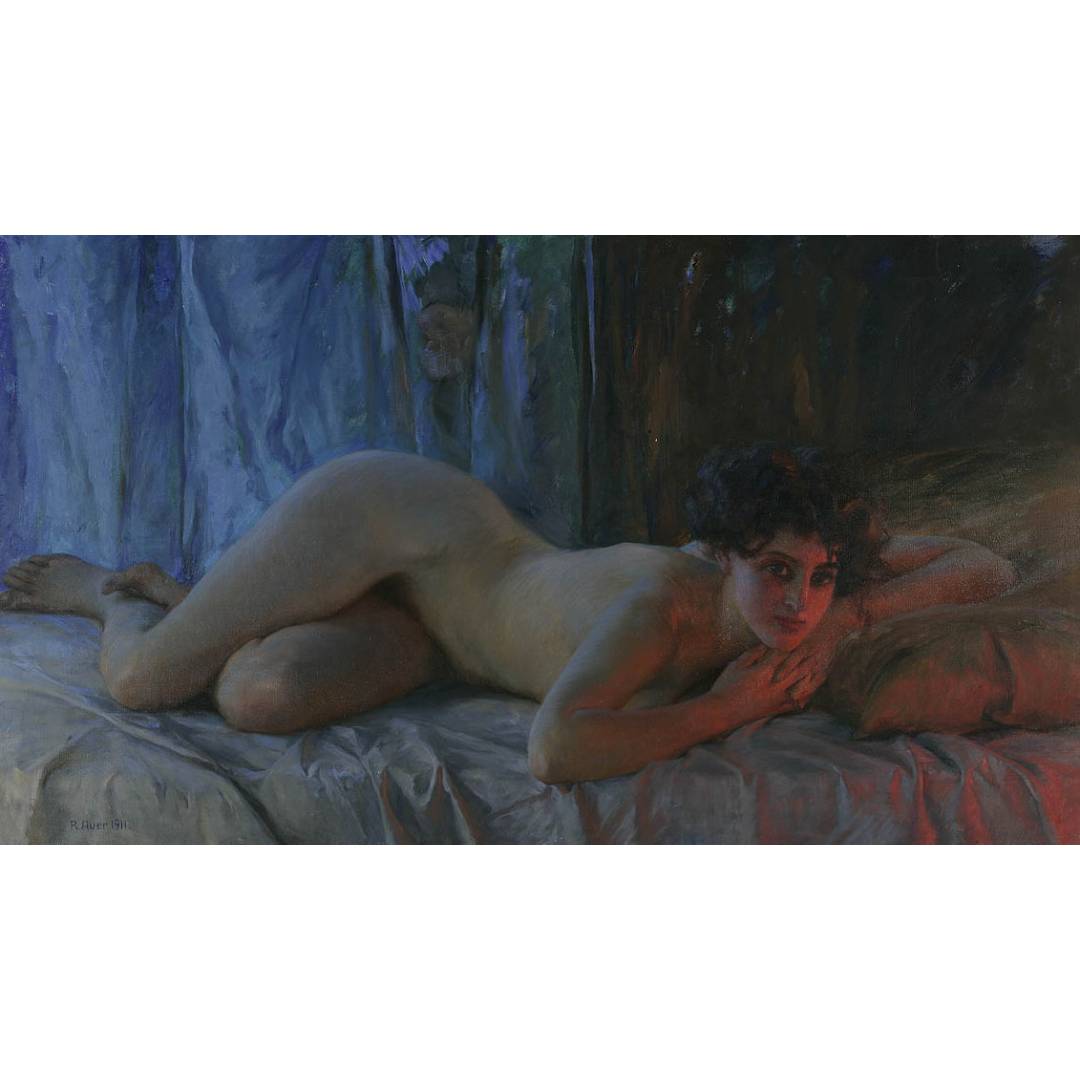
Robert Auer, At the Edge of the Red Light, 1911.

Robert Auer
(1873.-1952.)
At the Edge of the Red Light, 1911.
oil on canvas
85.3 × 150 cm
MG-360

The painting At the Edge of the Red Light by Robert Auer depicts a reclining female nude set within a richly decorated interior. The young woman’s body is rendered in full, with carefully modeled volumes and a smooth texture of skin, surrounded by the interplay of cool bluish and warm red tones. The red light in the right portion of the composition creates a sensual atmosphere, further emphasized by the model’s pose and her gaze directed at the viewer. Although the work belongs to the nude genre, its mood evokes symbolic and emotional layers, situated between eroticism, intimacy, and introspection. With this piece, Auer masterfully blends realism, Art Nouveau decorativeness, and psychological depth.
Robert Auer painted in the spirit of Munich academicism and Art Nouveau, combining rich coloristic expression, elegance of form, and refined thematic choices. His nudes and portraits are often imbued with an atmosphere of luxury, intimacy, and subtle melancholy. He applied layers of paint with soft transitions of light and shadow, complemented by decorative backgrounds that enrich the ambient quality of the works. Both traditional and modern, Auer successfully developed a personal style within the dominant movements of his time, cultivating sensuality and the aestheticization of the human form.
He studied in Zagreb, Vienna, and Munich, graduating from the Academy in 1895. Upon returning to Zagreb, he opened the city’s first private art school in 1897 and became one of the founders of the Croatian Artists’ Society. He worked as a teacher at the School of Applied Arts and became a professor at the Academy of Fine Arts in 1918. His oeuvre includes portraits, still lifes, allegorical compositions, and distinctive nudes, among which At the Edge of the Red Light stands out as one of the most notable works of Croatian Art Nouveau.

Text: Lorena Šimić, curator / museum educator, National Museum of Modern Art © National Museum of Modern Art, Zagreb
Photo: Goran Vranić © National Museum of Modern Art, Zagreb

Slavko Šohaj, Flowers with Watermelon and Lemon, 1986

Slavko Šohaj
Flowers with Watermelon and Lemon, 1986
oil on canvas
88.5 × 98.5 cm
MG-6936

Slavko Šohaj (Zagreb, 1908 – 2003) is regarded as one of the foremost exponents of Croatian lyrical intimacy. He graduated from the Academy of Fine Arts in Zagreb, where he studied under distinguished artists Ljubo Babić (Jastrebarsko, 1890 – Zagreb, 1974) and Vladimir Becić (Slavonski Brod, 1886 – Zagreb, 1954). His artistic education was further enriched by his stays in Paris (1931–1932 and 1939), where he was directly exposed to the vibrant avant-garde art scene of the time.
Šohaj made his public debut in 1934 in Zagreb, exhibiting as a guest of the "Group of Three". He was immediately recognized by critics as an authentic representative of figurative poetic realism.
His Parisian experience profoundly influenced his artistic trajectory, as he developed a highly personal visual language focused on intimate themes, portraits, nudes, and still lifes. His work reflects the influence of major French masters such as Henri Matisse (Le Cateau-Cambrésis, 1869 – Nice, 1954) and Paul Cézanne (Aix-en-Provence, 1839 – 1906), and also bears traces of inspiration drawn from Claude Monet (Paris, 1840 – Giverny, 1926).
Still life compositions, particularly those featuring fruit, are a recurring and defining motif throughout Šohaj’s oeuvre. From the 1960s onwards, his style underwent a gradual transformation—his paintings became more decorative and planar, marked by a growing emphasis on abstraction, stylization, and the subjective expression of form.
Flowers with Watermelon and Lemon, a work from the later phase of Šohaj’s career, is characterized by a vivid chromatic palette and an expressive painterly gesture. It exemplifies the artist’s sustained exploration of the relationship between color and form, and his continuous negotiation between abstraction and figuration.

Text: Luciana Fuks,  Intern curator at the National Museum of Modern Art © National Museum of Modern Art, Zagreb
Photo: Goran Vranić © National Museum of Modern Art, Zagreb

Matko Trebotić Sheet 2, from the portfolio “Yugoslav Graphics” (1979)

Matko Trebotić
Sheet 2, from the portfolio “Yugoslav Graphics” (1979)
Lithograph on paper
600 × 420 mm
MG-4220

Matko Trebotić (b. 1935) is a prominent Croatian painter of cultural and natural memory — a contemporary chronicler who finds the local in the universal and the universal spirit in regional, native motifs. His entire body of work in drawing and painting is founded on a dialectic of creation that condenses the world into symbols, and then expands those symbols back into the world. This is a reduction of narrative. His signature motifs include Old Croatian chapels, skulls, crosses, and cypresses — iconic elements of what critic Ivo Šlade called the “Trebotićian” iconography.
Trebotić graduated from the Faculty of Architecture in Belgrade in 1961. His first unofficial exhibition was held in Bochum in 1968, later recognized in the 2018 retrospective Fifty Years of Solitude... in Split. In the early 1970s, he studied at the renowned Folkwangschule in Essen under Prof. Hermann Schardt, as a Meisterschüler, where he also trained in graphic arts. From 1971 onward, he lived in Düsseldorf, where he developed a friendship with the influential artist Joseph Beuys.
Sheet 2 from the portfolio Yugoslav Graphics (1979) represents — as is characteristic of Trebotić — a memory of his native Split, rendered as if in the palm of a hand and simultaneously universal in its expression. It is a sublime blend of cultural layers: Antiquity, early Christianity, the early and high Middle Ages, the Renaissance… and beyond. This inexhaustible source of imagery reflects the artist’s deep personal necessity and sense of belonging to a multilayered site — a place both archaeological and spiritual — in stark contrast to the visual cacophony of contemporary trends, aesthetic fashions, and oversimplified ideologies.
Trebotić’s works are held in major Croatian and international collections and museums. He also painted ceremonial stage curtains, collectively titled Adriatic Polyptych, for leading Mediterranean theatres in Croatia. In 2009, he received the City of Split Lifetime Achievement Award.

Text: Željko Marciuš, museum advisor of the National Museum of Modern Art © National Museum of Modern Art, Zagreb
Photo: Goran Vranić © National Museum of Modern Art, Zagreb
Milivoj Uzelac, Odalisque on Cushions, 1934

Milivoj Uzelac
Odalisque on Cushions, 1934
Oil on canvas
80 x 100 cm
MG-999

The artistic work of Milivoj Uzelac (Mostar, 1897 – Cotignac, France, 1977) during his years in France after the 1930s is infused with a Fauvist sensitivity to color and the emotional expressiveness of Expressionism. His study of the works of French masters such as Henri Matisse (Le Cateau-Cambrésis, 1869 – Nice, 1954) and André Derain (Chatou, 1880 – Garches, 1954) left a visible mark on his paintings from this period. Odalisque on Cushions stands as a remarkable example of that influence. The composition features a reclining female figure in a relaxed pose, situated in an intimate interior setting, surrounded by cushions and everyday objects such as a pitcher and a plate of fruit. Beyond the cozy atmosphere and vivid coloration, the painting is also distinguished by the powerful presence of the figure.
Milivoj Uzelac was one of the key figures of Croatian modernism. He received his education in Banja Luka, Zagreb, and Prague, where he honed his painting skills. In Prague, he was closely associated with several prominent contemporaries, including Vilko Gecan (Kuželj near Brod na Kupi, 1894 – Zagreb, 1973), Marijan Trepše (Zagreb, 1897 – 1964), and Vladimir Varlaj (Zagreb, 1895 – 1962). Together, they formed the core of a new expressionist movement in Croatia, often referred to as the "Prague Four." After returning from Prague in 1919, Uzelac remained active in Zagreb for only a few years. In 1923, he left his homeland and moved to France, where he drew inspiration from contemporary European art movements such as Fauvism, Expressionism, and Cubism. Although he lived and worked in France, he regularly exhibited in Croatia and had a significant influence on the new generation of Croatian painters during the interwar period.

Text: Luciana Fuks, Curatorial Intern at the National Museum of Modern Art © National Museum of Modern Art, Zagreb
Photo: Goran Vranić © National Museum of Modern Art, Zagreb
Arsen Roje, Car Accident, 1966

Arsen Roje
(1937. - 2007.)
Car Accident, 1966
drawing, ink, coloured ink on paper
84 x 59.5 cm
MG-8428

The artwork Car Accident reflects Roje’s interest in visual communication through shocking contrasts and unexpected combinations of motifs, characteristic of pop art. The upper part of the image depicts a chaotic car accident scene in black and white, with lifeless bodies and scattered wreckage, while the lower part features a vividly painted, hyper-realistic apple against a blank background. This stark contrast between brutal reality and an apparently trivial motif emphasizes irony and social critique, questioning the perception of consumerism, death, and everyday symbols in popular culture. Roje employs a cold, documentary aesthetic combined with surreal elements, creating a powerful visual tension that leaves the viewer unsettled and reflective.
Roje’s work was marked by an early engagement with pop art, making him one of the first representatives of this movement in Croatia. His drawings and graphic works contain references to American popular culture, featuring motifs such as sports cars, revolvers, women's lips, and bold typography. However, his success in film design stemmed not only from his choice of motifs but also from his unique way of connecting them, creating unexpected relationships between images. His most famous work is the award-winning poster for Robert Altman’s movie M.A.S.H. (1970), in which he combined three seemingly unrelated elements—a military helmet, bare female legs, and a human hand—into a surreal, humanoid figure. Beyond film design, Roje continued to explore visual communication, often experimenting with language and meaning.
Arsen Roje was a visual artist and graphic designer, known for his pioneering contributions to pop art and graphic design. In 1956, he enrolled at the Academy of Fine Arts in Zagreb but soon clashed with academic rigidity and prevailing artistic conventions, which he considered outdated. Dissatisfied with the artistic scene, he moved to Paris in 1966 and later to New York, where he gained recognition in the film industry.

Text: Lorena Šimić, curator at the National Museum of Modern Art © National Museum of Modern Art, Zagreb
Photo: Goran Vranić © National Museum of Modern Art, Zagreb

Nasta Rojc, Horsewoman – Self-Portrait, 1922

Nasta Rojc
(1883.-1964.)
Horsewoman – Self-Portrait, 1922
oil on canvas
107 x 127 cm
MG-547

In the painting Horsewoman – Self-Portrait, Nasta Rojc depicts herself in a dark riding outfit, serious and dignified, next to a powerfully built horse whose head dominates the central part of the composition. The artist's gaze is direct and firm, almost defiant, as she tightly holds the reins, a symbol of control and determination. The dark palette and classical composition emphasize the gravity and elegance of the scene. By choosing an equestrian theme and portraying herself as a horsewoman, Rojc expresses not only personal independence but also a challenge to the social norms of femininity and women’s roles in art and society of the time. This self-portrait is a powerful statement of identity and a woman’s place in a traditionally male domain.
In her work, Nasta Rojc often combined a realistic approach with strong symbolic meaning. Her portraits and self-portraits, especially of women, convey a clear desire for self-definition, equality, and inner strength. She painted in the spirit of post-impressionism and symbolism, with a particular focus on the psychological depth of her subjects and the ambient mood. Her palette was rich yet restrained, and her compositions deliberate and stable, highlighting the dignity of the figures she portrayed.
Nasta Rojc was one of the most important Croatian female painters of the first half of the 20th century. She received her artistic education in Zagreb, Munich, and Vienna, and lived and worked between Croatia and abroad. She was among the few women of her era to pursue a professional career in painting, and through both her work and character, she challenged and expanded the visibility of women in the arts. In 1927, with fellow artists, she co-founded the Club of Women Artists, the first artistic association in Croatia composed exclusively of women—painters, sculptors, and applied artists.

Text: Lorena Šimić, curator/museum educator at the National Museum of Modern Art © National Museum of Modern Art, Zagreb
Photo: Goran Vranić © National Museum of Modern Art, Zagreb