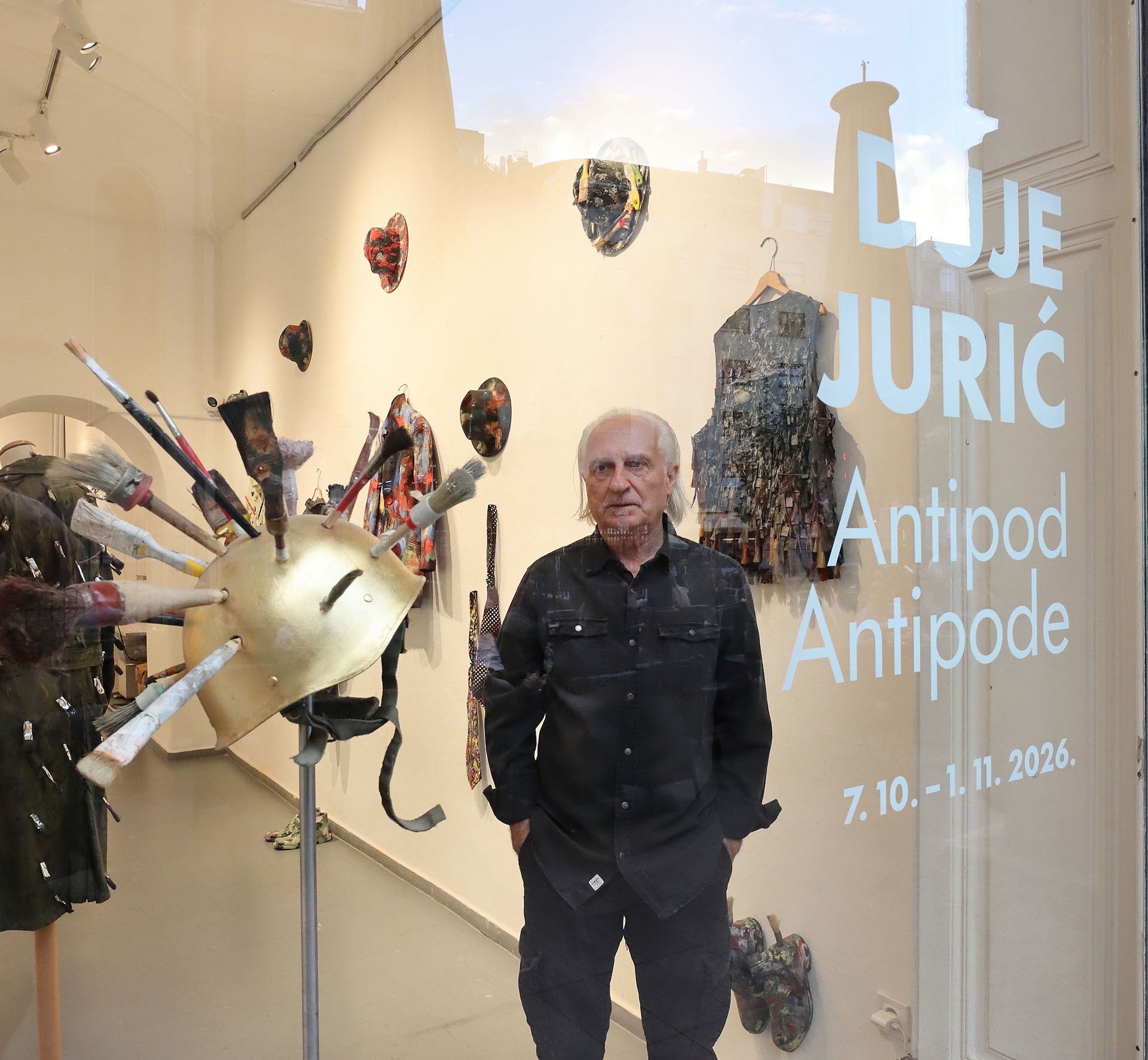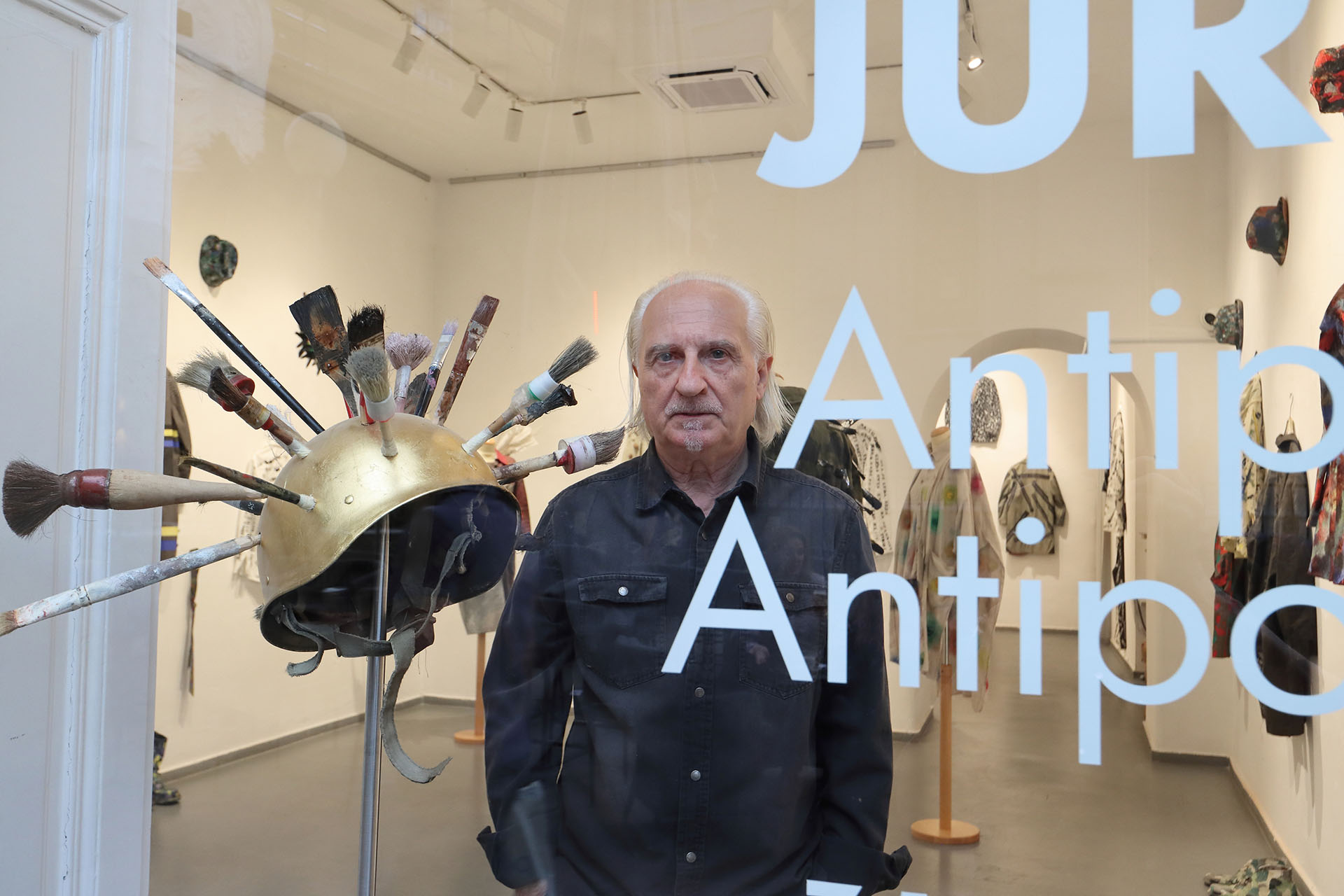
NMMU: What works do you present at the Antipode exhibition, which will be held from October 6th to November 1st at the Josip Račić Gallery?
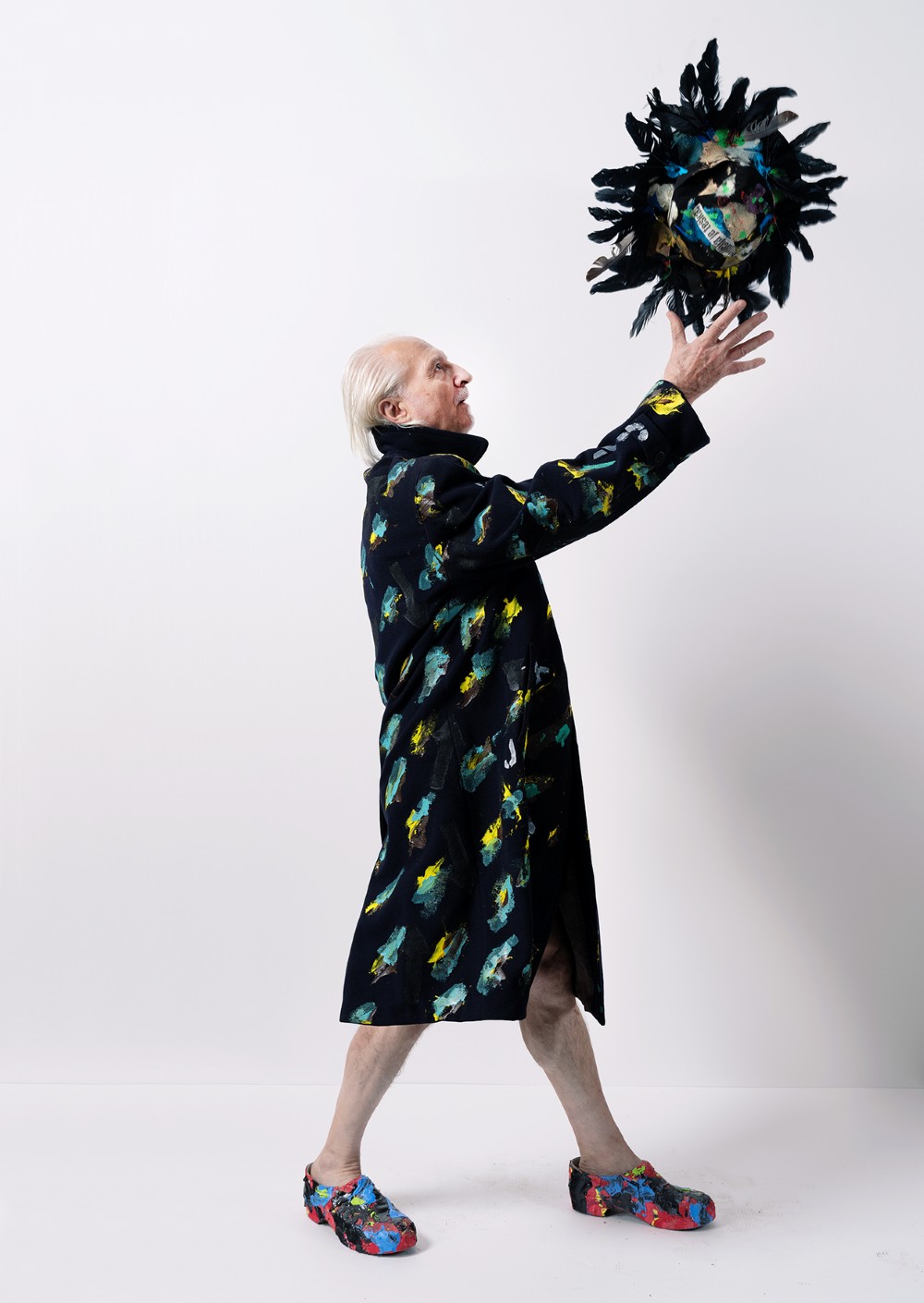
Duje Jurić: When painting, you often wipe your brush on the clothes you work in. You often get some kind of spontaneous composition that intrigues you to continue working... I intervened on the clothes with acrylic, oil paint, collage, often it was a combined technique. I often intervene on everyday objects from the environment, re-create already existing, ready-made objects, not just clothes. There is always a piece of worn-out clothing that you no longer need, or do not wear, and my friends, after seeing my works on the subject, began to bring me their surplus clothes on their own initiative.
Some clothing items were created a really long time ago, I could say that I have been intervening on clothes since the beginning of my painting work. It was similar with the painting of the suitcase, which I have exhibited several times so far, and they are also in some collections, for example, by FilipTrade. I had to work hard for suitcases, collecting them at flea markets, etc.
Honestly, I don't have a particularly emotional relationship with my works.
Perhaps I would single out Edita's showcase here, although this is not a garment. During the course of her illness, Edita Schubert gave me a glass display case, inherited from her father's dental office. We were friends and this work was triggered by the loss of a friend and a great artist whose work I appreciate.
The tendency to stretch into space beyond the limiting format of the "easel painting" has always challenged me. I created numerous ambiences and probably that's how the idea or maybe the need to be in person - an exhibit - appeared. Initially, this form of artistic expression was probably an experiment, research, and possibly an attempt at a new expression. At the opening of my solo exhibition at the Zvonimir Gallery in 1994, and then at the opening of the exhibition Fluxus, Donation by Francesco Conzo, in 1999 at the Museum of Contemporary Art, I wore clothes that accompanied the theme of the exhibitions. This was followed later by the performance Anything at All on Trokut's project Red – Black University in the Caffe As bar, in 2000, and the action, the performance Hommage to the Snail, in 2009.
The receptor or perceiver, the user or observer of works of art, is actually an unavoidable link in the chain of the author's artistic work.
I would refer to Marcel Duchamp on the role of the observer from his famous lecture "The Creative Act" in Houston (1957), where he defines the artist as a "media being" who acts through pure intuition and cannot fully evaluate his own creation. Instead, it is the observer who carries out the process of "aesthetic osmosis", that is, deciphers the work, brings it into contact with the outside world, and then completes the creative act.
NMMU: How do you view clothes?
Duje Jurić: I could define my attitude towards clothes as indifferent, even as a "necessary evil". I have to dress (!), it's a socially established custom, but I don't dress (finesse, fashion... and other related to clothing) in my personal opinion, he pays too much attention today.
Clothes? With my intervention, clothing items as a "raw material" lose their original (clothing) function and become objects on another level. Only on that level do they become interesting to me as a creator. How someone, the observer (the consumer of these works) perceives and experiences them, I consider a very important link in the chain. Again, I will refer to Duchamp's words from the above lecture, in an extended interpretation by Nicolas Bourriaud*, with which I fully agree. „... The very act of choosing an object is enough to start the artistic process...", "...'giving a new idea' to an object is already production itself.". Bourriaud sees the resulting production as a "lexicon of a practice", an intermediate material from which new statements are articulated. These testimonies are ultimately received or experienced by the observer, the user of the work of art. And he concludes "... Post-production artists are skilled workers in this appropriation of culture."
NMMU: With the experience of a curator-restorer... But also from the perspective of an artist and an environmentally responsible member of society, how do you view fast fashion? Do you support clothing recycling?
Duje Jurić: Everything should be recycled, therefore, of course, and even clothes. The textile industry is an extremely serious polluter. I see this as a priority obligation of all responsible inhabitants of the world.
NMMU: Are there any topics that continuously occupy you during your four decades of creativity?
Duje Jurić: In general, I have always had a very wide range of interests. There have always been plenty of topics that draw me as an author...
NMMU: Did you have the opportunity to wear women's shoes or women's clothing in any of your performances? Where do you think is the line between men's and women's fashion?
Duje Jurić: I've never dressed up in the way you're asking, I'm alien to that idea and thought. I don't really think about fashion, that topic doesn't really fit into my spectrum of interests.
NMMU: How do you remember Julije Knifer, with whom you collaborated on the realization of his murals in the southern French town of Séte (1889 and 1990, Villa Saint-Claire) and in Salzburg, Geneva and Dijon?
Duje Jurić: Personally, as a young artist, I found the collaboration with Knifer, a great artist, interesting, pleasant, fruitful, and to some extent challenging. I was fascinated by Knifer's modesty and dedication to work. I performed his murals, meanders of large dimensions that he, already old at the time, could not realize on his own. Unfortunately, the fate of these murals was short-lived, they were mostly painted for exhibitions and subsequently repainted. The only one that survived it is an interesting, large wall mural in the library of the University of Dijon (Campus Montmuzard, Dijon, Univerité de Bourgogne).
NMMU: With 95 solo and more than 250 group exhibitions in which you participated in the country and abroad, how do you remember your first solo exhibition abroad, in Dijon in 1991?
Duje Jurić: The exhibition was at the Atheneum Gallery in Dijon. There were six works of larger formats, (acrylic on paper) and I don't really remember the details about that exhibition. As a young artist, this experience, of course, was very significant to me. Later, at their request, I donated works from that exhibition to the Consortium Museum in Dijon. They were recently exhibited at the I Walk the Line exhibition, at the Consortium Museum.
NMMU: Have you traveled and stayed around the world a lot? Which city or place impressed you the most and why?
Duje Jurić: I love to travel and many of the world's destinations intrigue me and call me...
NMMU: What fulfills you the most, and what consumes the most energy? How do you relax and prefer to spend your free time?
Duje Jurić: I mostly spend my energy in creative work, but I also like to cook, read, and meditate...
The world is changing, the climate, society as well, the former values are not today's, technology is advancing, what would you say to young artists in this regard?
I think that for every work success, regardless of the scope of activities, it is necessary to invest your whole self, without calculations. The current picture of the world does not look optimistic to me and it is difficult to predict what will happen in the near future.
My appeal to the younger generations of artists, in short - to be open to experimentation, to persistently work on exploring personal creative potentials, to be honest and yourself, to work a lot, to have open eyes for all art events at home and abroad...
Maybe it's not a piece of advice intended for general use, but for me personally, this life motto was the guiding thread and I'm somewhat satisfied with how it works.
Prepared and interviewed by: Lana Šetka
Translated by: Stella Baki
* Bourriaud, N., Relational Aesthetics Postproduction of Cultures as a Scenario: How Art Programs the Contemporary World, Zagreb : Museum of Contemporary Art, 2013.