Sonja Kovačić – Tajčević
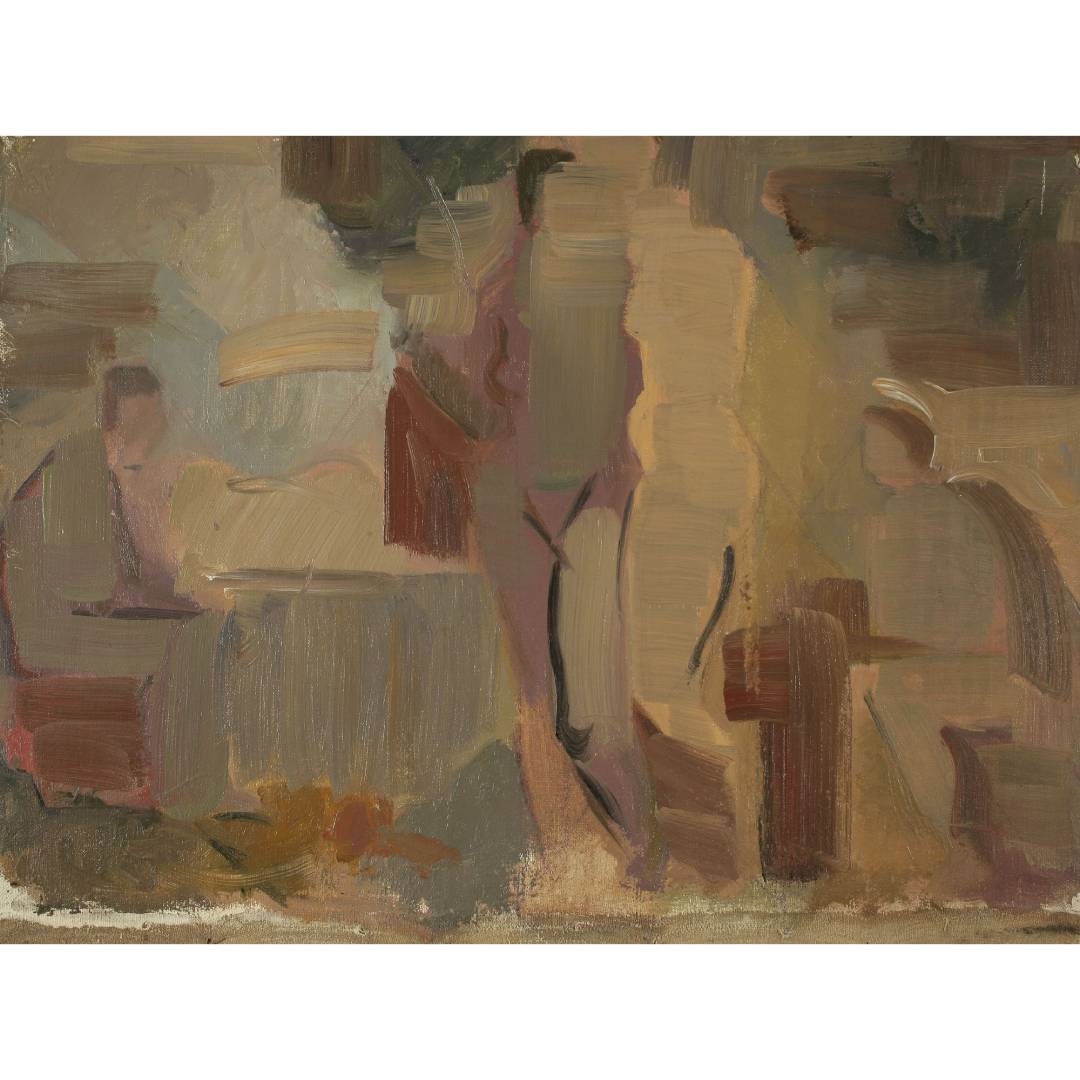
Study of Nudes, 1928–1934
oil on canvas
49.5 × 50.5 cm
MG-3220
Sonja Kovačić – Tajčević (Bošnjaci, 1894 – Rijeka, 1968) was one of the first academically trained female artists in Croatia, active from the second decade of the 20th century. Her artistic output is characterized by a series of figurative compositions, portraits, and landscapes, which comprise the majority of her oeuvre. She graduated in painting from the Academy of Fine Arts in Zagreb in 1917 and continued her academic training in Graz and Vienna. Further education followed during her study stay in Paris in 1926, where she studied under the renowned French painter André Lhote (Bordeaux, 1885 – Paris, 1962). She returned to Paris between 1928 and 1934, a period during which she created her most significant works under the strong influence of Lhote’s academic Cubism.
It was under this influence that Study of Nudes was created. The artist reduces the female figures to flat, geometrically structured forms, achieving a subtle balance between the figurative and the abstract. The figures are not conceived as individual persons but as universal symbols of the human form, harmoniously integrated into a cohesive compositional whole. This formal approach is further complemented by the chromatic conception: the palette is reduced to earthy and muted tones. The painting thus becomes a paradigmatic example of the artist’s ability to transform the traditional motif of the nude into an exploration of pictorial synthesis, where the figurative and abstract merge into a unified expression.
Text: Luciana Fuks, Assistant Curator at the National Museum of Modern Art © National Museum of Modern Art, Zagreb
Photo: Goran Vranić © National Museum of Modern Art, Zagreb

