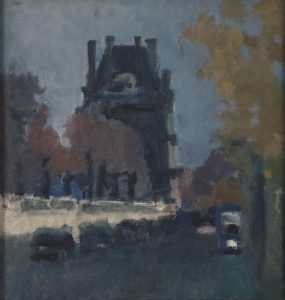
 Edo Kovačević
Louvre
1958
oil, canvas
46,8 x 44,8 cm
MG-3996
Edo Kovačević (1906 – 1993) was a master of flatly organized motifs structured by poetics and laws of the surface, as well as post-war lyrical figuration (intimism), sometimes on the marginal borders towards abstraction. Parallels with his early works can be found in the architecture of the Group Zemlja (1929 – 1935), of which he has been a member since 1932. The surface is a constitutive element of the architecture and composition of Kovačević’s painting (R. Ivančević). He graduated in 1930 from the Academy of Fine Arts in Zagreb (V. Becić). He went to Paris for a one-year study in fresco painting. There he met the members of the Group Zemlja, with whom he had been exhibiting since 1932, as well as A. Ozenfant in his famous studio designed by Le Corbusier, and J. Lurçat – the restorer of tapestry and old techniques. This will affect the flatness of Kovačević’s painting in question (Gunpowder Moat, 1932; Kožarska Street 1934.) and his subsequent tapestries.
He gradually transformed the initial linear-flat expression into impartial coloristic stagings of the poor periphery. After a palette of brown and muted colors during the war, he would reach the coloristic fullness in the blue range, peaking in Paris of the late 50s. This period and the palette brought the melancholy and the intimacy of the city – as the flat and blue-grayish diagonally deeply projected veduta in the work “Louvre” from 1958. For the rest of his life, he would be preoccupied with the motifs of roofs seen from a height, godly perspectives realized in oils, pastels and tapestries, as well as the intimate motifs of flowers. He was engaged in scenography, exhibitions and museums, and pedagogical work. He received the “Vladimir Nazor” Lifetime Achievement Award in 1981.
Tekst: Željko Marciuš, Museum Advisor at the National Museum of Modern Art Zagreb © National Museum of Modern Art, Zagreb
Photo: Goran Vranić © National Museum of Modern Art, Zagreb