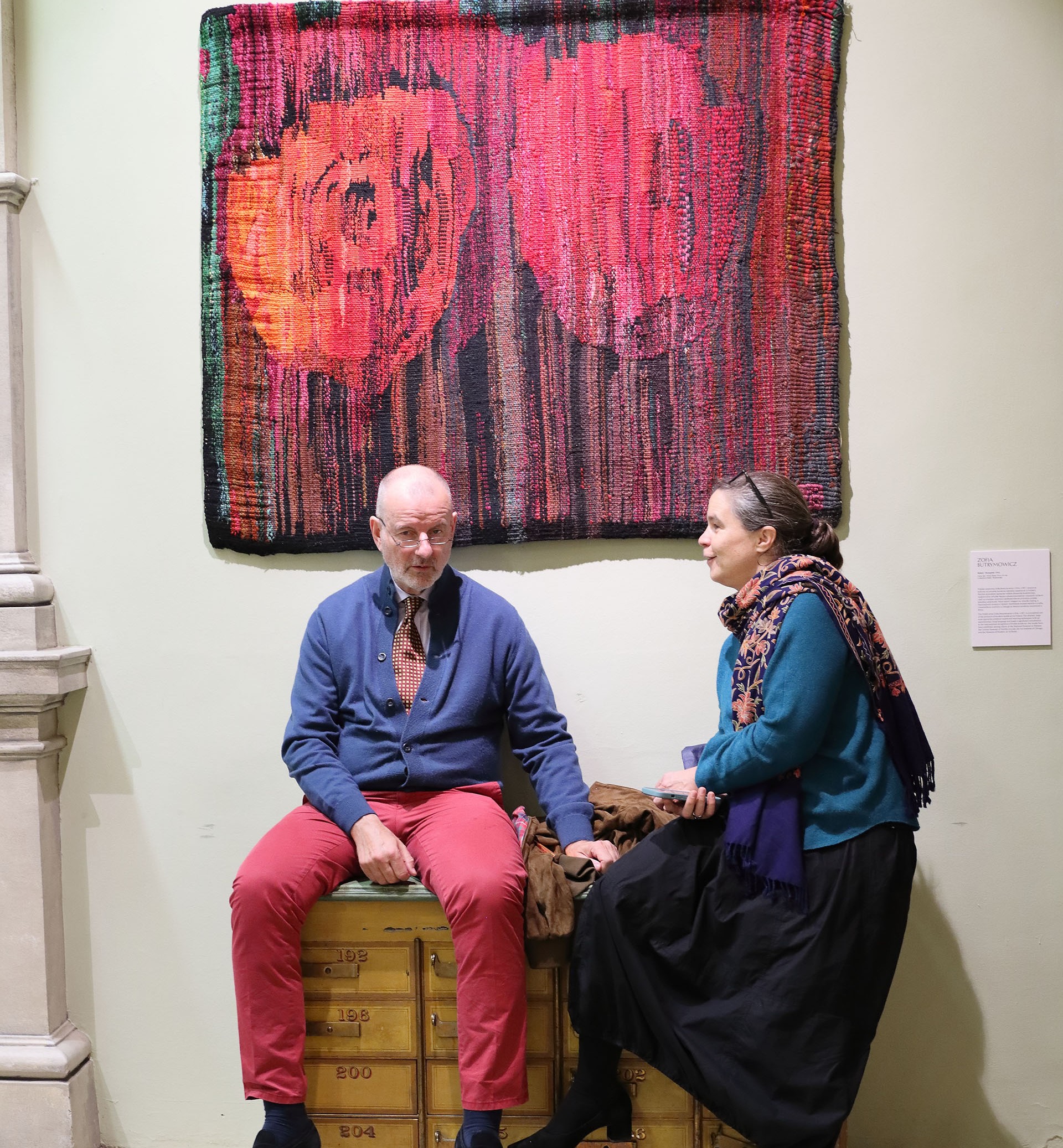
NMMU: You were born in a small town near Dortmund. What was it like growing up there, and what memories do you carry with you from your childhood and those formative years?
Volker Diehl: It was a very safe and happy childhood living in a small village in the 1960´s. But no museums and galleries, which I discovered much later through my passion for art, during my first year studying in Münster.
NMMU: Looking back, what stands out most from your years studying sculpture at Kunstakademie in Münster and art history in Berlin?
Volker Diehl: My professor Hans Jürgen Breuste, who was a sculpturer, but insisted on a wider knowledge to understand painting and sculpture. We were required to read poetry and general literature as well as refining our knowledge of music. He was a very special teacher.
NMMU: Could you tell us about your musical experience in a symphony orchestra? (playing double bass). Has your love for classical music stayed with you throughout the years, and does it still play a role in your life today? What kind of music do you turn to when you want to unwind and simply relax? Are there any musical instruments in your Collection?
Volker Diehl: I always saw a strong connection between music and fine art. In 1980 as a student I worked with Rene Block on his exhibition, For Eyes and Ears, in Academy of Fine Arts, Berlin. I met Nam June Paik and Joseph Beuys the first time. Very impressive and changed my life from one day to another. I became very good friend with Fluxus artist Joe Jones and Takehisa Kosugi. I still have musical instrument sculpture by joe Jones in my collection.
NMMU: When did you first develop a passion for collecting, and what was the very first object you acquired? Where and when did you buy it, and who did you buy it from? Does it have a story behind it? What was it like to be a collector when you first started out, and how would you say it has changed today?
Volker Diehl: As a student in 1981 I helped installing art exhibitions for DAAD Gallery. German Academic Exchange service. Markus Raetz was invited that year and one of the first exhibitions I worked for. We became friends and Markus gave a cardboard piece as a present to me. That was my first artwork of my collection. Still very proud of it, because I still love his art a lot.
NMMU: About your collection today? Is there any particular artwork you would love to add to it?
Volker Diehl: Every second day I practically fall in love with a new art piece. Unfortunately I cannot afford every second day buying artworks. But it's good energy anyway.
NMMU: Artists say that Paris is primarily for show, while the New York is real market. Would you agree with that assessment, and where do you see Berlin in that context?
Volker Diehl: I totally agree. New York is world capital of artmarket. Berlin is loved by artists and intellectuals for its creative energy. And Berlin is always changing and in the flow.
NMMU: What was your experience like working for Shigeko Kubota, Japanese-born avant-garde sculptor, performance artist, and a pioneer of video art, and wife of Nam June Paik?
Volker Diehl: I learned a lot about Eastern and Western philosophy of life, arts and cooking. Shigeko introduced me to Sushi in the those times only Sushi restaurant in Germany. KiKaKu in Düsseldorf. She treated me more like a son, then an assistant. Weekends Nam June, Professor in Düsseldorf Academy, visited her in Berlin. Both strong charismatic people.
NMMU: What are your memories of Andy Warhol?
Volker Diehl: A very kind and polite person. Me as a nobody visited him in his factory in May 1983, and he took a few hours to show me around and introduce me the his way of working. Again a very charismatic personality.
NMMU: You organized an exhibition Beschwörung – Incantation on contemporary Haitian art. What sparked your interest in Haitian Vodou?
Volker Diehl: I visited Haiti several times. Before the earthquake. And I fell in love with the magic and spiritual way of artists to connect art with religion and nature and myth. Very fascinating.
NMMU: Having founded two art fairs yourself, what is your view of their role in the art world?
Volker Diehl: It was great fun. And Art Forum Berlin in 1996 as well as Cosmoscow in 2010 where speeding up the development of artscene in both citys. Cosmoscow still very successfully working every year in September.
NMMU: How familiar are you with the Croatian art scene, especially considering that the tapestry artist Jagoda Buić was married to a German Hans Wuttke, while Goranka Vrus Murtić maintained had well-established contacts with Germany?
Volker Diehl: Not that familiar. But always somehow Croatian artists crossed my way. For example I met Braco Dimitrjevic when he was invited to Berlin end of 1970´s by DAAD already. I like his work a lot. And about Jagoda Buic? I was dreaming years to meet her personally, which I finally managed in July 2019 in Bonnieux, France. What a great important artist.
NMMU: Is this your first visit to Zagreb? Impressions…
Volker Diehl: Yes my first visit. I loved the people, the energy and the beauty of the architecture. I will come back for sure. And will highly recommend my friends to visit.
Reproductions: opening and the exhibition Goran Vranić © National Musem of Modern Art, Zagreb // Wojciech Sadley, Infantka, 1974, braided, macrame, sisal; 160 x 50 cm
© Collection Diehl, Berlin