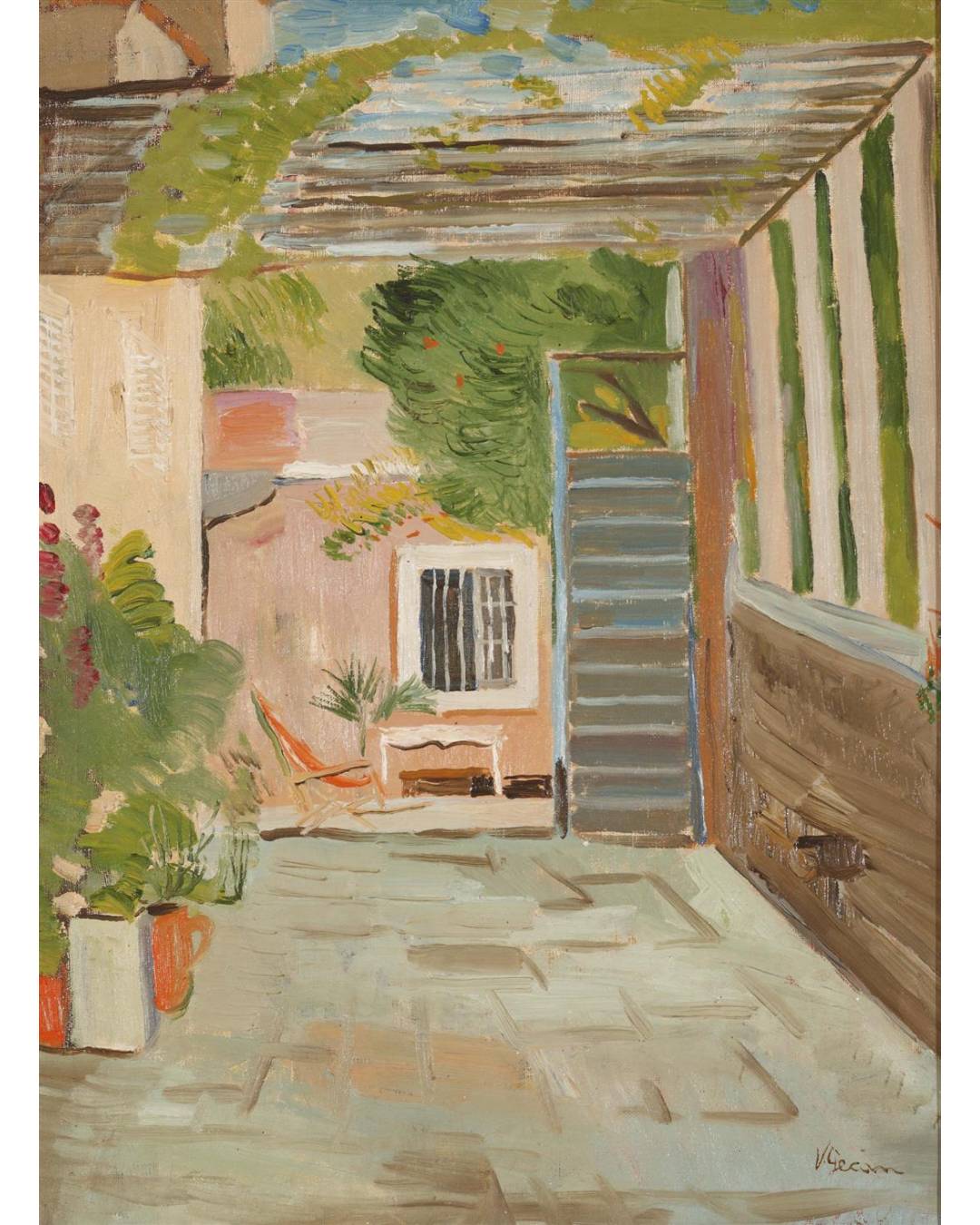

Vilko Gecan
Orebić, 1935
oil, canvas
57 x 43 cm
MG-1064
Vinko Gecan (1894-1973) was a Croatian painter, graphic artist, illustrator and caricaturist whose work was very influential in Zagreb’s modern art scene of 1920s and 1930s. He is most well-known for his expressionist paintings (Cynic, 1921) and his contribution to the avant-garde magazine ‘Zenit’.
In 1912 he attended the private art school of Tomislav Krizman with Milivoj Uzelac and in 1913 he started attending the Academy of Arts in Munich and the private art school of Moritz Heymann but his art education was stopped because of mobilisation and being a war captive for three years in Sicily. He lived in Zagreb, Prague and Berlin (1919-1924) and then in New York and Chicago (1924-1932).
In the Zagreb Spring Salon of the 1920s he participated with Milivoj Uzelac, Marijan Trepše and Vladimir Varlaj, known as the ‘Group of Four’ or ‘The Prague Four’. Trained in Prague, works of these young painters brought new expressionist ideas that went to dominate the 1920s Croatian art scene. From 1932 he lived in Zagreb where he finished his studies at the Academy of Arts in 1936.
In 1931 he started to experience the first symptoms of Parkinson’s disease, a tremor in his right hand which became stronger with time and made it harder for him to paint, especially proportions and anatomy. This made him turn to still lifes and landscape fragments with strong colorism, like in his work ‘Orebić’ from 1935 - a fragment of a terrace in front of a small seaside house which might have been an everyday scene for Gecan, painted with short, impressionist strokes.
Text: Stella Baki, curator / museum educator at the National Museum of Modern Art Zagreb
Photo: Goran Vranić © National Museum of Modern Art, Zagreb