Jelena Veszely Szilvássy
(1917–2020)
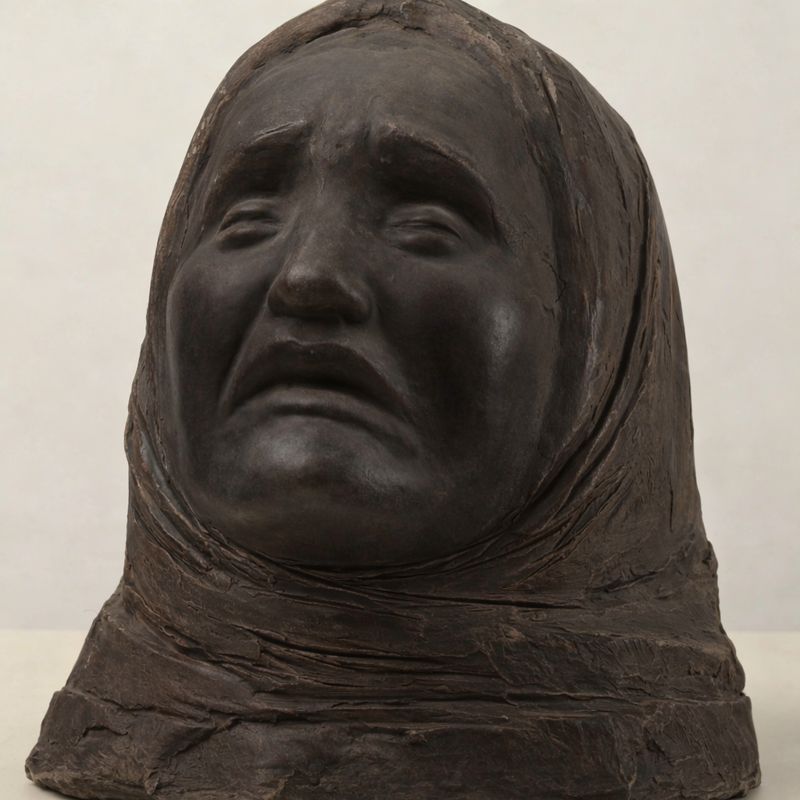
Mourning, 1940s
patinated plaster
24 × 21 × 25 cm
MG-3162
A sculptor who graduated in 1941 from the Academy of Fine Arts in Zagreb in the class of Frane Kršinić, Jelena Veszely Szilvássy developed an exceptionally fruitful international career. Although she was professionally active primarily in Hungary, her artistic roots remained firmly grounded in Croatia. Her oeuvre is marked by remarkable versatility, stylistic coherence, and profound human emotion, which in her sculptural language is transformed into universal symbols of pain, love, and human connectedness.
Her life and artistic path were shaped by historical circumstances and personal choices. In 1943, she moved with her husband, the painter Pál Szilvássy, to Nagybánya, where they remained until the end of the Second World War. The artistic couple then worked briefly in post-war Yugoslavia before settling permanently in Budapest. Despite this relocation, the artist maintained strong ties to Croatia, as evidenced by her early exhibitions in Zagreb in 1946 and 1947, as well as by the high Croatian state decoration she received in 2018 for her contribution to the development and international reputation of the Republic of Croatia.
Her artistic practice is characterised by both a diversity of media and a clear thematic focus. She created small-scale sculpture, public monuments, drawings, prints, and watercolours, working with materials such as stone, wood, and metal. Yet despite this breadth of expression, one constant runs throughout her work: the human figure. Her sculptural figures are neither strictly static nor playfully dynamic; instead, they embody a tension between these two opposites. Through gently elongated, stylised, and purified forms of women, mothers, children, or couples, she shaped intimate relationships that transcend the personal and become archetypal images of universal emotion.
A particularly representative example of this symbolic language is already present in her early depiction of mourning. The physiognomy of the female face—covered with a headscarf and lifted toward an undefined space beyond the viewer’s gaze, with half-open, tense lips, a pronounced chin, closed eyes, and furrowed brows—constructs a visual register of emotional suffering, loss, and inner endurance. In this context, naturalistic modelling does not serve a mimetic purpose but functions as a semantic tool for articulating an archetypal motif of grief. The headscarf, as a culturally coded sign of female identity and mourning practice, is integrated into the volumetric structure of the head and acts as a stabilising compositional element, while the expressive modulation of the face destabilises the formal closure of the volume and introduces an inner, psychologically driven dynamism. The result is a sculpture in which affective content and plastic structure intertwine to form a coherent iconographic and formal whole.
Through her long-standing activity in Hungary—where from 1970 onward she regularly exhibited in institutions such as the Institute for Cultural Relations, the Csók Gallery, and the Vigadó in Budapest, as well as in cities across the country including Hatvan, Veszprém, Tihany, and Balassagyarmat—the artist made a significant contribution to the visual culture of that region. Her public sculptures, permanently installed in Hungarian urban spaces, engage with audiences on a daily basis, making her oeuvre a living part of the collective identity.
Thanks to a continuous artistic practice that transcends boundaries between the private and the public, the national and the universal, intimacy and collective memory, this sculptor rightfully occupies an important place in contemporary Central European art. Her life and work stand as an example of artistic dedication and of the universality of visual language which, even when deeply personal, speaks to all people.
Text: Tatijana Gareljić, Museum Advisor, National Museum of Modern Art © National Museum of Modern Art, Zagreb
Photo: Goran Vranić © National Museum of Modern Art, Zagreb