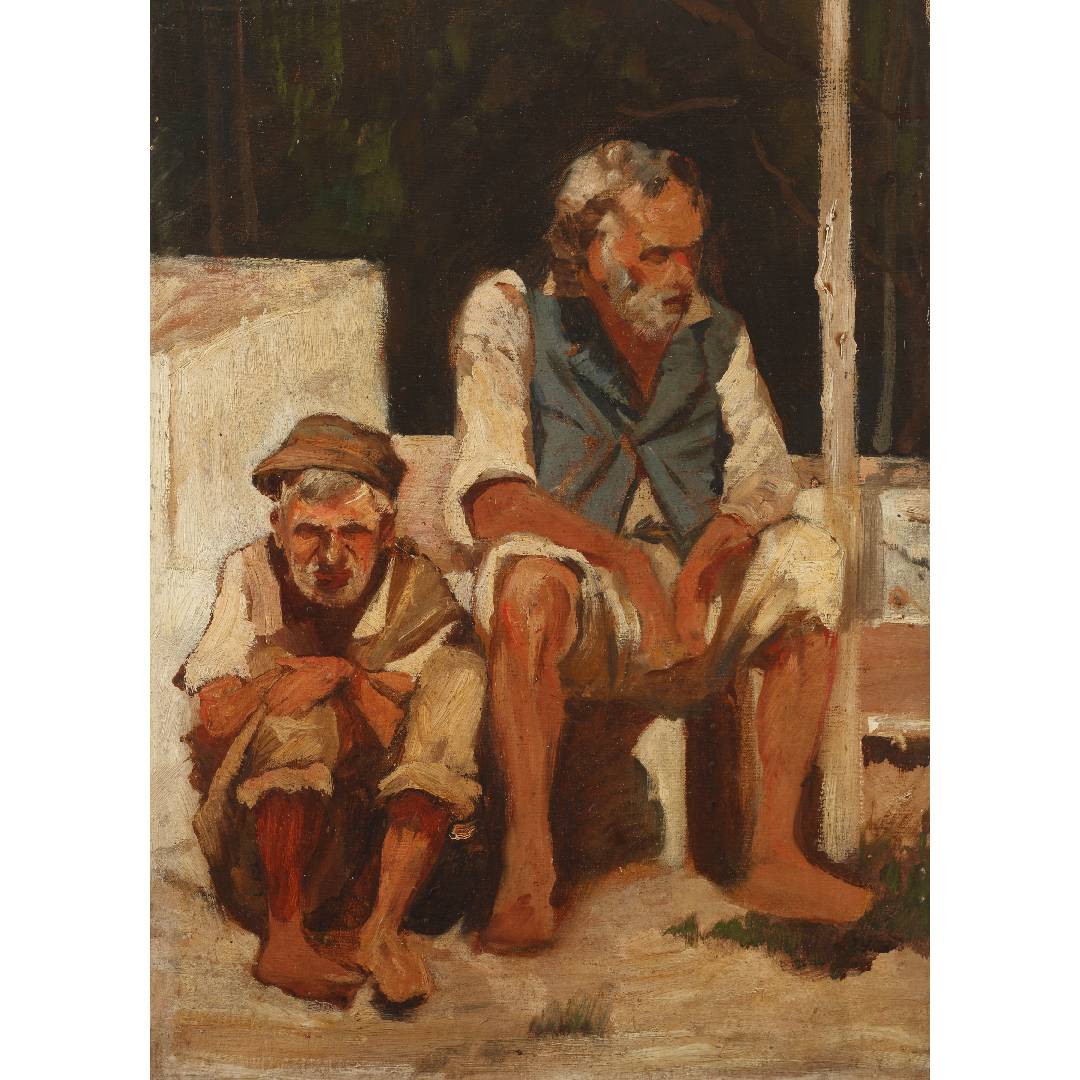
Izidor Kršnjavi Two Beggars, 1874

Izidor Kršnjavi
Two Beggars, 1874
oil on canvas
41.7 × 33.8 cm
MG-116

Izidor Kršnjavi (1845–1927) was a Croatian art historian, painter, and prominent cultural and public figure who, from the 1870s until the Croatian Salon exhibition of 1898, and even up to the eve of World War I, held a dominant—later still significant—role in shaping cultural and artistic life in Croatia. His monumental importance to the history of Croatian art and culture is reflected in numerous cultural and educational initiatives and his pioneering role in founding key Croatian institutions.
He was the first professor of art history at the University of Zagreb (1877–1918), initiated the founding of the Art Society (1878), which in turn led to the establishment of the Modern Gallery (today’s National Museum of Modern Art) in 1905, the Museum of Arts and Crafts (1880), and the School of Applied Arts (1882). Kršnjavi also served as the first director of the Strossmayer Gallery of Old Masters and editor of its first catalogue, and he reorganized the Archaeological Museum. He championed the revival of traditional crafts and folk art.
Kršnjavi’s Italian landscapes and genre scenes—characterized by small formats, a freer painterly technique with visible brushstrokes, clear daylight, and an overall atmosphere of spontaneous, direct observation of reality—embody a more modern understanding of realism in painting. Within this tradition, though less numerous than his landscapes and city views, are his studies of the human figure, especially depictions of Italian peasant women and other common folk, a subject frequently explored by both Croatian and foreign artists working in Italy. To this group belong Kršnjavi’s studies of beggars, beggar women, and street vendors, such as Two Beggars (1874), which, like comparable studies by Guglielmo Ciardi, verge on the genre theme. Similar figure studies were also created by artists such as Corot and other European painters of the period. In the context of the classical tradition, figure studies—like landscape studies—served two primary purposes: as exercises in direct painting from life (i.e., from a model) and as a means of studying costume and pose for later use in studio compositions with pastoral themes.

Text: Ivana Rončević Elezović Phd, Senior Curator, National Museum of Modern Art © National Museum of Modern Art, Zagreb
Photo: Goran Vranić © National Museum of Modern Art, Zagreb

Izidor Kršnjavi, Bedouins, 1874

Izidor Kršnjavi
Bedouins, 1874
oil on canvas
9.5×34.2 cm
MG-2112

Art historian, politician, painter and writer Izidor (Iso) Kršnjavi (1845-1927) was a key figure in Croatian culture in the second half of the 19th century. He was first taught painting by Hugo Conrad von Hötzendorf in Osijek. He studied painting at the Academy of Fine Arts first in Vienna and later in Munich, where he was mentored by Professors Wilhelm von Lindenschmit the Younger and Wilhelm von Diez, artists who used informal teaching methods to steer their students towards observational studies and plein-air painting. Between 1872 and 1877 he stayed in Italy on several occasions – he had a studio in Rome and in southern Italy he painted together with Karl Hubert Frosch, Henryk Hektor Siemiradzki and Ferdinand (Ferdo) von Quiquerez-Beaujeu. Having become dissatisfied with his work, he stopped painting in 1877. He favoured small-scale oils on canvas, drawings and copper etchings in the vein of the Realism of Munich’s Academy of Fine Arts and produced several sketches of the old masters reduced to basic strokes and colours for the purpose of teaching. Kršnjavi founded the Department of Art History and Archaeology at the Faculty of Humanities and Social Sciences of the University in Zagreb with a lecture he gave in 1877 under the title The Significance of the History and Archaeology of Art, and in 1879 he prompted to action the Art Society founded in 1868. From 1891 to 1895 he was the Minister of Education and Religion in Károly Khuen-Héderváry’s administration. In 1905, in his capacity as president of the Art Society he founded the National Museum of Modern Art. Kršnjavi’s project of reconstructing and equipping the seat of the Department of Worship and Teaching is programmatically important. Based on Hermann Bollé’s project, and in line with the culture of Classicism, Humanism and Christianity, the reconstruction was executed in the spirit of Idealism and Realism by artists who later became representatives of Croatia’s Modernism.

Kršnjavi’s Bedouins study was created during his stay in southern Italy and is a typical small-scale, strikingly horizontally elongated composition painted in the manner of Munich’s Realism freed from the strict rules of Academicism. He painted the sketchy depiction of a genre scene using a distinctly light and airy palette of colours under the influence of the light and atmosphere of the Mediterranean.

Text: Dajana Vlaisavljević, museum consultant of the National Museum of Modern Art © National Museum of Modern Art, Zagreb
Translated by: Ana Janković
Photo: Goran Vranić © National Museum of Modern Art, Zagreb