NMMU: Which artworks are you presenting at your exhibition at the Josip Račić Gallery?
Nina Annabelle Märkl: The works I chose are works of the cycle „Permeable Sculptures“, which I developed this year and in contrast works of the series „Triple Folds“ which I started in 2021.
I decided to have the „Permeable Sculpture“ works in the front room with view to the street and the showcases to strengthen the effect of permeabiltiy between the inside and the outside and the vision of the artworks, which overlap each other visually also including shifts of perspective.
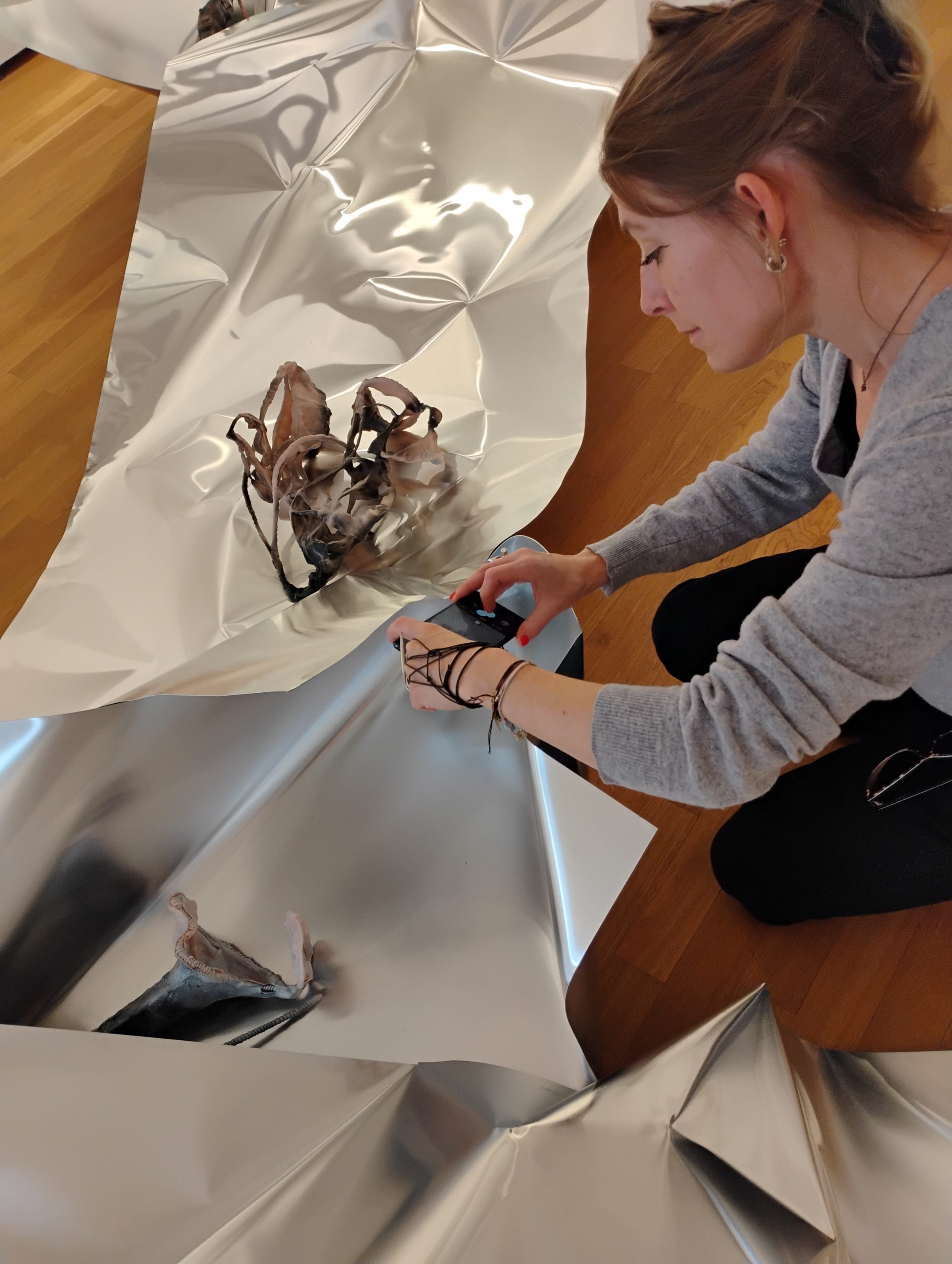
The works of the series „Triple Folds“ are in a way showcases themselves: They are sculptural works (cutout drawings on folded paper combined with aluminiumfolds) surrounded by bent macrolon, capturing reflections of light and surrounding space. The beholders also are reflected by the surface of the showcase and are so drawn into the world unfolding within the artwork.
So both strings of work, appearing very different at first glance, are connected by the concept of permeability and the shift of perspective that changes the view on the given artwork or setting.
NMMU: Why did you chose ink, and how you obtain specially treated canvases you draw on?
Nina Annabelle Märkl : Ink is the medium for drawing which I prefer most. You can't step behind a line drawn with ink. You see each and every step of the process, it's turning points and the points where decisions were made and where the drawing develops.
Drawing with ink is like life: you can't step behind it, it always holds the traces of everything that happend. And they stay visible…an ink drawing is like visible reservoir of moments and decisions. A visible reservoir of complexity showing all its former states at once.
I thought a lot about canvas as a medium: What I found out for my work is, that I want to have canvas as a kind of in-between material. That means: I wanted to prepare a canvas that you won't recognize as canvas at first glance. A free medium, which is not determined by given connotations, a medium that shifts between different aspects. So to say also an ambivalent medium. A medium permeable to different ways of perception. I wanted an undefinable material, which should be somehow slick, calling both associations of leather, of skins stored and stretched to dry and artificial associations for example like tarpauline or truck plane. A material shifting between high and low aspects.
And it should also be a sculptural medium, freed from frames. An entity of its own that has fringes, and borders which are defined by the artwork itself and the irregular way it is cut not by a given frame. The artwork so creates its own space, it's own context, that can be entered.
NMMU: You've been working as an independent artist for two decades. How important is freedom to you?
Nina Annabelle Märkl: Freedom is aspect that is most important to me.
On the other hand I need continuity and stableness within the modes I'm working to be able to feel, think and create in a free way. So I decided for me to have different fields: On the one hand the field of teaching at different institutions where I help people to find their own way of expression and to create their own way of working. This field is connected to society and the world outside. And then on the other hand my own work praxis, where all the decisions I make are up to me and to the dialog with the artwork and the world inside of me. About the transformation process of the things I perceive and contain into an artwork, as a comletely solitary thing to do.
Freedom is always about the balance between the inside and the outside world I think, and also about responsibility for balance and processes.
NMMU: Your works also imply the absence of boundaries: can you imagine the real world without boundaries?
Nina Annabelle Märkl: A complex question, also a philosophical one which is hard to answer briefly.
Generally there are different sorts of boundaries of which some are essential, some are useful, some are not useful/dysfunctional and some are destructive or opressive.
There are boundaries within ourselves and around us. Visible and invisible ones.
There are boundaries which are important to protect the individuum and society and also freedom.
We always have to reflect which boundaries are useful and which are not. Within ourselves and within a society based on democratic decisions grounded on humanist ideals, including diversity and complexity of life and human beings.
NMMU: Why are you drawn specially by hands and eyes in creating?
Nina Annabelle Märkl : Hands and eyes symbolize the senses which with we approach the world.
But what I draw are not only eyes – they are something more like developing entities or organisms of their own, which are derived by eyes.
Some of them are morphing into technical devices, like organic tools as symbols for the optimization of our bodies and mind. Most of my figuration has an organic part which is entwined with technical, unorganic elements.
With the hands it's quite the same.
Plus the language that unfolds from eyes and hands often contains micrimomentaneous information that spoken words can't deliver, as their language is a direct and unconscious one conveying sensitive aspects within brief moments.
Fragments and parts of the human body especially eyes and hands also remind of votiv offerings, which are brought as offerings to get help on different emotional or physical issues from a higher instance. Those votiv offerings are symbols of awareness but if you look at them how they appear in my work, some of them seem dysfunctional, distorted or not intact or they just don’t look in a way how we are used to them as they form for example symbioses with technical elements…they so have aspects of votiv offerings for complex and distracted times…
NMMU: Considering the fact that you were born in Dachau, how much of a burden has the weight of historical heritage been for you?
Nina Annabelle Märkl :When you were born and grew up in Dachau you always grew up with history. This is really significant.
In my generation, in my childhood in the 80s we were educated very aware of our history, the Nazi regime and the concentration camp. I became very aware about the responsibility we have as individuals who create the society and place we live in. So I don't see it so much like a burden of historical heritage, I more have the feeling of awareness and responsibility as I grew up in that specific place and I think this is very important to keep this alive for now and for the future. I think a lot of people have this specific sensitivity in Dachau.
NMMU: How much Stephan Huber, in whose class you graduated from has influenced you?
Nina Annabelle Märkl: I always felt highly connected to his art and his complex way of thinking through which he combines both reflexion and philosophy, literature and narration in his sculptural works, films and maps.
I was drawn into his unique way of dealing with narration and sculpture, opening up new perspectives based on the given world, developing individual, often surreal ways and narrations on the world.
I learned a lot about working with the atmosphere and dramaturgy of a given space. And my work, originally based in drawing developed more and more into sculptural ways of reflection and work praxis.
I think at first sight my work looks quite different.
But there still is a strong connection in the narrative approach and in the aim of developing a cosmos of its own by the means of art with specific qualities.
And I think in the connection to surrealistic tradition/concepts and its absurd, also philosophical, poetic and revolutionary approach.
NMMU: What is it like to teach at the Academy from which you graduated from?
Nina Annabelle Märkl: After my graduation there around 16 years ago the time after the Academy is longer than the time I spent there studiying…so it feels somehow familar but the fact that I studied there it is nothing that I reflect too much or what has a lot of influence on me I think.
NMMU: How familiar are you with Croatian art scene?
Nina Annabelle Märkl : I'm not too familar with the Croation art scene. But what I learned, beginning with my residency stay at Museum of Fine Arts in Split, was, how close different approaches of Croatian artists felt for me:
There is a great approach of thinking things differently in very individual ways.
A kind of subtle, sometimes playful sense of critical perception of politics and society and to some part a very humorous, playful and personal way of dealing with that.
So, I feel a strong interest and connection to different artists and their work.
So it's more an inner connection than a connection to a contemporary art scene 😉
What touched me deeply for example was the work by Nives Kavurić-Kurtović when I saw it in the Museum of Fine Arts in Split last year.
NMMU: Do you think the era of robotics in which we will increasingly live jeopardizes imagination and creation? If you had a robot what would you use it for?
Nina Annabelle Märkl: It might happen if we won't stay aware of our original and analogue ways of perceiving and feeling things.
I think the impact of A.I. is as strong as we allow it to be in our individual lives and within our creative processes as artists.
If I had a robot, he could take care of household, tax issues and organization of any bureaucratic stuff that has to be done 😉
Interviewed by Lana Šetka, National Museum of Modern Art, Zagreb
Image: Artist Nina Annabelle Märkl / Photo: Axel Liebler