Milivoj Uzelac
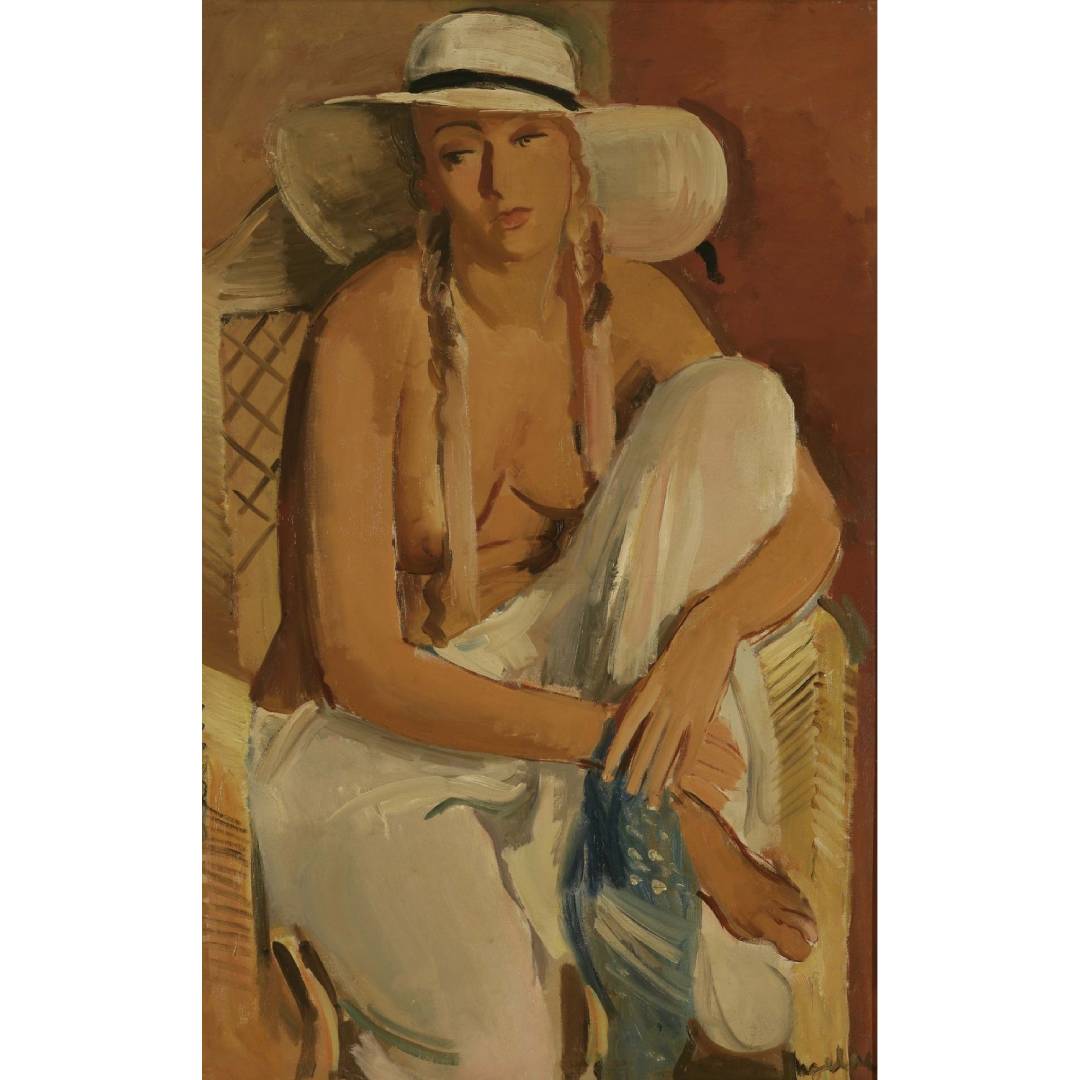
Femme avec Chapeau, 1928
oil on canvas
100 × 65 cm
MG-997
Milivoj Uzelac (Mostar, 1897 – Cotignac, France, 1977) was one of the key painters of Croatian modernism, whose oeuvre developed in close dialogue with contemporary European artistic movements. After studying in Banja Luka and Zagreb, he continued his training in Prague, where he associated with Vilko Gecan (Kuželj near Brod na Kupi, 1894 – Zagreb, 1973), Marijan Trepše (Zagreb, 1897 – 1964), and Vladimir Varlaj (Zagreb, 1895 – 1962). Together they represented a new expressionist tendency in Croatian art and are often referred to as the Prague Four.
After a brief period spent in Zagreb, Uzelac moved to France in 1923, where he continued to develop his artistic practice in dialogue with then-current movements such as Fauvism, Expressionism, and Cubism. Although he lived and worked abroad, he continued to exhibit regularly in Croatia, exerting a strong influence on the new generation of Croatian painters of the interwar period.
Uzelac’s artistic production in France after the 1930s is marked by a Fauvist sensitivity to colour and an expressionist emotional intensity. The painting Femme avec Chapeau (1928) is a striking example of a work that synthesizes French artistic models with the painter’s own distinctive style. The composition presents a monumentally shaped female figure wearing a white hat, seated in an armchair in a relaxed pose, her gaze turned away from the viewer. The composition is simple yet dynamic, animated by free brushstrokes and a rich palette of warm and cool tones.
The study of works by French masters such as Henri Matisse (Le Cateau-Cambrésis, 1869 – Nice, 1954) and André Derain (Chatou, 1880 – Garches, 1954) left a noticeable mark on Uzelac’s paintings of this period. In this work, their influence can be seen in the free treatment of colour and the pronounced voluminosity of the figure.
Text: Luciana Fuks, Curator for Museum Documentation at the National Museum of Modern Art © National Museum of Modern Art, Zagreb
Photo: Goran Vranić © National Museum of Modern Art, Zagreb