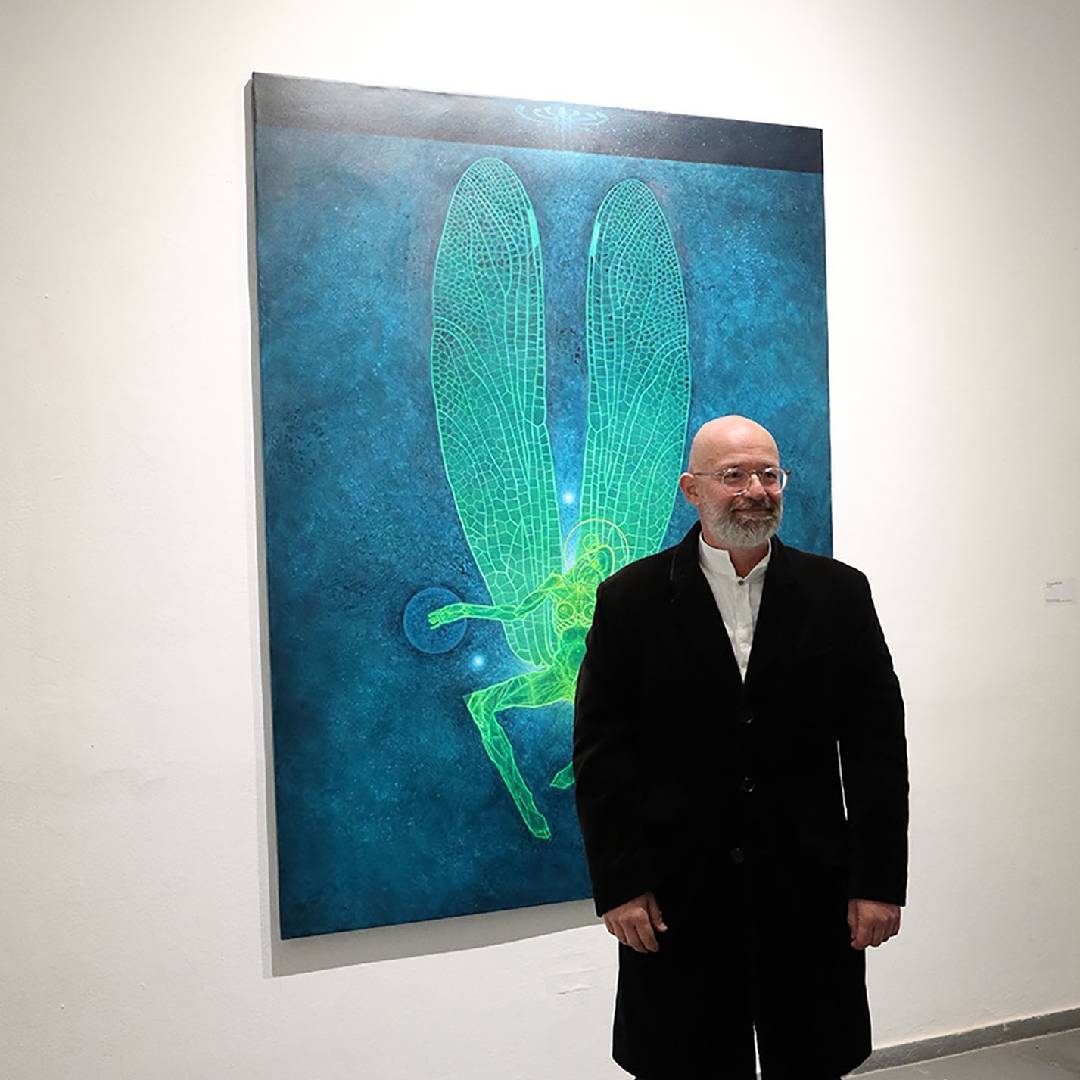
NMMU: Could you tell us something about the works you are showcasing in your exhibition Dragonfly at the Josip Račić Gallery?
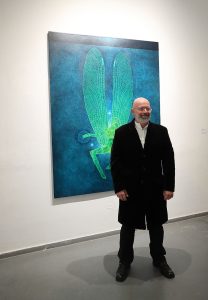
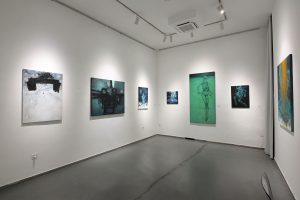
Hrvoje Marko Peruzović: My inspiration comes from a variety of sources, everything I see and experience in daily life, as well as all the impressions that have built up in my mind over the years. The Dragonfly series represents just a small slice of the numerous themes that have captivated me for a long time. Romina Peritz Körbler has worked to select and organise a coherent set of pieces, presenting them in a way that clearly illustrates the development and direction of some of my artistic explorations. This is also why the works on display were created over a period of around ten years. I try to paint every day, but I often move between different themes, perhaps because it keeps the process more engaging, and some ideas need time to mature before I return to them. The primary focus of my paintings is the human body, particularly the female nude, which serves as a starting point for a painterly exploration through which I seek to express various psychological states. The exhibition features fourteen medium- and large-format acrylic paintings on canvas, accompanied by two smaller works created as sketches and studies for the larger pieces. What distinguishes this series is the gradual evolution from a purely figurative approach towards abstraction. The human body dissolves, and as recognisable elements are stripped away, it takes on the form of gesture and calligraphic mark. In essence, the body is transformed into spirit.
NMMU: Dragonfly is regarded as a spiritual creature that helps guide people through difficult times, symbolising transformation, prosperity, happiness, strength, wisdom, peace, harmony, and purity. What significance does it hold for you?
Hrvoje Marko Peruzović: The point is in the synthesis. By combining the human body with elements of the insect, an entirely new context and symbolism emerges. This approach, used for millennia to create fantastical hybrid mythological beings, allows my women to exist somewhere between angels and fireflies. They are at once physical and ethereal, erotic and spiritual. They glow in the dark and, in a sense, transcend the laws of physics, giving way to the laws of metaphysics. The principle of combining the incompatible is one of my key creative strategies, applied on multiple levels. Angels, broadly speaking, act as heavenly aides or messengers, conveying messages from the other side and bridging the visible and invisible worlds. The exhibition also features a painting titled Metamorphosis, which clearly references Kafka, except that in my version, Gregor Samsa becomes a woman who transforms into an insect, taking on the form of a praying mantis. The language of symbols is universal, arising from the fundamental qualities and properties of certain phenomena, what Jung referred to as archetypes. At the same time, every era introduces new symbols with their own unique meanings, and as an artist, it feels completely natural for me to weave these into my work, forming a kind of personal symbolism.
NMMU: You have studied in Paris, Milan, Venice, and Vienna. What memories of these cities stand out most for you?
Hrvoje Marko Peruzović: Each of these cities had a profound impact on my artistic development. Experiencing something firsthand is very different, you can truly absorb the atmosphere and context in a way that books, photographs, or films simply cannot. It’s also important to remember that in the early 1990s there was no internet, and getting a hold of certain books or art monographs in my country was far from easy. With most museums closed because of the war, it was much harder for young artists to obtain the necessary information. I was fortunate to travel to these European cities during my formative years, visiting major museums and galleries, studying the works of the old masters, and immersing myself in the spirit of the artistic periods that have a particular resonance for me. Most of all, Vienna, because the Secession was an artistic movement that I connected with from an early age and embraced as an artistic credo, to which I later added something personal and contemporary, in keeping with the spirit of the times. Venice, meanwhile, is both a museum and a time machine, a city where time seems to have stood still. Throughout history, both Venice and Vienna have exerted a profound cultural influence on this region, of which we were long an integral part, sharing in that civilisational heritage. Travel is essential for gaining a deeper understanding of both the world and ourselves.
NMMU: You write poetry, aphorisms, and short essays on visual art. Do literature and visual art intersect in your work, or do you keep them separate? What do you enjoy reading?
Hrvoje Marko Peruzović: In some ways, they do intersect, though each medium maintains its own independence. I often use poetry to explore painting, artists, art in general, and various life experiences. Certain things can be expressed more quickly and precisely in words, whereas painting is a non-verbal form of communication that depends on silence and conveys what is difficult, or even impossible, to articulate. Both arise from a strong inner need to express something, to release it and give it form as a work of art. I simply choose the medium that best suits my mood and state of mind at the time. Reading is just as important to me as looking at paintings. My interests are quite wide-ranging: I read everything from journalism, classical and contemporary novels, philosophy, and specialist art literature, to poetry, which has always held a special place for me.
NMMU: Does an artist ever truly rest? What does an ideal holiday look like for you?
Hrvoje Marko Peruzović: I don’t believe an artist ever really rests. I like to say that an artist is at work even while asleep. Art is simply a way of existing in the world. It’s like breathing. You are constantly absorbing information, experiencing the world around you, never knowing when something will find its way into your work, whether as the first line of a poem or a new combination of shapes and colours. When you are doing something you truly love that gives you fulfilment, it feels both like work and rest at the same time. Sometimes I become so absorbed in my work that I completely lose track of time, and I regret having to pause to attend to other things or, late at night, to finally go to bed. In that sense, I don’t feel the need for any hobbies. My ideal holiday would be having plenty of time and tranquillity to read, preferably somewhere by the sea.
NMMU: What is your relationship with the body, and how has it changed through your life experiences?
Hrvoje Marko Peruzović: The body is a truly fascinating mechanism on many levels. It is the foundation of our existence in the world and, as such, a compelling subject for artistic reflection and wonder. Above all, it serves as a starting point for visual exploration, offering endless possibilities of form, while also providing a means to express a wide variety of psychological states. When I refer to the body, I am also thinking of the human face. It is perfectly clear that the body cannot be separated from the spirit, and this understanding is central to my artistic approach. Through the study of the body’s anatomy, I aim to reveal the anatomy of the spirit as well, portraying the human being as a whole. Initially, I focused primarily on what is visible, but over time I have increasingly sought to capture what cannot be seen, what we feel or can only sense.
NMMU: If you could change the world today, what would you change? Do you ever wonder, in certain situations, where humanity has gone?
Hrvoje Marko Peruzović: I have no illusions about achieving a utopian transformation of the world or of human nature. We keep going around in circles. True change has to come from within, and in that sense, what I would hope for is that people become more self-aware, learning and embracing the insights and wisdom that humanity has acquired over time. Far too little attention is paid to philosophy and psychology, which, despite their limitations, have provided answers to many essential questions, yet are rarely applied to life in the way they ought to be. Without this idealistic approach, I don’t believe meaningful change is possible. Reality is complex, difficult to fully comprehend and even harder to influence. Yet, not everything is bleak. That unavoidable duality is simply part of the way life functions. Life has never been easy, but that does not mean it cannot also be beautiful. My work as an artist may not alter the world on a grand scale, but in its own way it helps both me and those around me to navigate and accept the more challenging aspects of life. In this sense, life without art would be almost unimaginable and largely meaningless. One can always find good people, and it is in difficult situations that a person’s true character is revealed. It is vital to ensure that the balance between good and evil in the world is not severely upset. We must maintain that metaphysical equilibrium. Everyone can contribute in their own way, by carrying out their work honestly and morally. That is why I see the creation of beauty, as an aesthetic category in the classical sense, as a noble act, almost a quietly subversive gesture, within the greyness of the contemporary world.
NMMU: What do you consider the greatest human virtue?
Hrvoje Marko Peruzović: I would say authenticity. Being true to yourself and, in turn, to others. This reflects the ancient Greek wisdom: to know yourself. To accept who you are and to cultivate yourself in accordance with the principle of good. Philosophy comes into play here as well. It’s about striving towards an ideal you know can never be fully attained, yet through reflection and personal growth you can approach it, even if only a little. That is the essence of Kant’s moral law within us. All your intelligence and beauty mean nothing if you are not a good person.
NMMU: What drives you?
Hrvoje Marko Peruzović: There is a deep, almost inexplicable need to create, one that is difficult to articulate. Ever since I was a boy and made my first mark with a pencil, discovering that drawing could open up new worlds that stir emotions within us, that sense of wonder has remained with me, and I hope it never fades. This is accompanied by a constant desire to perfect my work, to keep refining my practice so that I can convey as fully as possible everything I carry inside. It also brings with it a kind of perpetual, lingering dissatisfaction that quietly gnaws at me, like a small stone in my shoe, urging me to continue developing and exploring. I believe it operates in much the same way as a drug affects a person. The act of creation is rewarding in itself, but the sense of fulfilment that comes from completing a painting or a poem that truly satisfies you is something that cannot be adequately described.
NMMU: What do you remember most about Professor Đuro Seder, in whose class you graduated?
Hrvoje Marko Peruzović: Of all the professors at the time, Đuro Seder seemed the most natural choice for me. He was first and foremost an outstanding painter, but also a man of considerable intellectual breadth. At that time, he was the only prominent colourist, and alongside my interest in the figure and drawing, I was deeply drawn to colour. He was quiet, measured, and gentle, yet his authority enabled him to guide students with remarkable clarity in how to think about and approach a painting. He attended every opening of his students’ exhibitions, including mine, and we remained friends after graduation, so I often visited his studio. Beyond Seder, I was fortunate to have professors at the academy who were both great artists and remarkable individuals, such as Rudi Labaš, Josip Biffel, Nikola Koydl, Mladen Pejaković, and Matko Peić.
Interviewed by: Lana Šetka, National Museum of Modern Art, Zagreb
Translated by: Robertina Tomić
Photo: Goran Vranić, National Museum of Modern Art, Zagreb