Kamilo Tompa
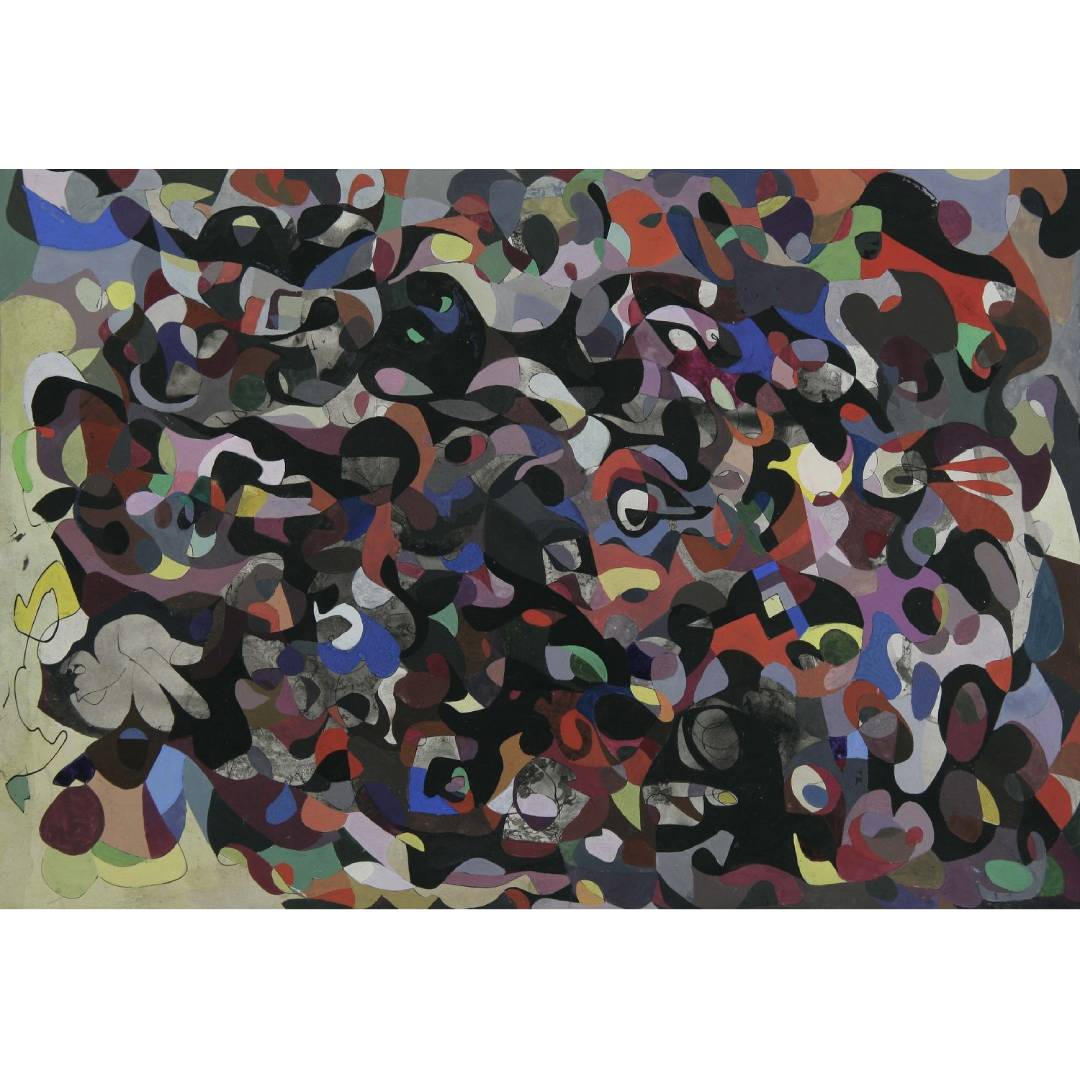
Structural Composition, 1960–1970
mixed media on paper
358 × 500 mm
MG-5137
Kamilo Tompa (Samobor, 1903 – Zagreb, 1989) was a Croatian painter, graphic artist, and scenographer. He was educated at the Academy of Fine Arts in Zagreb and continued his studies in art history in Paris. He worked as a professor at the Faculty of Architecture and served as head of the scenography department at the Academy of Theatre Arts in Zagreb.
The artist’s early oeuvre was marked by social engagement and the influence of the Zemlja (Earth) group, while his later work moved along the boundary between figuration and abstraction. After the Second World War, he gravitated toward Surrealism, and from the 1970s onward he devoted himself entirely to pure abstraction, most notably in the cycle Structural Compositions. As a scenographer, he realized numerous acclaimed stage designs at the Croatian National Theatre in Zagreb and also collaborated on animated films. In addition, he worked in mural painting, ceramics, and small-scale sculpture. In 1967, he received the Vladimir Nazor Award for Lifetime Achievement.
The painting Structural Composition from the eponymous cycle belongs to the artist’s mature abstract phase. Its dense, rhythmical composition is built from vibrant, interwoven forms. Abstract shapes, layers of color, and fragmented motifs complicate the perception of the work, creating a tense interplay between form and meaning. This “visual network” functions as a mental landscape- suggestive, introspective, and open to interpretation-demonstrating how Tompa consistently developed his own visual language within abstract poetics.
Text: Luciana Fuks, curator for Museum Documentation at the National Museum of Modern Art © National Museum of Modern Art, Zagreb
Photo: Goran Vranić © National Museum of Modern Art, Zagreb