Ivan Zasche (?)
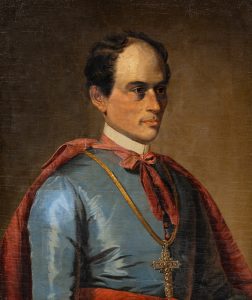
Portrait of Josip Juraj Strossmayer, mid-19th century
Oil on canvas
43 × 35 cm
MG-54
Among the 19th-century portraits in the collection of the National Museum of Modern Art in Zagreb, the Portrait of Josip Juraj Strossmayer (MG-54) stands out for its artistic quality. The painting entered the museum’s collection in 1947, having been acquired from a private owner, and was subsequently restored between 24 July 1949 and 23 December 1952. It has been dated to around the mid-19th century, with a possible attribution to Ivan Zasche (1825–1863), a Croatian painter of Czech origin who studied at the Academy in Vienna from 1846 to 1850. At the invitation of Bishop Juraj Haulik (1788–1869), Zasche settled permanently in Zagreb, where he produced a series of Biedermeier representative and intimate portraits and miniatures, airy landscapes, urban views, altarpieces, and a series of meticulously rendered drawings of traditional costumes from the Lika region.
This attribution is further supported by a label on the reverse of the painting bearing the inscription: “author: Zasche Ivan (?)”. In terms of its painterly manner and style, the Portrait of Josip Juraj Strossmayer can be compared with Zasche’s well-known Portrait of Ban Josip Jelačić in the Croatian History Museum in Zagreb, painted before 1863, as well as with the Portrait of an Old Man of 1857 (MG-64). The latter is also comparable in its penetrating psychological characterization of the sitter and suggestive gaze. The treatment of the folds in the drapery of the bishop’s cloak and uniform can likewise be compared with the rendering of the dress in Zasche’s Portrait of Julijana Koritić pl. Mrazovečka from the mid-19th century (MG-66), both works being held in the collection of the National Museum of Modern Art.
The quality of the Portrait of Strossmayer becomes particularly apparent when compared with the Portrait of a Dignitary by an unknown artist, also held in the museum’s collection and dated approximately to the last quarter of the 19th century (MG-3051). The latter is of a lower artistic standard, with the treatment of the uniform, hands, and facial features revealing a flatter and less accomplished approach to representation.
Text: Ivana Rončević Elezović, PhD, Museum Advisor, National Museum of Modern Art © National Museum of Modern Art, Zagreb
Photo Jovan Kliska © National Museum of Modern Art's archives