N. N.
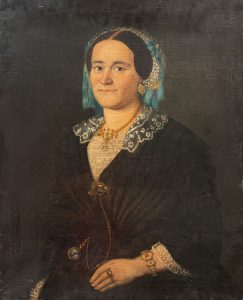
Portrait of a Lady, first half of the 19th century
Oil on canvas
77.7 × 63 cm
MG-58
The Biedermeier style found particularly distinctive expression in the applied arts. The term itself reached Croatia via Vienna and became established during the second half of the 19th century, referring primarily to the Old Viennese (Alt-Wien) style of furnishing bourgeois interiors. Within this cultural context, the demand for bourgeois portraiture grew increasingly strong, as portraits came to symbolize a new social status—a subject previously reserved primarily for the nobility and high-ranking members of the clergy.
The Biedermeier bourgeois portrait thus became a distinctive feature of the period, characterized by psychological characterization, an emphasis on linearity and smooth, polished surfaces, simplified forms, and an intimate atmosphere, often featuring motifs drawn from bourgeois interiors and gardens.
Among the works in the collection of the National Museum of Modern Art, a considerable number of which have been preserved in their original, highly decorative frames—frames that should be regarded as an integral part of the paintings—the Portrait of a Lady (MG-58), by an unknown artist, is particularly notable for its quality. The painting has been dated to the first half of the 19th century and features especially intriguing details in its depiction of jewellery, which, when viewed in isolation, can be regarded as miniature works of art in their own right.
In terms of the sitter’s pose, composition, style, subject matter and motifs—particularly the jewellery—the painting bears a striking resemblance to Portrait of Josipa Dadić, 1852–1856, by Vjekoslav Karas (1821–1858), which is also part of the collection of the National Museum of Modern Art.
According to the observations of Petra Kursar, MA, Senior Conservator-Restorer at the National Museum of Modern Art, the painting was restored using an old wax-based restoration technique. The museum’s Inventory Book also records the precise period during which the restoration was carried out: from 21 June to 10 August 1949.
Text: Ivana Rončević Elezović, PhD, Museum Adviser at the National Museum of Modern Art © National Museum of Modern Art, Zagreb
Photo: Jovan Kliska © National Museum of Modern Art, Zagreb