Vojin Bakić
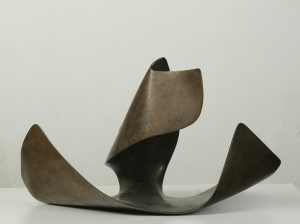
Foliated Form IV, 1958
bronze
48 x 84 x 42 cm
MG-2448
Vojin Bakić (1915-1922, Bjelovar) was a famous Croatian sculptor considered to be one of the forerunners of Croatian and European high modernity in sculpture. He graduated in 1939 at the State Academy of Arts in Zagreb, and he finished his specialisation under Frane Kršinić from 1940 to 1941 with whom he had a very close professional and personal relationship.
The sculpture „Foliated Form IV“ belongs to a series of works with the same name created from 1958 to 1964. They were made from negative spaces that were left over after the sculptures had been cast. In an interview for Vjesnik from 1980 he explains the process of how they were made and he notes his appreciation of moulds and negative forms and how both full and hollow shapes and spaces have the same value to him. The name ‘foliated’ (from foliage) suggests forms that grow and develop just like leaves and flowers.
„Foliated Forms“ represent a transitional phase where Bakić created sculptures with thin surfaces like eggshells. During that period he was solving new sculptural problems and putting emphasis on the volume. He distanced and freed himself from tradition while further exploring his sculpture. Developing his sculptural form through reduction, cutting, bending, folding and piercing the material allowed him to open the sculpture to space.
Bakić expands his exploration incited with his intellectual and creative curiosity but mostly with his wish not to create the same and to reevaluate his past accomplishments and principles of creation.
Text: Stella Baki, curator / museum educator at the National Museum of Modern Art Zagreb
Photo: Goran Vranić © National Museum of Modern Art, Zagreb