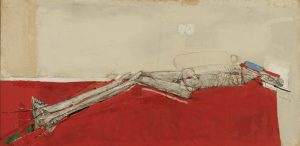
Ljubo Ivančić
Figure, 1970.
oil on canvas
100 x 180 cm
MG-3318
Ljubo Ivančić (1925–2003) is regarded as a leading figure of Croatian expressive, materially oriented figuration and abstraction, working at the intersection of existential painting and Art Informel. The enduring themes of his oeuvre are (self-)portraits and nudes.
Ivančić's painting is permeated by the tragedy, absurdity, and grotesqueness of human existence. His formative influences stem from the materiality and atmosphere of Croatian Mediterranean modernism, represented by artists such as Emanuel Vidović, Marino Tartaglia, Juraj Plančić, and Ignjat Job, while his exploration of the human condition draws upon both tradition and modernity, finding inspiration in Rembrandt, Francisco Goya, Georges Rouault, and Francis Bacon.
His achromatic and chromatic palette is filtered through dense, earthy, matter-laden tones that gradually became lighter and more colouristically vibrant during the 1970s, reaching their fullest intensity by the mid-1990s. Equally characteristic is Ivančić's method of depicting elongated and deliberately disproportionate figures, expressive deformations, suggestive forms, and scenes imbued with a powerful sense of atmosphere.
After joining the Yugoslav Partisan resistance during the Second World War in 1942, Ivančić graduated from the Academy of Fine Arts in Zagreb in 1949, completing his postgraduate studies under Đuro Tiljak. He later taught at the Academy from 1961 to 1979 and directed its Master Workshop from 1975 to 1984. In 1991, he was elected a full member of the Croatian Academy of Sciences and Arts.
Figure I (1970) exemplifies the distinctive treatment and composition of Ivančić's nude figures. The painting reveals a tension between the translucent volume of the female body—defined primarily through contour and conveying a naturalistic sense of human existence—and the dense, achromatic yet subtly chromatic material surface, animated by the intense glowing energy of parts of the background. Ivančić's nudes are not beautiful in the conventional sense. They are truthful. They embody existential nakedness in its purest form.
Text: Željko Marciuš, Museum Advisor at the National Museum of Modern Art, Zagreb
Photo: Goran Vranić © National Museum of Modern Art, Zagreb