NMMU: Which works are you showing in your current exhibition at the Josip Račić Gallery?
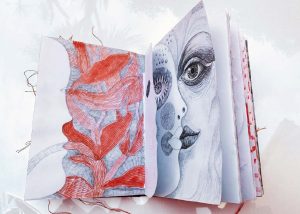
Manuela Vladić-Maštruko: My current exhibition at the Josip Račić Gallery features a project titled History of Illness, Reading, Joy, Sadness and Old Age (Metamorphoses). The works explore both the fragility and resilience of the human body, as well as the way the human spirit uses creativity (art) to bridge the growing divide between physical and spiritual decline. This decline inevitably occurs when the body can no longer keep pace with the agility and playfulness of the mind and spirit. This most commonly results from the biological decline of the body through natural processes associated with ageing and illness. Faced with a long-term illness, as well as the biological and physiological changes brought about by ageing in my own body, I began, as a form of therapy, to work on a handwritten and illustrated artist’s book, in which I explore the themes set out in the title from both a personal and universal perspective, as well as within a broader sociological framework. By addressing topics such as old age and illness, which as social constructs often carry negative connotations, I aimed to undergo a personal process of transformation, from the physical to the spiritual, and from the destructive to the constructive. I also sought to contribute to a wider social understanding by suggesting that even the so-called sombre subjects and states can be approached and expressed through creative energy, and can in turn return to us a comparable sense of vitality and spiritual energy.
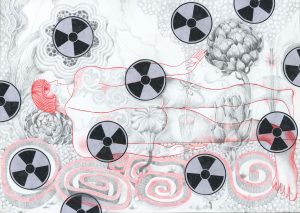
The book has a layered, multi-dimensional structure in both its visual and written elements, while the interplay between image and text is enhanced by various three-dimensional interventions that emerge from and recede into the two-dimensional surface of the paper, in the style of a pop-up book. Employing the same technique, I have also produced a series of original drawings titled Meditations, which are also on display at the Josip Račić Gallery.
NMMU: Could you elaborate a bit more on the title of the exhibition, History of Illness, Reading, Joy, Sadness and Old Age (Metamorphoses)?
Manuela Vladić-Maštruko: The title History of Illness originates from the brief clinical records used by doctors to document a patient’s health, but also extends to the everyday emotions of joy and sorrow that accompany life. It encompasses the physical changes brought about by ageing and illness, and further reaches into the potential for spiritual transformation. Such transformation may be realised when ageing and illness are understood not only as conditions of decline, but also as opportunities for acceptance, personal challenge, and learning.
Each chapter focuses on a particular illness or a specific part of the body/organ, as well as the transformations brought about by disease and ageing. I write and draw about changes, events, and sensations linked to individual parts of the body (ranging from facial wrinkles and the onset of cataracts to the insertion of various medical prostheses), and I visualise them by perforating the paper with needles, combining collage techniques (using archival medical and tattoo atlases), and employing pencil drawing or brushwork. At times, the approach is humorous and (self-)ironic, while at others it directly conveys vulnerability, sadness, fear, or hope. Yet across these personal transformations, each identified by a distinct name, a sense of shared human experience and equality emerges, where the singular and individual becomes more general and collective.
In some chapters, I adopt a carnivalesque approach to identity, transforming myself into and identifying with female artistic and mythological figures from antiquity through to the modern and contemporary periods; from Aphrodite to Frida Kahlo. I also reflect on the representation of the female body in art history, shifting between positions of object and subject, and I do so for a variety of reasons. Like Frida Kahlo, I began life marked by pain after surviving a traffic accident. Following the accident, we both underwent numerous operations, and mobility aids have become an integral part of our working environments in the studio. This connection is also evident in the expression and incorporation of autobiographical elements into my artistic practice, closely linked to my life circumstances. I feel a form of vocational sisterhood with the Croatian artist Edita Schubert and the British artist Kiki Smith, both in their use of laboratory equipment within an artistic context and in their creation of surreal figurative works and representations of bodily disintegration, which fundamentally engage with (female) embodied and spiritual experience.
Over the past two and a half years, I have been working intensively on the book, which is still in progress, as well as on a series of drawings titled Meditations, which are also being exhibited at the Josip Račić Gallery. While working on the book, I began sharing short videos of its development on my Facebook and Instagram profiles, and the positive feedback prompted me to reconsider it not only as a personal therapeutic notebook, but also as an artistic work of composite value. The project has so far received support from the Croatian Ministry of Culture and Media and the Croatian Writers’ Association as an online initiative, and in its early phase it was presented at the 22nd Festival of Firsts in Zagreb (2024), centred around the theme of Mourning, as well as in Pula as part of the exhibition Paradigmatic Rhythms of Anaesthesia (2025). This year it has also gained international recognition, including a feature in Women United Art Magazine, and in June my video work on the artist’s book will be shown in the exhibition Disabled Women Make History and Art at the Toledo Museum of Art (USA).
During my participation in the international Zagreb Film animation workshop in Komiža on the island of Vis, I began developing both the concept and storyboard for transforming the project into a documentary-animated film, which I see as the next stage in its evolution and as an additional communicative channel. In essence, the project began with an artist’s book as a form of personal confession, after which the narrative started to expand in several directions. I am drawn to research and experimentation, and I particularly value working in uncharted territory and exploring different media, narrative forms, and their hybrid expressions. For me, shaping an engaging exhibition installation for this presentation was a particularly demanding challenge. Since an artist’s book cannot be freely handled by every visitor without risking damage, I devised an installation format that includes two video works showing the book being paged through and its interior revealed, along with a series of 70 photographic images from the book printed on Forex panels. The exhibition also features installations with test tubes and Petri dishes, creating a laboratory-like environment in which the body is not presented as a finished system, but as an ongoing, evolving process. In dialogue with the drawings placed in Petri dishes, which evoke a microscopic, close-up view, a tension is established between the inner and the outer, the visible and the invisible, as well as between the personal, intimate, subjective realm and the so-called external, objective world.
Where the Petri dishes evoke an intimate, almost microscopic world of the body, the test tubes introduce a vertical procession of “samples” – fragments of lived experience. These are not scientific classifications but a fragile, personal cartography: charting experience, tools, process, and the residue of making – pencils, threads, pigment – and where they are left empty, they speak of absence and the intangible, as well as a readiness for what is yet to come.
The minimal labels, written in a schoolchild’s hand, do not name but gesture: trace, attempt, shift, pause – drawing time into the work as a slow, silent current of change, and space as a site of cultivated growth. Suspended between the micro and the macro, the installation conjures a space in which the body surfaces as trace, as process, as perpetual dissolution and emergence, a transcendental renewal.
Although the arrangement of Petri dishes and test tubes evokes a laboratory or clinical setting, it also calls to mind the symbolism of the alchemical laboratory, in which ancient alchemists sought to transform base metals into gold. In doing so, it invites a metaphorical transmutation, one in which old age and illness, much like those seemingly base metals, are rendered into something of another order of value: if not an elixir of youth, then an elixir of wisdom.
NMMU: Beyond your artistic practice, teaching holds an important place in your work, much of it devoted to children. You have conceived and illustrated fifteen picture books. What can you tell us about them?
Manuela Vladić-Maštruko: It all began when my two daughters, Lena and Nika, were born. I started spinning little stories to tell them, and they would often ask me to paint scenes from those tales; indeed, we spent a great deal of time painting and dreaming up stories together. From quite early on, they had cameras in their hands, crafting their own small video narratives with puppets and beloved pets. Then in 2003, in our family workshop, something rather remarkable took shape: the first Croatian artistic interactive digital picture book in the form of a video game, titled Melisa in the Land of Sweets, which went on to be presented at the Museum of Contemporary Art in Zagreb. Although on its surface level (to use gaming parlance, the first level) it was aimed at children, its deeper layers engaged with the fear of what was then a new technology, the position of the museum within a consumer culture of entertainment, and the tension experienced by the individual between their own personal sense of happiness and the imperative of happiness as a social construct, within a materialistic climate and context.
Most of my picture books take the form of classic hardback volumes, and as a medium shaped in this way they hold particular qualities for me, from the tactile (format, paper quality and texture) to the visual and cognitive (theme, colour, form, typography), and they are not interchangeable with their digital counterparts. For me, every story calls for its own specific means of expression: some will be far more powerfully told in a digital format, others in an analogue, traditional one.
In creating illustrations for my picture books, I have always enjoyed experimenting and testing myself in new techniques and media. Some twenty years later, I transformed my first picture book, The Little Snail Painter, into an animated film. A particularly fascinating experience in the realm of children’s book-making was working on a picture book for blind and visually impaired children, titled I, Tree, which I published in collaboration with Zadar City Library and my association Arte Insula. Finding a technique capable of printing a tactile Braille picture book proved enormously challenging, and that search, involving countless attempts and setbacks, as well as the pursuit of funding to realise the undertaking, lasted nearly four years. Working on the picture book also required studying the ways in which blind and visually impaired people perceive the world, rigorously applying those principles, and finding an appropriate subject matter and developing its narrative.
Beyond writing and illustrating picture books, theory is equally a part of my practice, and for around ten years I regularly participated in international professional conferences at the Bratislava Illustration Biennial, presenting papers and publishing several academic articles.
NMMU: What memories do you have of your childhood?
Manuela Vladić- Maštruko: We lived close to the sea, and the sea was the great nourisher of our imagination, every childhood game we played was saturated with it (with the exception of cowboys and Indians). We fashioned boats from driftwood and sardine tins, built rafts in the nearby park and launched ourselves towards the open water, marked the end of the school year by cooking limpets and periwinkles over an open fire in my mother’s galvanised boiler, learnt to swim amongst the crumbling remains of an old Italian wooden bathing house, and kept our cats and dogs fed on bogue and goby we had caught ourselves on a hook and line…
I cannot point to any particular art teacher from my early schooling whose charisma or influence left a lasting mark. If anything, it was my mother who was my first and most formative teacher in that regard. She had no formal education to speak of, yet something in her nature drew her irresistibly towards art, which she pursued with the wholehearted enthusiasm of a devoted amateur. Within the serious material constraints of life in the 1960s, she would carefully cut reproductions of artworks from women’s magazines and arrange them on the walls of my room. My particular favourites among them were Van Gogh and Picasso from his Rose Period. My parents rarely read to me, but they more than made up for it with bedtime stories of their own invention, and kept me well supplied with picture books and subscriptions to children’s magazines. As far as I can recall, it was precisely through those magazines that I taught myself to read at the age of four. My favourite picture books from childhood, which I still keep to this day, are Branko Ćopić’s Ježeva kućica with illustrations by Vilko Gliha Selan, and Fran Levstik’s Tko je Videku sašio košuljicu with illustrations by Roža Piščanec. I believe they have had a very considerable influence on my imaginative world to this day. In my childhood, children were not taken to museums, except perhaps on school trips, but looking at and reading the picture books in my collection were, in effect, my first visits to a gallery or museum. And that is precisely as it should be, and indeed still is. Picture books are a child’s first encounter with art, and for that reason they deserve to be conceived with great care and quality.
NMMU: What are your memories of your student days at the Zagreb Academy of Fine Arts?
Manuela Vladić-Maštruko: The years I spent at the Zagreb Academy of Fine Arts stand out as the most rewarding of my time in the city. We approached both study and life with considerable passion. The youth cultural scene was exceptionally active, centred principally around the Student Centre Gallery, a number of prominent music clubs (Kulušić, Jabuka, Lapidarij) and youth-oriented publications such as Polet and Studentski list.
If I were to single out one figure of exceptional importance to my studies and artistic development, it would be Professor Ferdinand Kulmer. He was a remarkable artist, but equally a remarkable teacher, possessed of a rare and precious pedagogical intuition. A single mentoring remark from him could catapult you straight into the future: to a place you might eventually have reached on your own, but only after a great deal more time and wandering. Something of that same quality I have encountered in my own teaching work with children and young people. It is a kind of intuitive, almost mystical, insight into another person’s creative nature and potential, which allows the teacher to give their student precisely the nudge they need, at precisely the right moment.
There was a well-worn path that most of us followed after graduating: it began at the Vladimir Nazor Gallery, which opened its doors exclusively to newly qualified artists, and wound its way through the Extended Media Gallery, the Student Centre Gallery, and the Spektar Gallery – known today as the Vladimir Bužančić Gallery. The Youth Salon in Zagreb and the Youth Biennial in Rijeka were events we invested with enormous significance, pinning considerable hopes on them as stepping stones towards a future career. It was, all in all, a time saturated with expectation and dreams, though looking back, I suspect that had rather more to do with being young than with anything particular in the social climate of the day.
Two figures loom large in my memory from that time: Antun Maračić and Željko Jerman, both charismatic, both enormously important to me. Artists in their own right, they were equally at home in the realm of theory and criticism, writing reviews and commentary for the media of the day. A little older than my generation, they nonetheless took a genuine and generous interest in younger artists, championing and promoting their work wherever they could.
NMMU: Did you ever work in theatre, designing sets or costumes?
Manuela Vladić-Maštruko: I have designed costumes and sets for a number of smaller productions, but the work I am most proud of, and most sorry never to have seen realised, was a costume design for a ballet production of Spartacus at the Leningrad Kirov Theatre. My dear colleague, the Slovenian sculptor Bojan Štokelj, was responsible for the sets and invited me to take on the costumes. The deadlines were punishing, and I drew day and night; in those days before the internet, the only way to get my drawings to Slovenia each evening was to put them on the night train, from where Bojan would send them on by air from Ljubljana to Leningrad, today’s Saint Petersburg. Sadly, Bojan was already ill, and as his condition deteriorated, he passed away before the project could come to fruition. I have let go of many drawings over the years, but these I have never been able to part with, they remain in my archive to this day.
NMMU: The themes running through your recent work – identity, memory, the relationship between inner and outer worlds – are deeply introspective. Are there artists in whose practice you recognise a kindred sensibility?
Manuela Vladić-Maštruko: There are certain artists I have returned to again and again throughout my life – not out of any desire to work as they do, but because their work asks questions that feel, in some essential way, like my own. Among them are Frida Kahlo, Kiki Smith, and Niki de Saint Phalle, each preoccupied in her own distinctive manner with the body, vulnerability, identity, and transformation. I feel a deep closeness, too, with Louise Bourgeois and Joseph Beuys, artists who possessed the rare gift of transforming the most intimate personal experience into the universal language of art.
What holds my attention above all is the capacity to give visual form to interior experience, to memories, fears, dreams, the sensations of the body. Art interests me precisely insofar as it constitutes a space of encounter between the inner and outer worlds, between personal and collective experience.
NMMU: A house by the sea?
Manuela Vladić-Maštruko: After nearly forty years in Zagreb, my husband and I returned to my childhood home in Zadar. The return happened naturally, at that point in life when our daughters had grown up and found their own way in the world. It was far more than a change of address, it was a homecoming of a deeper kind: a return to oneself, to a landscape of memory, to the place that had shaped my childhood.
The house is situated near the sea and set within a Mediterranean garden whose character shifts continuously across the seasons. The view of the sea, the particular quality of light, the plant life, and the rhythms of the natural world have all become integral to both my daily existence and my creative practice.
I consider living by the sea to be a source of a certain expansiveness, and a continuous lesson in patience and the acceptance of change. This may account, at least in part, for the increasing preoccupation in my recent work with time, transformation, and the relationship between transience and duration, and with the process by which personal experience is absorbed into a broader human narrative.
NMMU: Your favourite way to spend time?
Manuela Vladić-Maštruko: My favourite time is that spent with family, friends, books, and working. The dog and the many other pets we have had over the years brought a particular kind of simplicity, love, and joy into daily life. With them, one finds it easier to remain present in the moment and not to forget how important the small things are: movement, play, touch, togetherness.
I also love moments of solitude in the studio, drawing, reading, or jotting down thoughts. These are not separate activities; it is often precisely from reading, observing, or conversation that new ideas for artistic work are born.
NMMU: Which emotions would you use to describe your life and professional journey so far?
Manuela Vladić-Maštruko: If I were to describe my life and professional journey in terms of a few key emotions, they would be curiosity, perseverance, gratitude, and joy. Curiosity has continually led me towards new media, techniques, and areas of research. Perseverance has been essential in facing life’s and professional challenges, including illness and the many changes that come with time.
I also feel deep gratitude towards all the people I have met along the way – professors, colleagues, students, family, and friends. The joy of creating has remained unchanged since childhood, when I first held a pencil. Perhaps it is precisely this lasting joy – a kind of love for life – that explains why I have devoted my entire life to art.
Edited and interview conducted by: Lana Šetka
Translated by: Robertina Tomić
Reproductions:
(1) Manuela Vladić-Maštruko, drawing from the Meditation 6 series, 2026 / mixed media (graphite pencils, coloured pencil, thread, collage, perforations, tempera on paper) / 29.7 × 42 cm / Photo by Manuela Vladić-Maštruko
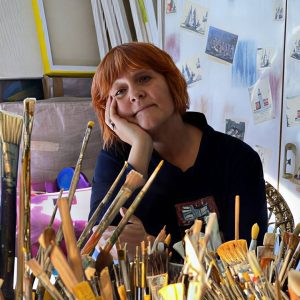
(2) Portrait of artist Manuela Vladić-Maštruko in her studio (detail) Photo by Vojin Maštruko
(3) Manuela Vladić-Maštruko, from an artist’s book, 2024–2026 / Photo by Manuela Vladić-Maštruko