NMMU: You currently have a selection of works on display at the Josip Račić Gallery, made between 2009 and 2023. What do they have in common, and how might they differ from one another?
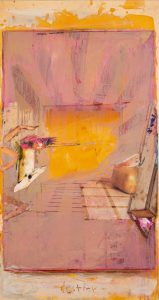
Tomislav Ćurković: The works currently hanging at the Josip Račić Gallery could almost have been pulled at random from a broader body of work that stretches back to 2001. Several things bind that body of work together, and these pieces are no exception. The first is almost too obvious to mention: they are paintings. The second is equally plain, though it can occasionally go unnoticed (by a wandering eye) – without exception, every work is a landscape. None of these works were painted en plein air. Instead, they were made in the studio, rooted in memories of particular landscapes from travels that have been meaningful to me. They were not produced through direct observation; in some cases, they emerged years down the line, as an attempt to look at and paint something once witnessed with as much faithfulness as possible (I have purposely avoided the word “recollection”, as I believe there is a meaningful distinction to be made).
The approach I take to developing most of the paintings in this cycle is tied to one of those rare moments that we all encounter every so often. I mean those situations where something has been right “under our noses” all along, “looking back at us” as we look at it, …and yet we simply fail to see it. On one occasion, travelling by train for days across the vast, flat, monotonous plains of India, staring out through what were still open carriage windows at the time, I finally managed, genuinely, for the very first time, to see what I had stared at so many times before. Yet it felt entirely new.
Before me was a painting cleaved into two planes by the horizon. That line held steady throughout, it remained, always, a line. Below it, the content shifted and transformed ceaselessly, dictated by the speed of the train. Houses dwindled into specks of varying colour, people melted into meadows, lorries into trees, and distant towns took on exquisite forms. A warm wind carried a sfumato of brick-red dust across everything, whilst the entire painting, as though conducted by the most supremely gifted theatrical lighting designer, transitioned in perfect unison from turquoise blue, through pale pink, into a deep and sumptuous violet, and finally into black… a black like oil, like petroleum, across which tiny silver and yellowish pinpricks had already begun to scatter, the lights of lamps and the glow of stars…
That was the moment that illuminated what I had been reaching for in my work, rarely with any success, and always through tremendous effort, almost completely in the dark about what I was asking of a painting. It “vindicated”, for me, every subject and motif I had ever chosen to paint, along with the formal qualities and structural logic of the painting itself.
After that, everything felt markedly easier. Never easy, but markedly easier.
More often than not, I begin with a line, the horizon, which remains “immovable” and divides the painting into two halves, two spaces that are then gradually populated with all manner of content, atmosphere, narrative and detail. It is a process I find endlessly interesting, and I am frequently caught off guard, not just by the sheer abundance and intricacy of the details that come to the surface, but also by the fact that sometimes, when everything falls into place and my concentration is at its deepest, that information can be coaxed into appearing... and it comes.
NMMU: Do you work in contemporary music as well as visual art?
Tomislav Ćurković: Yes. I suppose... It’s difficult for me to answer that. I don’t know what contemporary music actually is nowadays? Perhaps trap? If it is, then I’m certainly not involved in it. If contemporary means everything that’s recorded or performed today, then yes. Even when I make music solely with piano or attempt to compose in some sort of mediaeval style. There’s a bit of music on my YouTube channel under the pseudonym Tomazzo Gallina, if anyone’s interested... The record label Slušaj najglasnije!, belonging to Mr Franjić, got behind an album with a great deal of electronics, which I titled “Untitled” and released under the name Tom C. Turkey, as I was aiming for the global market... Rather unsuccessfully, if we’re going by views or likes. However, I’m quite pleased with the album itself and listen to it often.
NMMU: You also create set designs and theatre music. How did that collaboration with theatre come about?
Tomislav Ćurković: Well, that’s just it… It really comes down to one person, and I’d venture to say the only person through whom such a thing could ever have happened. Senka Bulić found her way to me through a recommendation from Zlatko Wurtzberg, who was at the time keeping a close eye on the young contemporary art scene and writing critical pieces about it. Once Senka got in touch, we met in Pula for a conversation. I had not the slightest interest in theatre or set design at the time. Actors in wigs, cardboard backdrops, dust and boredom. That was my impression of the theatre. Something that should have gone the way of the Austro-Hungarian Empire. Senka told me in no uncertain terms that I hadn’t a clue what I was on about, and took me to Avignon, where the world’s leading theatre festival is held each year. It goes without saying that she was right. We took in an enormous number of performances and projects, each one more remarkable than the last, without pause, whole days and nights of it. At no point before or since have I felt what Romeo Castellucci or Pippo Delbono managed to stir in me. Other artists of comparable stature, such as Jan Fabre or Matthew Barney, I had already known, but solely as sculptors. At any rate, I found myself quite unexpectedly on familiar territory, amongst people who spoke in a language I recognised as my own. And that was precisely the sort of theatre Senka had set her heart on making; our collaboration went on for, I believe, the better part of two decades. I am immeasurably grateful to her for it. There is nowhere near enough room here to do justice to such a remarkable human being. To come across an artist like her, someone who works with that degree of energy and concentration, with an unwavering sense of purpose, and above all a person of quite extraordinary backbone, is an exceptionally rare thing… few mothers have ever brought such a person into the world, and I rather fear none will again.
NMMU: What are your memories of the time you spent on a scholarship at the Cité Internationale des Arts residency in Paris?
Tomislav Ćurković: Paris left a warm impression on me, though the reasons have little to do with the city as such. It is a magnificent place, of course, and for any painter it is essentially a necessity… one must go, at least once in one’s life. Rather like a painter’s Hajj. I made my rounds with genuine pleasure and gratitude, taking in both the obvious landmarks and the less frequented corners that all of us know from history, art history above all. It is the sort of city where a person, a traveller, if they listen with sufficient care, with the very best pair of headphones they can lay their hands on, can always faintly detect that strange, lingering sound. The sound produced by a vast nuclear detonation, or what might be called the Big Bang of the art world, which went off at the turn of the 19th into the 20th century. An explosion after which, in art, or let’s say painting, scarcely anything of genuine significance has happened since. In that respect, the city stands as one great monument, but equally as a tomb of painting, and if you happen to be a painter, you move through it in some peculiar mixture of elation, nostalgia, fury, pride and melancholy. Yet Paris lodged itself in my memory as something permanently and beautifully treasured for an altogether different reason. I had arrived there some three years after graduating at the academy in Zagreb, after years of studying alongside people who shared very similar interests. With some of them I formed deeply close friendships that have lasted a lifetime. Nothing illustrates this better than a particular moment in the studio, gazing out from the third floor over the Seine and Notre-Dame, when I received a call from a dear fellow student from the Academy, a close friend, who was standing out in the rain in the depths of winter on some drab Zagreb square, with neither shelter to duck into nor a place to lay his head for the night. There was simply no other response available to me but: “Jump on the first bus and get yourself over here!” By some miracle, without so much as a penny in his pocket, the man somehow made his way to Paris, and for the remainder of the scholarship we shared the studio together. He set about learning French immediately… To cut a long story short, I eventually returned to Croatia while he remained in Paris, and today that same man is a widely respected director, making films, amongst them one about his now long-cherished friend and cinematic legend Aki Kaurismäki. He takes his morning coffee by the Seine in the company of Jim Jarmusch and other like-minded creatives he works with, then perhaps flies off to Japan that same afternoon to lecture film students, and “La vie est belle!” The point I was really trying to make, through all of this, is that not only am I a painter of exceptional talent, but I am also, it turns out, a thoroughly decent person. 🙂
NMMU: Given that you occasionally work in graphic design, have you ever designed a catalogue for one of your own exhibitions, or worked on a visual identity?
Tomislav Ćurković: No, I haven’t… not that I couldn’t, but I have friends who do it a great deal better, and with far more enthusiasm and expertise in that particular field.
NMMU: Which film would you pick as your personal favourite? And how does someone with experience in filmmaking approach watching films?
Tomislav Ćurković: I wouldn’t really describe myself as someone actively involved in filmmaking. I tend to think of it as a small aside from a period of life that has long since passed. In my younger days I had a strong urge to travel and discover other countries, other ways of living and thinking. Out of all those wanderings I managed to make three films. They didn’t do badly, I must say. Much the same could be said of some of the music videos.
NMMU: What sort of hobby does an artist have, given that making art is already the finest job in the world?
Tomislav Ćurković: It depends, I played football myself, as it happens. Deceptively simple as this question might seem, it is anything but, and it matters that it gets raised. It can prove quite incendiary, and I have a feeling it can spark a fire rather quickly, depending on who is doing the asking, in what setting, and of whom. It has a way of splitting people into opposing sides, for and against, black and white, with little patience or desire for nuance. For a great many people, and for quite some time now, being an artist and having a hobby are considered one and the same thing. There is a widespread conviction that art is essentially a form of leisure, a break from proper work. That has been the prevailing attitude here for as long as I can recall, and it is only more pronounced today. The reasons are not hard to fathom. Professional knowledge, formal education and genuine competence have long since stopped being meaningful measures of anything, even within the professions themselves, regardless of which field one is speaking of. I needn’t labour the point any further. It rather seems that artists are the canary in the coal mine… we shall be the first to go, and by the looks of things, every other line of work may not be far behind.
NMMU: What do you consider a perfect moment to be?
Tomislav Ćurković: Just that: a perfect moment. I described one earlier, in my first answer.
NMMU: Would your ideal conditions for creating involve soft, drizzling rain, or a clear blue sky?
Tomislav Ćurković: I’m not sure the weather and the act of creating are particularly connected, in my case. So long as it isn’t extremely cold, I believe I could, and should, be creating regardless.
NMMU: Glancing through your biography, it would appear that the only outlet you haven’t yet explored is literary… though dance and acting might also be on that list... Is that something we might expect from you in the future?
Tomislav Ćurković: Absolutely, possibly. Though I rather suspect it’s too late for dance, I’m afraid. A gentle shuffle at most, perhaps. On the subject of literary work, my closest friend Nenad Bunjac was, in addition to being a goalkeeper of the highest calibre, a literary genius of some distinction. In the presence of such a towering figure, it seemed to me the height of bad taste, to say the least, for me to be making any effort in that direction, even though he himself was always urging me to do so. Sadly, he passed away not long ago.
Acting would undoubtedly draw me in, were it somehow possible to perform without anyone actually watching. I have no great desire to be looked at. I am perfectly happy for people to look at what I have made, but not at me personally. With acting, those two things are considerably harder to keep apart. The camera, for its part, has never taken kindly to me. I am much like my paintings in that respect: I come across a great deal better in the flesh, without question.
Interviewed by Lana Šetka, Nactional Museum of Modern Art,, Zagreb, 2026
Translated by Robertina Tomić
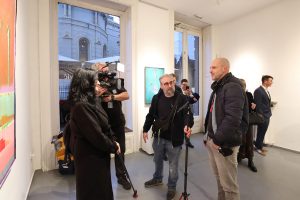
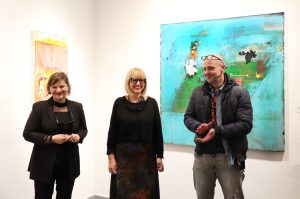
Photo: (1, 3) Goran Vranić © National Museum of Modern Art, Zagreb
(2) Tomislav Ćurković, Destiny, 2021, mixed media, 80 x 43 cm / Hrvoje Franjić